
“You get thirty seconds and six pairs of eyes. You don’t start scrolling”
Volleyball coach Dennis Boekhout on the screen that opens when you call a time-out, and why it shows a window of a few minutes instead of totals.
The hand goes up, the referee whistles, and six players gather round waiting for you to say something. A volleyball time-out lasts thirty seconds: too short to read a stats screen, too long to say nothing at all. Dennis Boekhout (28) coaches a youth team in the Netherlands and built Koach, the app in which he tried to fix that exact moment.
A conversation about the window the app shows instead of a total, about the arrow that tells you whether things got better or worse, and about what an app is better off not doing.
Have you ever called a time-out without knowing what you were going to say?
“More often than I’d like to admit. [laughs] Your hand goes up because you can feel it slipping away, not because you have a plan. And then six players are standing round you waiting, and you hear yourself say ‘come on, focus’. That isn’t information. That’s noise.”
So what did you actually need at that moment?
“Not more numbers. I knew the score, it’s up on the board. What I didn’t know was how we got there. Did we just drop three points in a row, or have we been scrambling for seven rallies? That difference decides whether you say something about the opponent or something about your own side.
“And you have thirty seconds. You are not going to sit and read a stats screen with six pairs of eyes on you.”
So what happens now when you tap Time-out in the app?
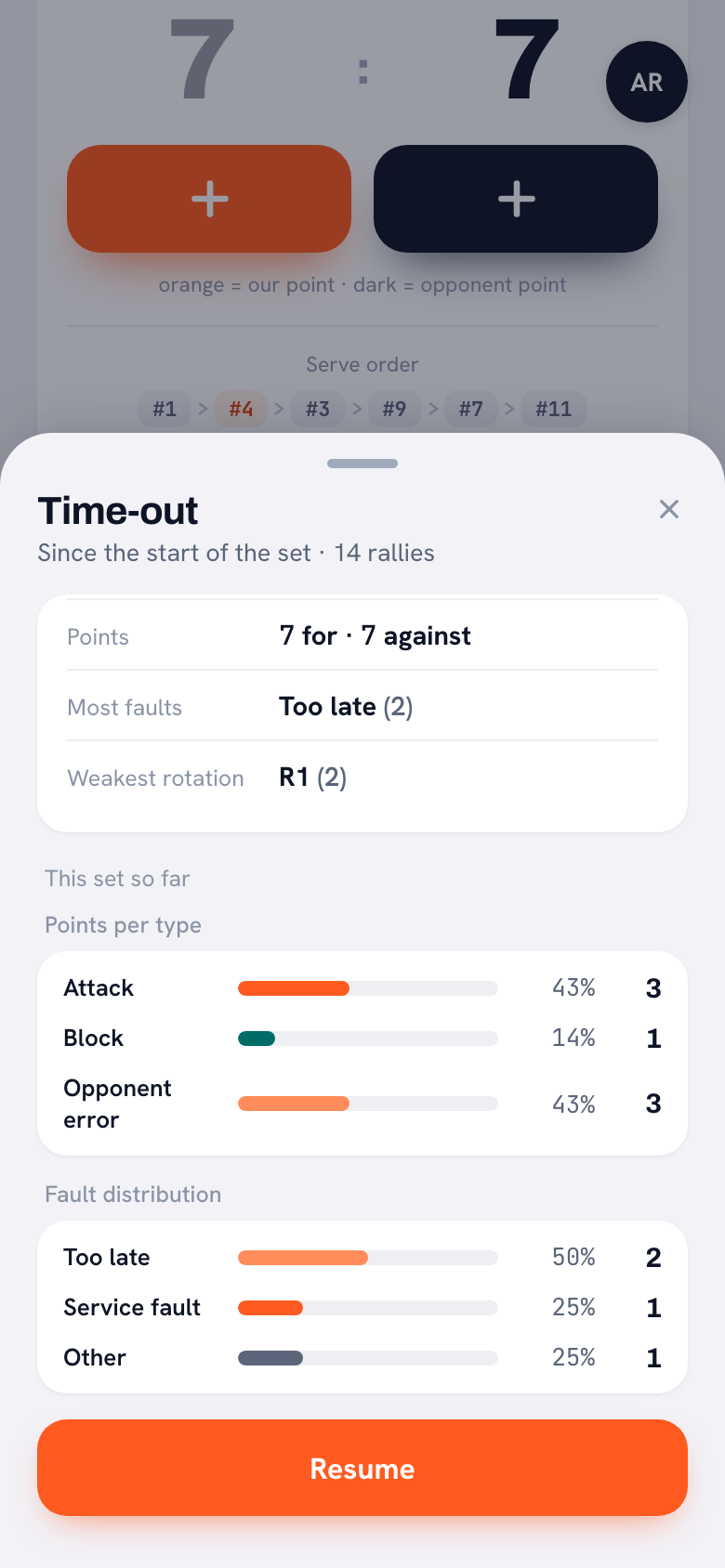
“A sheet slides up with a look back at the stretch you have just closed off. At the top it says where that stretch began — since the start of the set, or since the previous time-out — with the number of rallies next to it. Under that, three lines: points for and against, the fault type that came up most, and the rotation where we gave away the most points.
“Last time it read fourteen rallies, seven for and seven against, ‘too late’ twice, weakest rotation R1. I can turn that into one sentence before the referee whistles again.”
Why a window and not the numbers for the whole set?
“Because a total tells you how the set is going, and you already know that: it’s on the scoreboard. A time-out isn’t about the set, it’s about the last few minutes. If we played the first ten points well and then lost four rallies, that disappears into a total. In a window it’s simply there.
“And the window closes at the exact moment I stepped in. That’s the fairest cut there is: from my previous time-out until now.”
What does ‘weakest rotation’ mean exactly?
“The rotation in which we conceded the most points during that window. The app counts rotations from where the setter stands, R1 through R6, so it’s the same numbering as on the lineup board.
“And straight away the honest caveat: across fourteen rallies, R1 with two points conceded is a hint, not proof. It can be coincidence. I use it to go and look, not to hold a player to account.”
At the second time-out there’s an arrow. What is it comparing?
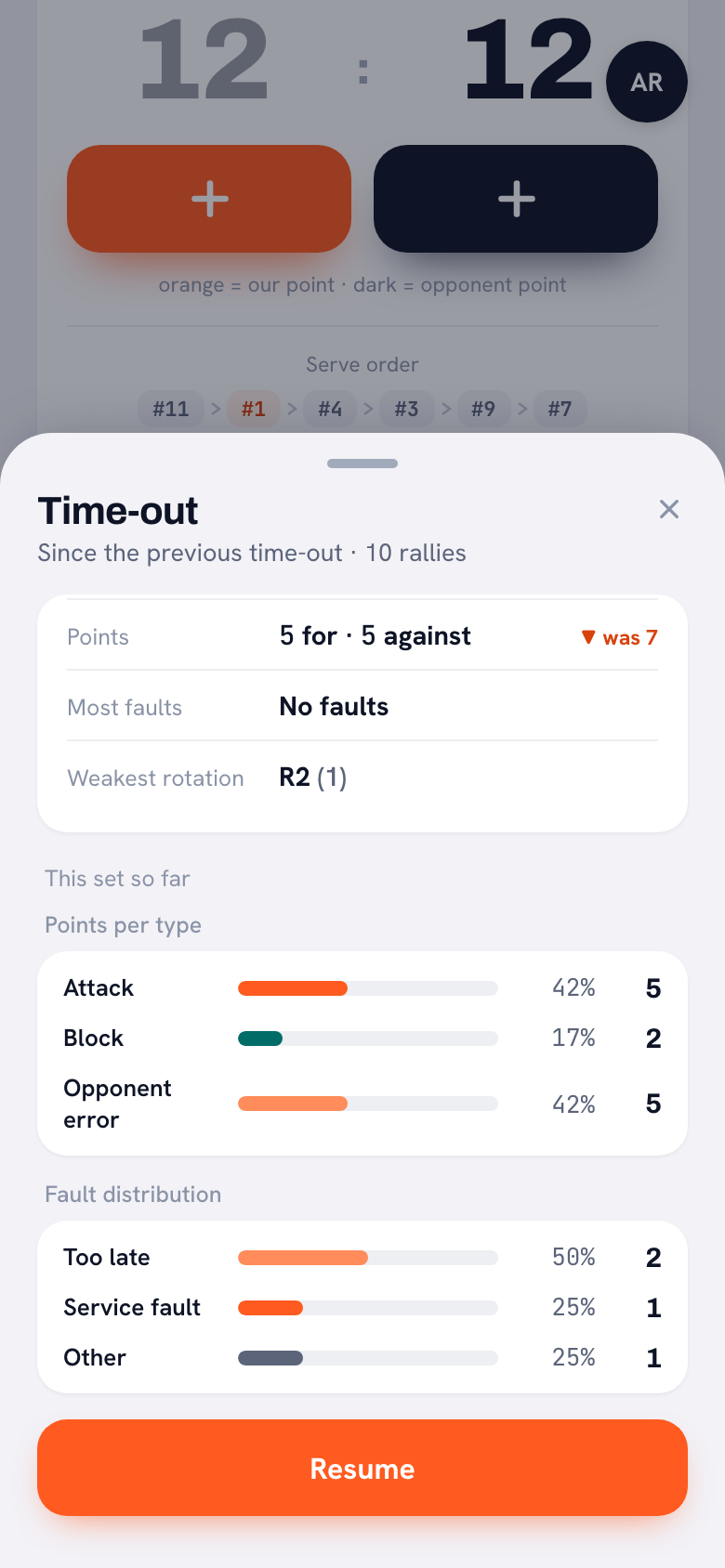
“The stretch you have just closed off against the one before it. If points read ‘5 for’ with a red arrow down and ‘was 7’, then we scored less in this stretch than in the previous one, even though the score is level.
“That’s a different conversation. If it also says ‘no faults’, we aren’t doing anything wrong and they are simply playing better. ‘Come on, focus’ is useless at that point. You need to say something about their server or their middle attack.”
There’s more below those three lines. Why down there?
“That’s the breakdown of this set so far: points by type — attack, block, opponent fault — and the fault distribution. The same blocks you get in the set break and in the match report.
“But they sit at the bottom on purpose. Something has to go at the top, and by doing that you are saying the rest matters less right now. In thirty seconds you read three lines. The rest is for the set break, or for Sunday morning on the sofa.”
Where does that fault type come from?
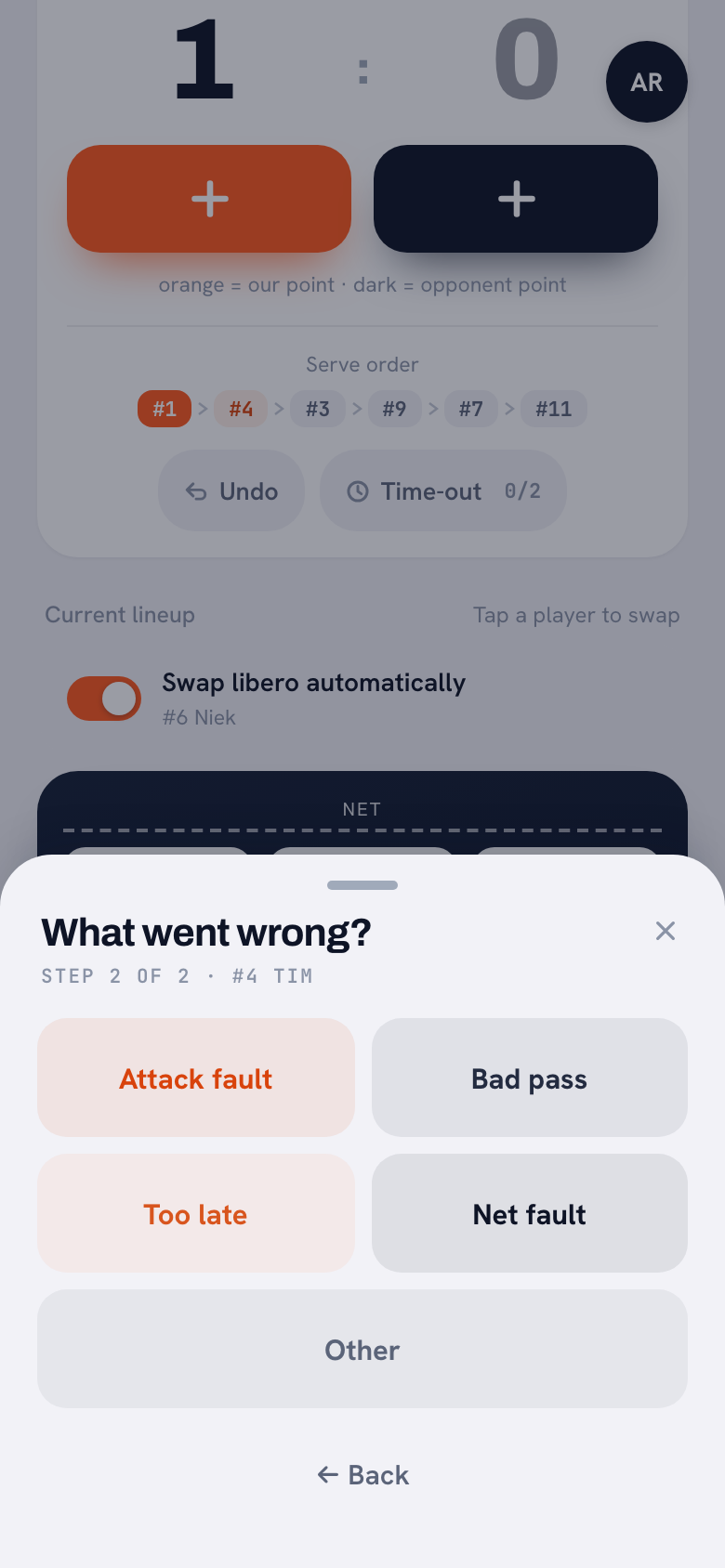
“From me, to be honest. Every time the opponent scores, the app asks who made the error and what went wrong: service fault, attack fault, bad pass, too late, net fault or other. If it was simply a good ball from them, you tap that and it doesn’t count as a fault of ours.
“Which also means the card is exactly as good as what I tap during the rallies. Hit ‘other’ five times in a busy set and your time-out will say ‘other’, and you have nothing. The app can’t fix that for you.”
And the wave under the scoreboard?
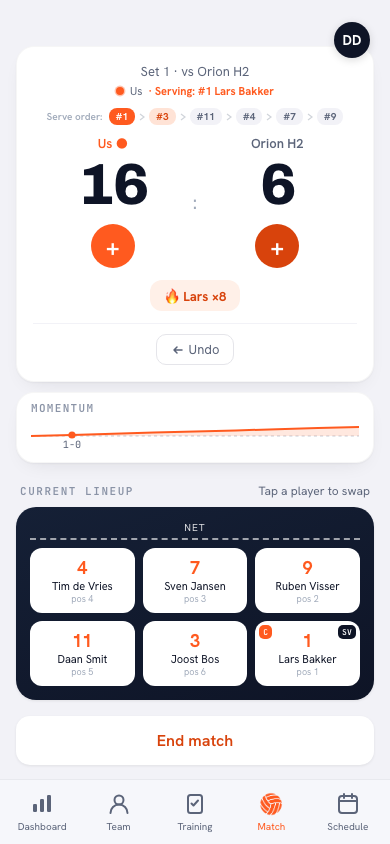
“That’s the momentum of the set in progress. Above the line we’re ahead, below it we’re behind, and the dot marks the start of the longest scoring run. You can slide your finger across it to read the score at any rally.
“It only appears from four rallies on. Before that it’s a dash that says nothing, and I don’t want to look at it. A shape reads faster than a row of numbers: one glance tells you whether it’s a dip or a slide that has been going on for ten rallies.”
Does the app also tell you when to call a time-out?
“No. And that’s a choice, not a forgotten feature. The app doesn’t know my setter is ill, that we just got lucky twice, or that the opponent has brought on a substitute. It only knows what I tapped. Telling a coach ‘step in now’ on that basis would be nonsense to me.
“What it does show is the counter on the button: 0/2, 1/2, and red as soon as they’re gone. That’s not advice, it’s a rule — two time-outs per set. I once went to call a time-out I had already used. You don’t want that twice.”
And when the card shows nothing useful?
“Then that happens. No faults, a window that runs level, a weakest rotation with one point conceded: nothing is wrong and my time-out is simply a breather. That’s allowed too. Thirty seconds of standing still is sometimes enough.
“Then I say something about the next serve instead of something about us. Better than inventing a problem because a screen happens to be open.”
So what do you say in those thirty seconds these days?
“One observation and one instruction. Nothing else fits. ‘Twice too late on their middle attack — get into the block earlier. And Lars, serve short.’ Then I tap Resume and we play on.
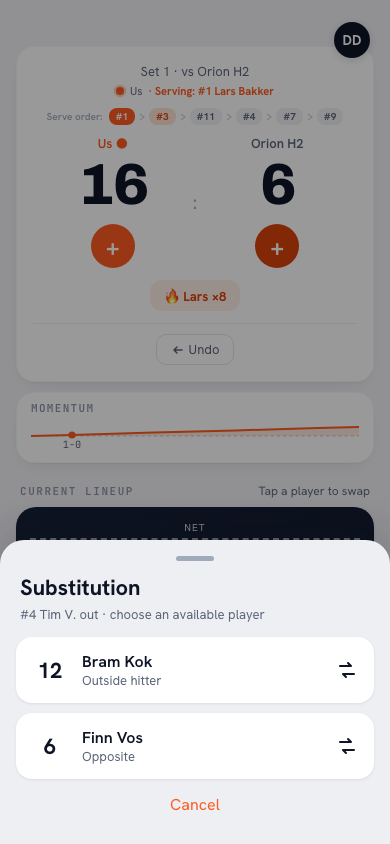
“And sometimes I say nothing and make a substitution instead. I pick who comes off, and the sheet shows straight away who is available, with their position next to them. Six substitutions per set, so that’s another thing you’d rather not keep in your head.”
Thirty seconds, one clear sentence
Koach is free to try. Score your next match live, and at your first time-out you get a look back at the stretch you have just closed off.
Try Koach free