Who Takes the Ball Between Two Passers in Serve Receive?
The serve lands exactly between two players. Both take half a step, both stop, the ball drops. Nobody made a technical mistake and the point is gone anyway. The seam is the one hole in serve receive you can close by talking.
Why the seam costs so many points
Servers at every level learn the same thing: do not aim at a player, aim between two players. A ball straight at someone is a gift; a ball between two players forces a decision under time pressure, and that decision costs a tenth of a second. That tenth is enough to be late, or to reach for the same ball together and get in each other's way.
The annoying part is that it is not a technique problem. Both players can pass perfectly well. It is an agreement problem, which makes it the cheapest leak a coach can plug: one sentence in training, repeated every week.
The basic rule: one sentence
The rule that works best in most teams goes like this: the ball between two passers belongs to the player who is moving toward the setting zone. Because the target of every pass is front right, in practice that means the left-hand player of the two takes it. She gets the ball on her right side, moves to her right and therefore already has her body and her platform turned toward the target. In the same situation the right-hand passer has to move left and play with her back half-turned to the target — technically far harder, and the pass often sails behind the setter.
There is one exception you may add, and only one: if your libero is at the seam, she claims it. She is your best passer, she is central, and she is welcome to take over her neighbours' zones. No team under pressure remembers more than these two rules.
Two kinds of seam: left-right and short-deep
Coaches almost always picture the seam as the gap between two players standing next to each other. But in a serve-receive formation with four or five passers there is also a seam between the front passer and the back passer, and that is exactly where the short serve drops. The rule for it is the mirror image and just as simple: short belongs to the front player, deep belongs to the back player. The front player moves to the ball, the back player holds her ground and keeps the depth covered. Reverse that and you get two players sprinting forward and an empty back court.
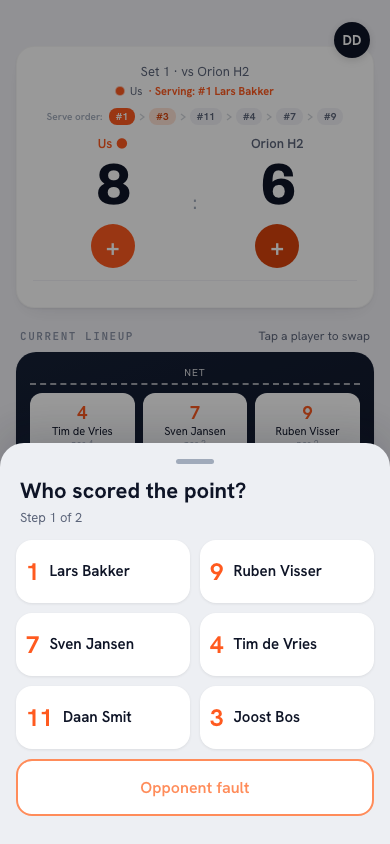
Whether your agreement survives a real match is something you only know if you measure it: the 0-3 pass ratings in Koach show that inside a single set.
Calling: what, when and by whom
A claim rule without a voice is a paper agreement. Three guidelines:
- Call early. The call has to come before the ball crosses the net, not after. Whoever calls once the ball is already on her side is too late to make anyone else stop.
- Call what you are doing, not what you are leaving. 'Mine!' is an instruction; 'out!' is one too, but only when you shout it at somebody else. Two players shouting 'leave it!' at the same time is the single most common recipe for a ball on the floor.
- The non-passing player confirms. Have the player who lets the ball go raise a hand or call 'yours!'. It costs nothing and removes the last flicker of doubt.
Move the seam onto your best passer
The smartest solution to a seam is to relocate it. Do not put your weakest passer in the middle of the court with seams on both sides; put her by a sideline, where she has one neighbour instead of two. Shrink her zone on purpose and have the strong passer next to her claim out loud: 'everything between us is mine'. That is not an insult, it is a division of labour — and it is exactly what top teams do, where the libero routinely pulls two thirds of the court toward herself.
Check that division rotation by rotation, too. A seam that is nicely covered in rotation 1 may sit between your two weakest passers in rotation 4. That is the rotation the opponent will find inside two sets.
How to train it
Serve or throw deliberately into the seam, ten balls in a row at the same spot, and count only two things: was there a call, and did the ball reach the setter? Technique is irrelevant in this drill. Then raise the pressure: have two servers alternate so the passers do not know who is coming. If you want to make it genuinely uncomfortable, move one passer halfway through — then the team has to apply the rule again instead of executing it out of habit. More drills are in serve-receive drills.
Count the balls that drop between two players for one whole set. Most coaches guess two and count six. That number alone is usually enough to convince the team that this rule is not a detail.
Frequently asked questions
Who exactly takes the ball between two passers?
By default the player who is moving toward the setting zone — in practice the left-hand one of the two, because she gets the ball on her right side and is already turning her body toward the target. If the libero is at the seam, she claims it.
Should you call before or after the ball crosses the net?
Before. A call that comes once the ball is already on your side is too late to make your teammate stop. In training, have players call deliberately at the moment the server contacts the ball.
What do you do with the short serve between the front and back passer?
Agree that short belongs to the front player and deep to the back player. The front player moves to the ball and the back player holds her position, so the back court does not empty out.