
“The app points at your weakest rotation and then keeps quiet”
About the rotation check before the first serve, the six side-out bars afterwards, and why Koach deliberately never tells you which rotation to start in.
An hour before the first serve the lineup is on the sheet, and then the arithmetic starts. Which rotation has your two best attackers together in the front row? How far down the order does your best server come up? Most coaches do that by feel, or not at all. Koach has a sheet for it that points at your weakest rotation — and says nothing else.
A conversation with Dennis Boekhout about what is and is not on that sheet, about the six bars that show afterwards where your set leaks away, and about the rule he set himself: pointing is allowed, prescribing is not.
You have the lineup sorted. What is the first thing you do?
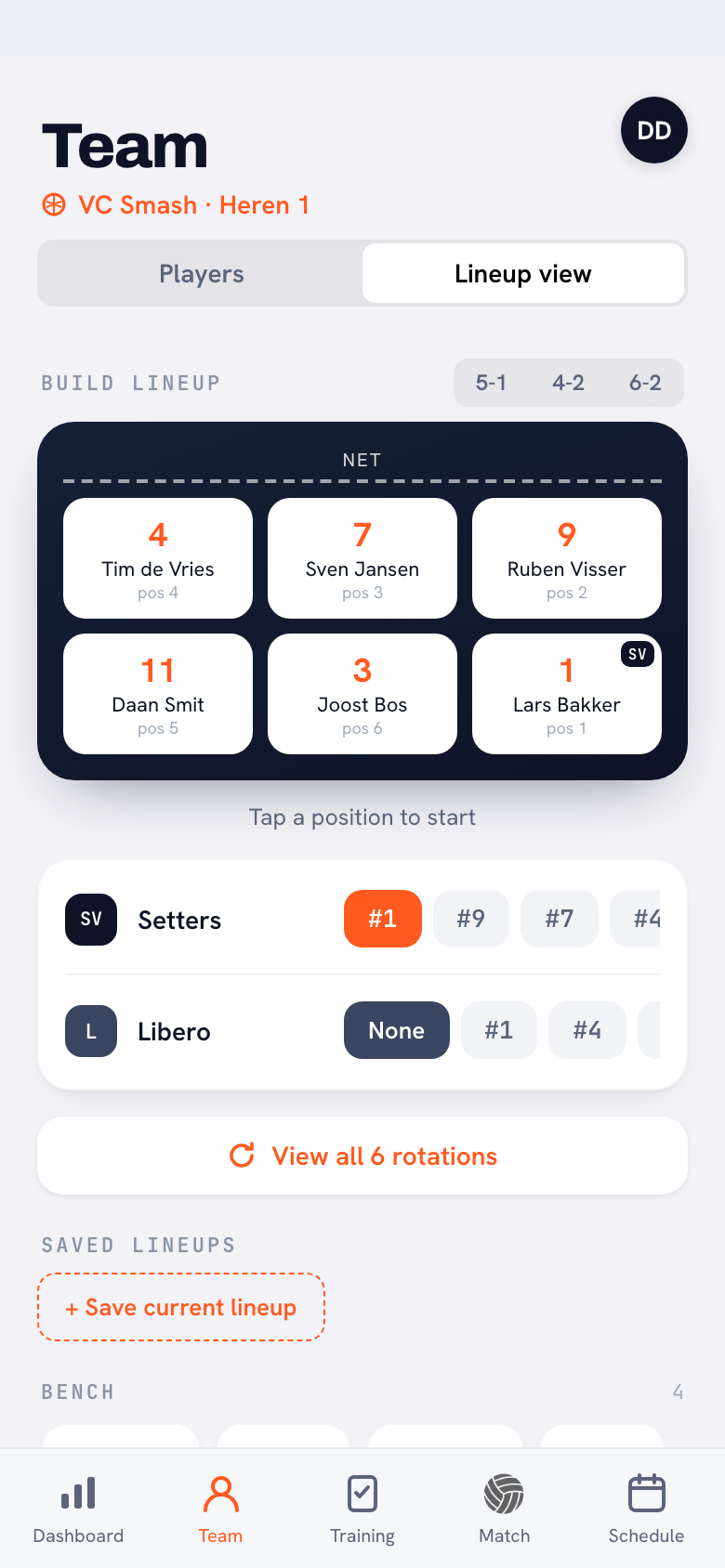
“I tap Rotation check. It sits under the court on the setup screen, and it does nothing until all six positions are filled — there is nothing to calculate before that. What I am after is simple: where is my setter, and what falls out of that. Because the moment you put him somewhere, the other five rotations are fixed. That is not a choice any more, that is arithmetic.
“And I would rather not do arithmetic on the back of a beer mat in a noisy gym.”
So what is actually on that sheet?
“Three lines. Who your best server is and how far down the order he serves. In how many of the six rotations your two strongest attackers share the front row. And: weakest rotation R-something, lowest front-row attack power. Below that, the six rotations as little courts with a bar for strength. Tap one and you see who serves and who is front and back.
“That is it. Three lines and six pictures. I had a fourth line in there once and I ripped it straight back out.”
Why no fourth line saying ‘start in rotation 4’?
“Because the app does not know that. It knows the numbers; I know the week. My opposite turned an ankle on Tuesday, my middle is just back from the flu, and against this opponent I want my best passer serving early. None of that is in the statistics.
“And if the app does say ‘start in R4’, you do one of two things: you follow it blindly, or you never trust it again. Both are wrong. Pointing is fine, prescribing is not.”
Those numbers, R1 through R6 — where do they come from?
“From your setter. The app looks up which position he is in and derives the rotation number from that. It is exactly how coaches talk to each other anyway: ‘we are in the rotation where the setter serves’. Nobody counts zones.
“There is a flip side. If you do not mark a setter, the app does not know which rotation you were in. That set’s figures then end up under a dash, and the dash simply sits there in the list. I would rather have an honest dash than a made-up R3.”
And a team that has not scored a match yet?
“Then it says, in so many words: no player stats yet, insights grow as you score matches. You do get the six little courts — who stands where is pure arithmetic, you need no data for that. But the three lines and the strength bars stay away.
“That mattered to me. An empty screen pretending to know something is worse than an empty screen saying it knows nothing.”
Does any of it come back during the match?
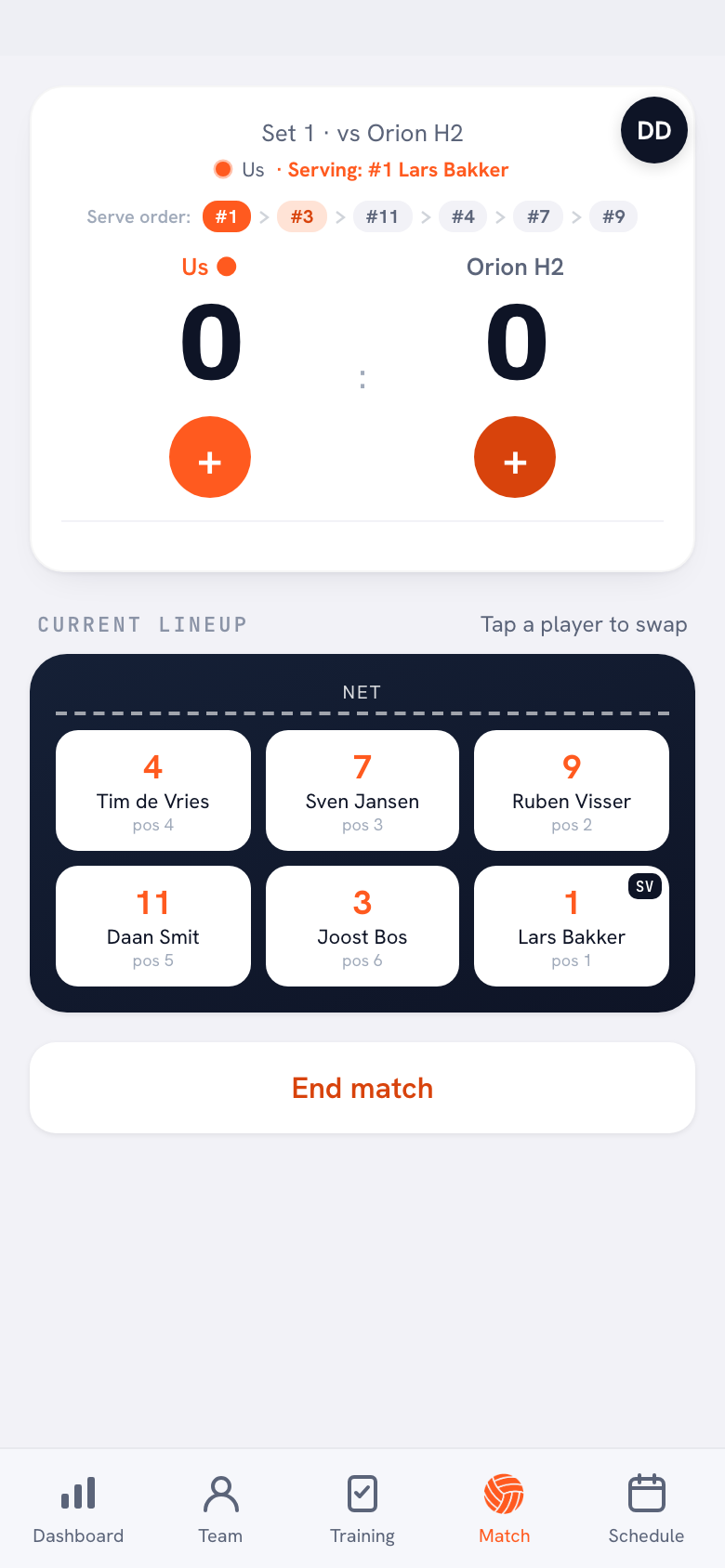
“On the time-out card. You call a time-out, the sheet slides up and it says: since the start of the set, this many rallies, this many points for and against, most errors, weakest rotation. ‘Weakest’ means something else there than it does beforehand: it is the rotation where you have given away the most points since the start, with the count behind it.
“At 7-7 after fourteen rallies it reads R1 with a two behind it. Two points. That is not a conclusion, it is a direction to glance at in the thirty seconds you have.”
And afterwards?
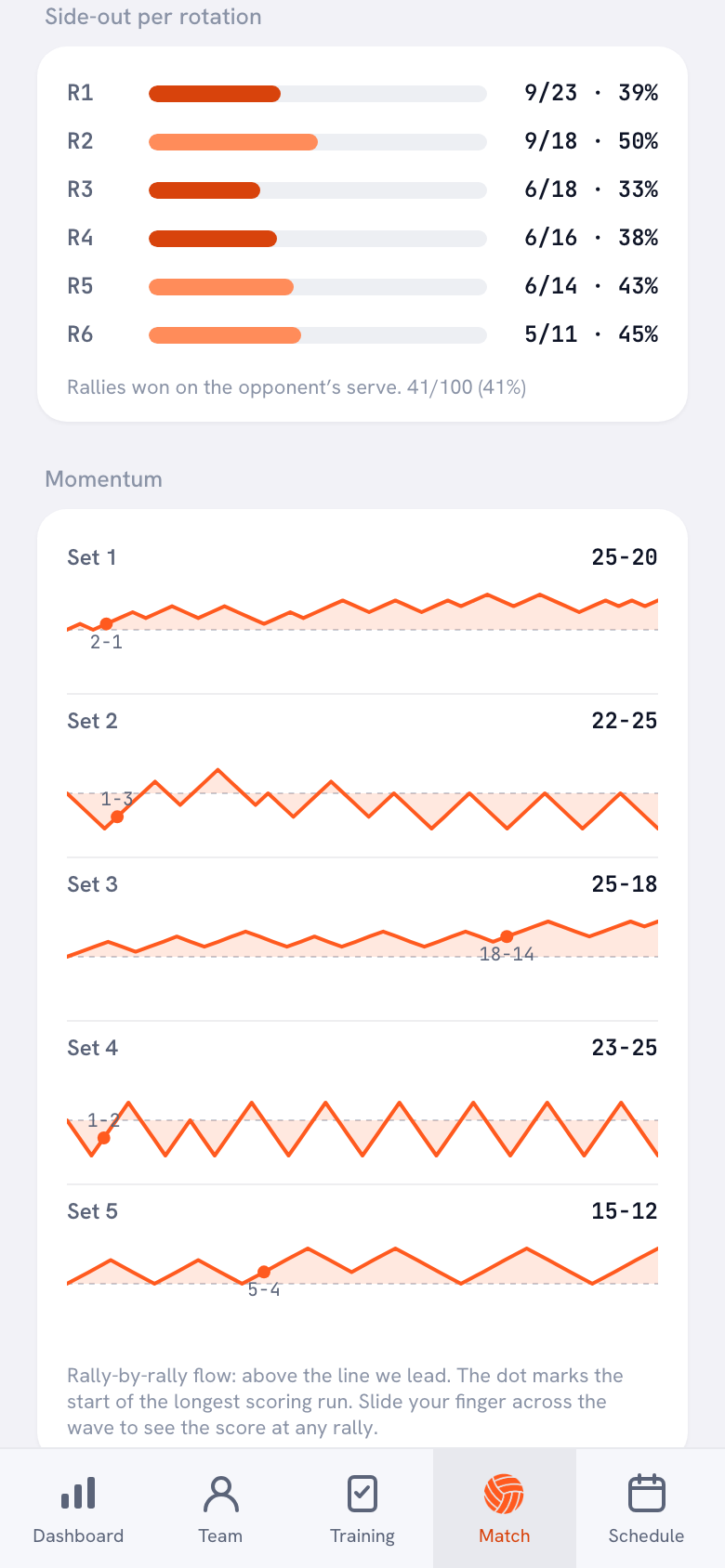
“Then the match detail carries the Side-out per rotation block. Six bars, R1 through R6, with the count and the percentage next to them. Side-out is the rally you win on the opponent’s serve — the single most telling team number in volleyball, because every rally you fail to take there lets the opponent serve again.
“The total sits underneath. In the example I always show: 41 out of 100. Forty-one percent. That is the number that tells you nothing.”
Why does that total tell you nothing?
“Because there are six different stories inside it. In that example R2 does fifty percent and R3 does thirty-three. That is not noise, that is half a set of difference. But your average is a tidy forty-one, and you will never change anything on that number. You only change something once you know it leaks in one specific rotation.
“One average hides exactly the problem you are looking for. That is why it is six bars and not one.”
How many rallies do you need before you can believe one of those bars?
“More than you think. That is why the count is always next to it: 9 out of 23, 6 out of 18. Not just the percentage. Six out of eighteen is thirty-three percent, but it is also only eighteen rallies — that can be one good serving run by the opponent.
“I only start counting on something when I see it come back across a few matches. The app puts the number there so you can weigh that yourself; it does not weigh it for you.”
Say R3 keeps lagging behind. What do you do with it?
“Usually nothing during the match. [laughs] First I look at why it leaks there. Is my weakest passer in the back row in that rotation? Is my middle up front with only an outside hitter beside him? You can see that on the same rotation sheet, because it lists who is front and who is back.
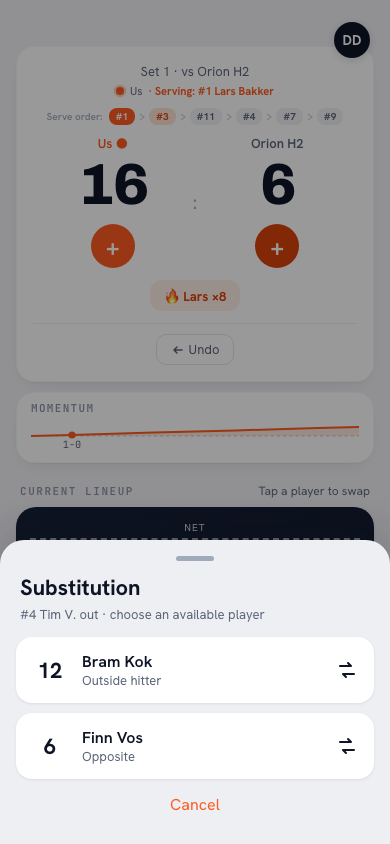
“Sometimes it is a substitution — one player out, one in, and the whole front row of that rotation shifts. But more often it is Tuesday’s training: half an hour of serving pressure on that rotation. You get six substitutions per set; you get more Tuesdays than that.”
Is there something you deliberately did not build?
“The advice. No ‘start in R4’, no notification telling you to do something, no star next to the best lineup. The app points at your weakest rotation and then keeps quiet.
“That is not modesty. A coach who knows his own six rotations is better than a coach who believes an app. The sheet is there to make that first coach faster, not to replace him.”
Find your weakest rotation
Set your lineup in Koach, mark your setter and open the rotation check before the first serve. After a few scored matches the six side-out bars appear on their own.
Try Koach for free