
ADHD and sport: setting up a volleyball practice
Almost everything you find about ADHD and sport answers the question of which sport suits a child. That is a question for parents, and in your case it was answered long ago: he is in your team. Your question is a different one. It is Tuesday, quarter past seven, the hall echoes, twelve children are standing in a line and in forty seconds something has to happen. This article is only about that.
What you as a coach actually hold in your hands
Start with what isn't yours. You don't diagnose anything, you don't treat anything, and you don't need an opinion on whether a diagnosis is correct. That belongs to the parents and to the people trained for it. What is entirely yours: the length of your instruction, the predictability of your programme, the amount of waiting time, the noise level in your corner of the hall and the way you correct. Five dials, all of them adjustable within ninety minutes of court time.
And that is the core of this article straight away: you aren't adapting anything for one child, you are removing waiting time and noise. A drill in which nobody stands still for longer than half a minute and where the instruction fits into two sentences isn't a concession to one player. It is simply a better drill — and the other eleven benefit just as much.
ADHD and autism aren't the same thing, and it would be odd to pretend otherwise. What you see in the hall also differs from player to player, so don't go by what you think you know about a diagnosis — look at what this player finds difficult. Your dials are the same in both cases: instruct briefly, plan predictably and design the waiting time out. They work just as well for the player who has nothing on paper at all and still drops out the moment you talk for three minutes. So never wait for a label before you change anything.
Waiting time and noise: the two things that make a hall expensive
Work your own session out for once. Twelve players in one line with one ball, and you feed a ball in every eight seconds: in ten minutes seventy-five balls go through the drill, six per player. For the rest of those ten minutes — a good nine minutes — that player is standing still. For most of your group that is tedious. For the player who struggles with waiting, that is the real task of those ten minutes, and he is going to lose it. How to shorten that line is in more ball contacts per player.
Noise is the second cost and it is less visible. A sports hall echoes, balls bounce, there is a second group on the other side of the net, whistles go and you are shouting a coaching point from ten metres away. For most people it arrives in fragments and for one player it doesn't arrive at all. That isn't a matter of not wanting to listen, but of a message the hall ate on the way.
Make it measurable before you overhaul anything. Ask a parent or your assistant to tally during one session how often you stop the drill to explain something, and how long you then talk. Four interruptions of a minute and a half is six minutes of standing still. That is where your gain is.
Instruction in two steps, and demonstrate instead of explain
The hard rule: a maximum of two actions per instruction. Not "you pass to the setter, who sets it wide, you run through to position four and then join the back of the line" — that is four, and after the second one the rest is noise. Instead: "Pass, then join the back." You tell them the rest once the first two are running.
Put the name at the front, not at the end. "Sanne, pass and then join the back" works; the same sentence with the name at the end often arrives as half a sentence, because attention only opens on hearing the name.
- Demonstrate instead of explaining. Ten to fifteen seconds of silent demonstration says more than three sentences of explanation. Let a player demonstrate while you add two words.
- Check back on the action, not on understanding. "Got it?" usually only produces nodding. "What do you do first?" produces the truth within five seconds.
- Say literally what you want to see. "Really go for it" can mean anything. "Two steps of approach and then jump" can't.
- Use the same three or four words per skill all season. If your language changes every week, the player has to translate before he can correct.
- Start it together if it doesn't get going. Stand next to him and do the first repetition with him — faster than repeating the instruction for the third time, and it isn't about your authority.
A fixed spot and a fixed order
Every unfamiliar detail costs attention, and attention is exactly what you need for volleyball. So make as much detail familiar as you can. Give the player a fixed spot in the circle during the explanation: at the front and to one side, not in the middle of the group and not at the back where half the hall sits between your voice and his ears. In the game format, give him the same side of the net and the same starting position. Put him next to a calm player, not next to his best friend and not next to whoever talks loudest.
Do the same with the shape of the evening: the same opening every week, the same finish, and only the middle section changes. Anyone who builds their session in fixed blocks has that automatically — see practice blocks: building your session like a programme. The point isn't that the content becomes dull, but that the frame around it doesn't have to be reinvented every week.
Don't turn that fixed spot into a prison. A player who stands in the same position all season because that is calmer for you learns less than he could. Hold on to the spot in the circle and the order of the evening, and vary what you have him play.
Announce transitions thirty seconds in advance
The most expensive moment of a session isn't the drill but the transition between drills. That is where the structure briefly disappears, everybody walks through each other, balls roll away and you shout over the racket about what is going to happen next. That moment can be repaired with thirty seconds.
Work with a countdown and with three fixed components. The countdown: "Two more balls, then we go to the net." The three components in the moment itself: how long left, where to and what to bring. For example: "Thirty seconds left. Then all balls into the cart and everybody at the centre line." That is one sentence you say in the same order at every transition, all season long.
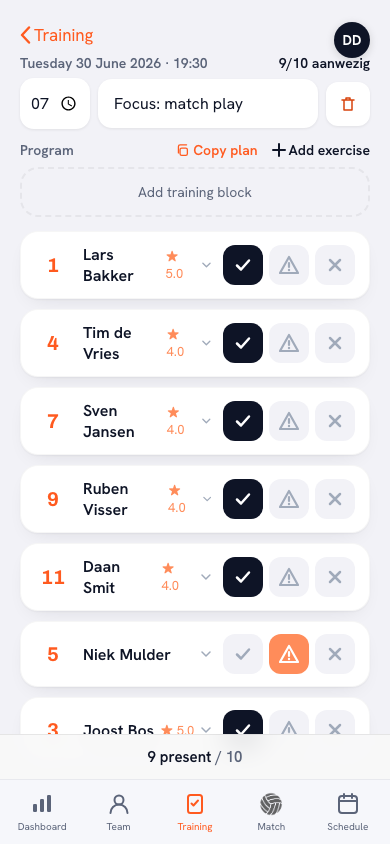
At the start of the session, say in four sentences what is going to happen tonight. Fifteen seconds of work, and it needn't be solemn: "First warm-up. Then passing in pairs. Then attacking from position four. We finish with six against six." If you set your programme up in Koach as blocks with times, you read it off your phone; a whiteboard does exactly the same job.
If something is different from normal — half a hall, a different coach, a drill you hadn't planned — name it before you begin. "Something is different tonight: we only have one court. That means we work in three groups." One sentence of change, one sentence of consequence: that is the difference between an adjustment and a surprise.
Give waiting time a job
Waiting without a task is the problem; waiting with a task isn't. So give every waiting period a function, and rotate it so it doesn't become a supporting role. Five jobs that genuinely amount to something:
- Feeder. Not as a punishment but as a key position: the quality of the drill hangs on the ball that goes into it.
- Counter. Tallies the series or keeps the score in the game format. There is always something to count, and it keeps the eyes on the game.
- Referee. In game play: in or out, net fault, who serves. Instructive, and it gives a reason to keep watching.
- Demonstrator. Runs the drill through once while you say the two words. That is a role with status.
- Ball retriever with a zone. Not "collect balls", but "you keep the back line clear". A defined task is doable, an open one isn't.
More important than the jobs is the design rule underneath them: nobody waits longer than twenty to thirty seconds. You achieve that with more balls at once, two lines instead of one, or a wave format in which the next player starts while the previous one is still finishing. And if there is a big spread of ability in your group, you can work with different tasks inside the same drill without splitting up; that is in one session, six ability levels.
Key point: you aren't treating a diagnosis, you are removing waiting time and noise. Instruction in two steps, an announced transition and nobody standing still for more than half a minute — that isn't an exception for one player, that is the session the other eleven get better from too.
Correcting: one point, beside the player, never across the hall
How to give a correction — one point at a time, in action words, up close instead of across the hall — is in correcting without shouting. Two things come on top of that in this situation.
First: anything about behaviour rather than technique you do without an audience. A correction on attitude with the group standing there produces defensiveness in most players, and for this player it can shape the rest of the evening. Second: don't talk during the escalation. If it gets out of hand, take the player out of the situation without spectators, say one sentence ("we'll talk about it later") and let it settle. A little later, once it has come down, a conversation is usually possible; in the moment it rarely is, however reasonable you sound.
Afterwards, write one line about what worked and what didn't: which drill, which moment of the evening, what you said. After four sessions or so you often see a pattern that is invisible in the hall — that it mostly goes wrong in the last half hour, or in the drill with the longest line. How to keep such notes short and factual is in keeping player notes.
The conversation with the parents: fifteen minutes, five questions
Have that conversation before the season or in the first two weeks, and not after the first incident. A conversation that starts with "something happened" is about blame; a conversation in September is about approach. A quarter of an hour is enough, and five questions:
- "What works at school or at home when something has to be explained?" Parents have often worked that out already; you only have to copy it.
- "How can I tell when it is becoming too much?" The first signal is often something small and concrete, well before the outburst.
- "What helps then, and what definitely doesn't?" The second half often delivers the most, and it is easily skipped.
- "What do you want me to do if it goes wrong during practice?" Agree it: step outside for a moment, call you, or simply carry on.
- "Who do I call, and may I do it straight away?" One name and one number, agreed before you need it.
What you don't ask about: the diagnosis itself, medication, or what an assessment report says. That isn't your territory and you don't need it either — what you need is information about what works in a sports hall. If parents volunteer it, you listen; if they don't, you work with the five answers above.
In the same conversation, agree two things: that you may share it with your co-coach (one person, by name) and not with the team. Pay attention to record-keeping too: what you may write down and store about a minor differs by country and by club, so ask your board what is allowed at yours. Finally, put a five-minute follow-up on it after six to eight weeks; that saves you the conversation that would otherwise come anyway in February. The rest of your agreements with parents are in parents on the sideline.
What you don't share with the team — and where your role ends
Never name a diagnosis in front of the group, not even with the best intentions and not even as "just bear it in mind". The moment a label is lying in a changing room it quickly becomes the explanation for everything that player does, including things it has nothing to do with. And it isn't your information to share.
What you do instead is make rules that apply to everybody, so that nothing is visible as an exception. Everybody gets the instruction in two steps. Everybody has a job while they wait. Everybody hears thirty seconds in advance that the drill is changing. If a teammate still asks why somebody is doing something different, you answer about the rule and not about the person: "In this team everybody gets what they need to get better, and that isn't the same for everybody." More explanation makes it worse. In any case, set out with the group how you deal with mistakes and irritation — that conversation is in making team agreements.
Finally, the limit. Go back to the parents and to your club with any of these four: the player is being systematically excluded, danger arises for him or for others, the enjoyment still isn't there after weeks, or you are losing virtually all your attention to one player. Then describe what you saw in facts and periods — "since November, three times a session, always in the last half hour" — and leave the judgement to the people whose job it is. What is being asked of you is not treatment. It is ninety minutes that run predictably, with short sentences and little waiting.
Frequently asked questions
Do I need to know whether a player has a diagnosis before adapting my session?
No. Everything in this article — short instructions, a fixed spot, announced transitions, a job while waiting — makes the session better for the whole group and requires no diagnosis at all. If parents share information that is valuable, but never wait for it before you change something.
Isn't it unfair on the other players?
It would be if you gave one player a privilege. Removing waiting time and noise is not a privilege: it gives everybody more ball contacts and clearer instructions. Do make sure the adjustments apply as a team rule and not as an exception for one name.
What do I do if it really escalates during practice?
Take the player out of the situation without an audience, say one sentence that you will talk about it later, and don't get into a conversation in the moment. Let it settle for five to ten minutes and come back to it briefly once things are calm. If there was danger, or it involved a teammate, tell the parents that same evening.
What if the parents don't want to talk about it?
Respect that and don't push. You don't need a diagnosis to adapt your session, so ask your questions about behaviour in the hall: what helps when it gets too busy, and what do you want me to do if it goes wrong. That is information most parents are willing to give.
Am I allowed to write down what a player needs?
Keep it short, factual and limited to behaviour you saw in the hall, and use it only to steer your own sessions. What you may record and store about a minor differs by country and by club, so ask your board which rules apply at yours.
Can I do this on my own, without an assistant coach?
Yes. Shorter instructions, a fixed order and announced transitions cost no extra person, only a bit of habit. The only change that is genuinely work is redesigning drills so that fewer lines form — and you do that once, after which you reuse that set-up all season.