
Volleyball and autism: setting up practice for your player
The short answer
Volleyball and autism go well together when practice is predictable: a fixed structure, changes announced in advance, literal and short instructions and a place to recover when the gym gets too busy. Every child is different, so ask the player and the parents what helps.
Volleyball and autism: maybe you have an autistic player on your team, or a parent mentioned it at registration. This article is for the coach who wants to know what they can do in the gym. No diagnosis and no treatment, but practical choices about predictability, language and sensory input.
What you need to know about autism as a coach
Autism is not an illness. The NHS, the UK's health service, describes it as a difference in how your brain develops, which affects how you see and experience the world and how you communicate with others. According to the WHO, the abilities and needs of autistic people vary a lot and can change over time.
In a gym you sometimes see some of that. Among other things, the NHS mentions finding changes in routine hard, reacting very strongly or hardly at all to light, sound or touch, and taking things literally. But the NHS also adds that every autistic person is different and that many autistic people do not have all of those signs. Every child is different, and the parents and the player themselves are the best source for what works for this child. This article gives you the questions and the levers; the answers come from them.
Two things first. You do not diagnose anything: if you think a player is autistic, that is not up to you, and it is not something to discuss with other parents either. And ask how someone talks about it: one person says "I am autistic", another "I have autism". Follow what the player or the parents say themselves.
Much of what ADHD and sports says about short instructions and little waiting time helps here too. This article is about what often matters extra with autism: predictability, literal language and sensory input.
Predictability: a fixed structure and changes in advance
A practice that starts and ends the same way every week often costs an autistic player less energy, and they can then put that energy into the volleyball. The National Autistic Society, the UK charity for autistic people, advises sports coaches in its guide for coaches and clubs to give every session the same structure, including the moments that are usually unstructured, such as breaks.
- A fixed opening and close. The same spot for the bags, the same warm-up, the same circle at the end. Only the middle part changes.
- Show the program. Write the parts in order on a whiteboard, or let the player see the plan beforehand. A check mark after each part that is done shows how much is still to come.
- Announce changes early. A different gym, a substitute coach, a friendly match: say it one practice earlier or send a message. Also say what stays the same: "Next week we practice in the small gym. The structure is the same."
- One new thing at a time. Teach a new drill in a familiar format, in a familiar spot, with a familiar partner.
- Give the loose moments a shape. The water break, the waiting and walking in and out are often the hardest minutes. A fixed spot on the bench or a small task, such as counting the balls, makes them predictable.
A match day has the most unknowns: a different gym, travel time, waiting and a referee with a whistle. Explain beforehand in a few sentences how the day will go: who drives, what time you arrive, where the team sits and what happens when the player is not on the court for a while.
Clear language: say what you mean
Sports language is full of figures of speech, and someone who takes things literally gets lost in it. The National Autistic Society advises avoiding figures of speech, combining instructions with a demonstration and something visual, and giving the player time to process an instruction.
| Instead of | Say |
|---|---|
| "Give it everything!" | "Jump as high as you can on the attack." |
| "Take that ball!" | "If the ball drops in your zone, you call 'mine' and you play it." |
| "Settle down now." | "We stop. Ball between your feet." |
| "One more time." | "Three more balls, then we take a drink." |
After a question or instruction, wait a few seconds (the National Autistic Society mentions about six seconds), and do not immediately repeat it in other words: then the player has to start over. Also make a team's unwritten rules explicit. Who calls when a ball drops between two players? What do you do after a point? Who sits where in the circle? Do not demand eye contact or a high five: someone who does not look at you may be listening very well, as the National Autistic Society also says. And give concrete, sincere feedback instead of effusive praise: "You were still before you played the ball" says more than "Great!". How to give a correction briefly and without an audience is in correcting players without shouting.
Sensory input in a busy gym
A gym is a difficult place if you are sensitive to sensory input: echo, whistles from other courts, bouncing balls, bright light and people who touch you unexpectedly. For young autistic children, the NHS mentions among other things that some do not like noisy or brightly lit spaces. What you control yourself:
- Choose your spot. If you can choose, practice on the quiet side of the gym, away from the door and the other court.
- One stop signal without a whistle. A raised hand or "ball between your feet" works for the whole group, and it saves a shrill sound.
- Silence during the explanation. All balls still, then you talk. That helps everyone.
- No unexpected touch. If you want to put an arm or foot in the right place, ask first or demonstrate. In tag games, choose a version where you tag with a ball.
- Aids by agreement. Some players benefit from ear defenders; the National Autistic Society mentions them as an aid. Agree with the player and the parents what is allowed and when.
Also agree on a quiet spot and a sign. A fixed spot just off the court, and a sign that means "I need a break", without the player having to explain why. Agree as well on how they come back: on their own, after a set number of minutes, or when you give a sign. A player who shuts down or gets angry after an unexpected change does not need a lecture at that moment, but rest.
Ask about what does work. Do not only ask parents and player what is difficult, but also what the player is good at and enjoys. A player who loves numbers may like keeping score. A task like that gives something to hold on to in the loose moments.
Working with the parents and with the player
Have a short conversation before the season or in the first weeks, not only after the first difficult moment. Ask what helps at home or at school when something needs explaining, how you can tell it is getting too much, what helps then and what definitely does not, and what the player enjoys. The five questions for such a conversation are worked out in the article on ADHD; they work just as well here. With older youth and adults, you have the conversation with the player. They often know exactly what they need.
Write down briefly what works, as facts: "wants to know in advance who their partner is", "break spot by the bench". No diagnosis and no medical information. What you are allowed to record about a minor differs by country and by club; check with your board. Agreements with parents in general are in parents on the sideline, and what changes in practice per age in coaching youth volleyball by age.
What a coach never does
- No label in the group. Do not mention a diagnosis in front of the team, not even with good intentions. If the player wants to tell the team, that is their choice, with help if they want it.
- No exceptions that stand out. Make rules that apply to everyone: everyone hears the program in advance, everyone knows the stop signal.
- No forcing. No mandatory high five, no demanding eye contact, no putting them in the middle of the circle.
- No treatment advice. Therapy, medication and diagnosis belong with the parents and the people trained for that. If you see a player not enjoying it for weeks in a row, or if there is danger, discuss it with the parents.
If you want players with and without a disability to play in one group, or you are looking for games with adapted rules, also read adaptive volleyball.
Planning a predictable practice in Koach
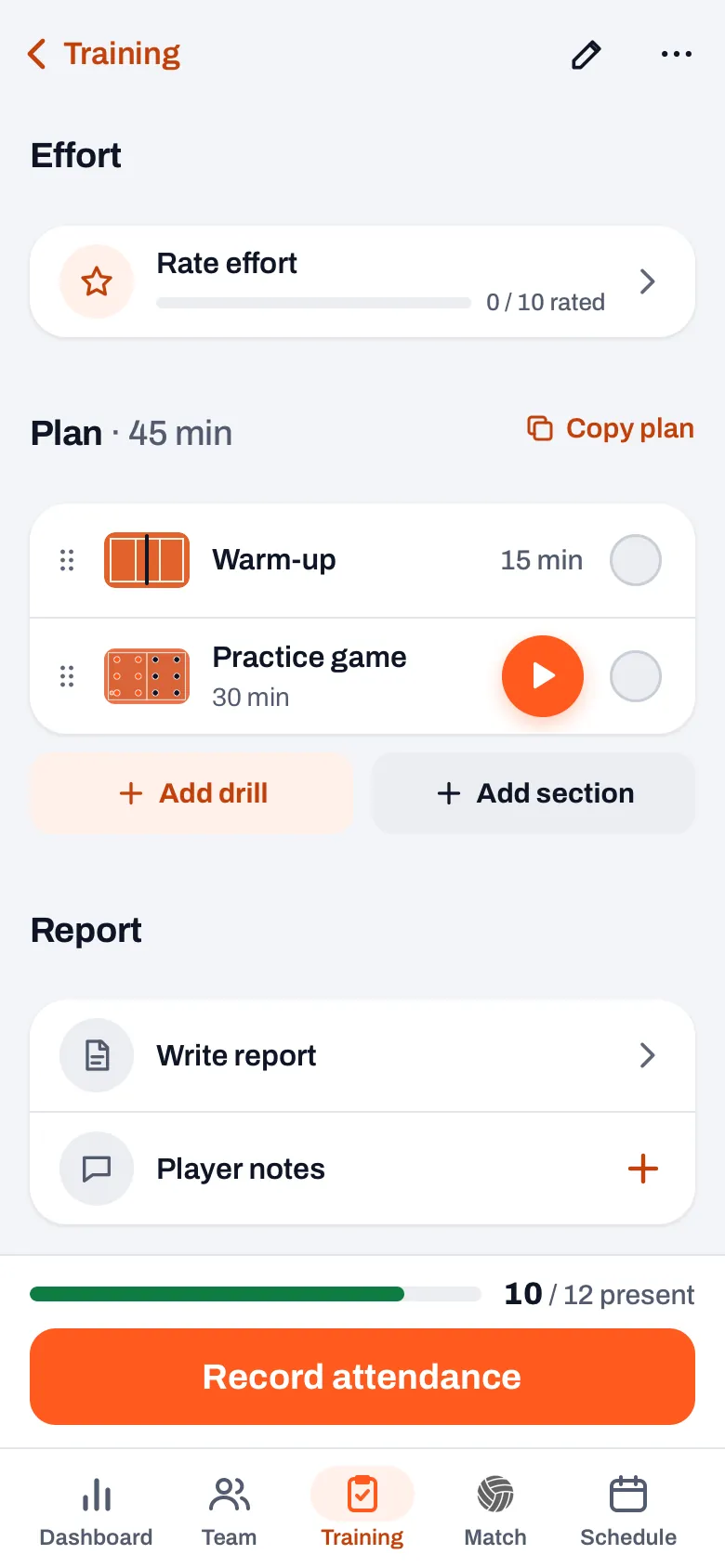
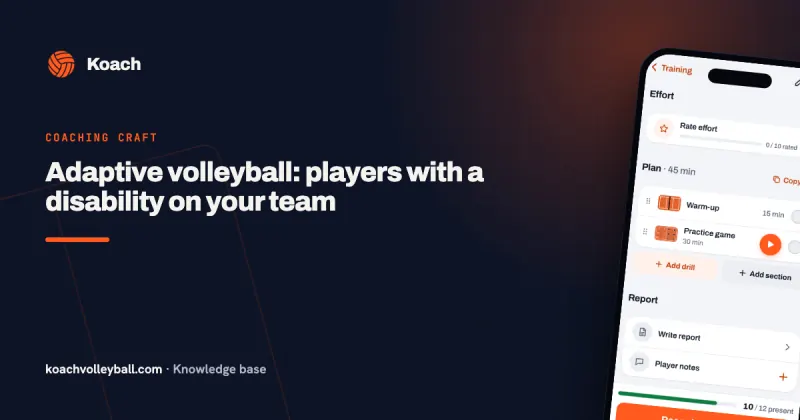
In Koach you set up the practice as a plan: sections in a fixed order, each with a name and minutes. If your player has their own player account, they see that plan for an upcoming practice, read-only. If they tap a drill, it opens with the court and the phases, so they can already see at home what is coming. Parents do not see the plan; with a younger child you show it on your phone or put the order in a message. If a structure works, bring it back the following week with Copy plan: same order, same times.
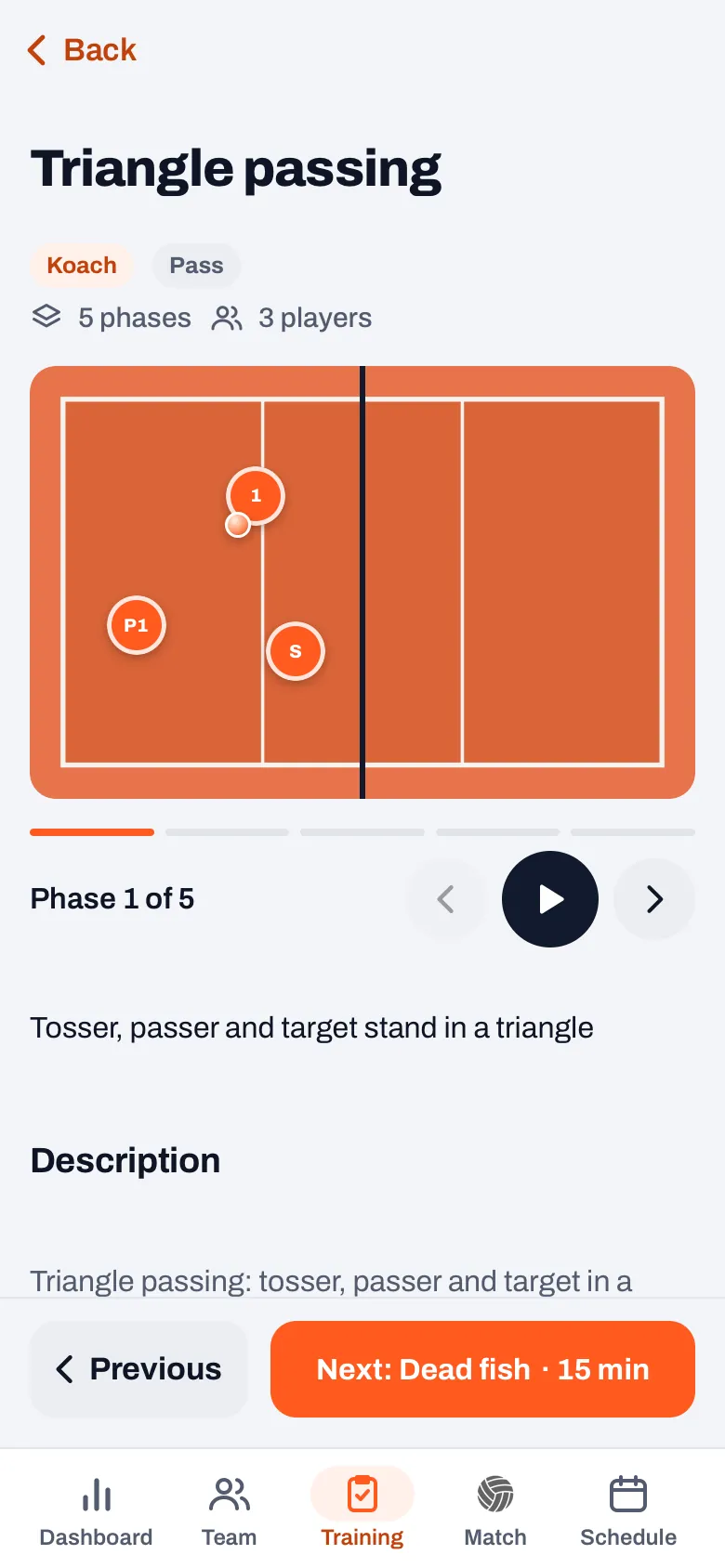
A drill in Koach has a court with phases that you play back step by step. That helps with showing instead of explaining: the player sees where they stand and where the ball goes, in the same order as in the gym.
If something changes, post it as an announcement on the dashboard, where players and parents read it. Player notes on a practice are only for coaches, but if your team belongs to a club, the club's leadership can read them in the team log. So keep them factual and short.
14 days free, no credit card. Set up your practice as a fixed plan and use the same structure for a few weeks in a row.
Plan your practice in KoachWhat Koach costs after the 14 free days is on the pricing page.
Frequently asked questions
Is volleyball a good sport for an autistic child?
That differs per child. Volleyball has no physical duels, a fixed rotation and clear rules, and that suits many children. At the same time, a gym is busy and a team sport asks for a lot of interaction. Let a child join a few trial practices and ask afterwards what they enjoyed and what they found difficult. The parents and the child know best what works.
Should I tell the team that a player is autistic?
No, not without the permission of the player and the parents. It is not your information to share. Instead, make rules that apply to everyone, such as a fixed stop signal and the program in advance. If the player wants to tell the team themselves, that is their choice, and you can talk together about how.
What do I do if an autistic player gets overwhelmed during practice?
Keep it calm and short: no questions, no discussion, and let the player go to the agreed quiet spot. Agree on that spot and a sign in advance, and on how they come back. Talk it over later with the player or the parents: what happened just before, and what can you do differently next time?
Can an autistic player wear ear defenders at practice?
At practice that is an agreement between you, the player and the parents. The National Autistic Society mentions ear defenders as an aid for people who are bothered by noise. Whether something is allowed in an official match is in the rules of your federation or competition; check with the organizers in advance.
Turn your practice into a fixed plan
14 days free, no credit card. After a few weeks you know which structure works.
Get started with KoachOr read first what the volleyball coaching app does.