
Adaptive volleyball: players with a disability on your team
The short answer
Adaptive volleyball is volleyball in which you adapt the ball, net, court, rules or game format so that players with a physical or intellectual disability can take part fully. Start from what the player can do, change as little as possible and as much as needed, and ask the player what works.
Adaptive volleyball starts with one question: what does this player need to take part? Sometimes that is a lighter ball or a lower net, sometimes a group of their own with its own game formats. This article is about the standing game: what you can adapt, how a player with a disability fits into a regular team and where you can find support.
What is adaptive volleyball?
Adaptive volleyball is an umbrella term. It covers every form of volleyball in which you change the game so that people with a physical or intellectual disability can take part fully. There are organized forms with their own rules, and there is what you adapt as a coach in your own gym.
The best-known organized form is sitting volleyball, a Paralympic sport under World ParaVolley. That federation divides its disciplines: sitting volleyball and Beach ParaVolley are the primary ones, standing volleyball and sitting beach volleyball the secondary ones. How sitting volleyball works is covered in sitting volleyball rules; this article is about the standing game. For people with an intellectual disability, Special Olympics volleyball is one of the options. Special Olympics also runs Unified Sports, in which people with and without an intellectual disability play on the same team. Which forms and competitions exist in your country differs by country; your own federation will know.
Physical activity is just as valuable for people with a disability as for anyone else. According to the WHO guidelines on physical activity, there are no major risks when people with a disability are active, as long as the activity suits their current level of activity, their health and their physical function (Bull and colleagues, 2020). The same guidelines say that some people may need to consult a health care provider or a specialist in physical activity and disability to determine which type and amount of activity suits them.
Start from the player, not the disability
Two players with the same disability can need completely different things. So start with a conversation with the player, and with a child also with the parents:
- What goes well, and what is difficult? Think of moving, jumping, tracking the ball, strength in the arms or hands, and the pace of explanations.
- What is tiring, and how can you tell?
- Is there anything I need to know for safety, and what do I do then?
- What does the player want: mainly to take part and have fun, or also to play matches?
What is medically possible and where the limits are, the player or the parent discusses with their own doctor or physiotherapist; that is not for you to decide. Your field is the game. The rule you keep to: adapt as little as possible and as much as needed. And adapt the task rather than the person: the same drill for everyone, with a different assignment for whoever needs it. How to do that within one drill is covered in one practice with big differences in level.
What you adapt: ball, net, court, rules and game format
You have five levers. Adjust one at a time and see what it does.
| Lever | Examples |
|---|---|
| Ball | A lighter, bigger or softer ball, or a beach ball that falls more slowly. A ball in a striking color for someone who sees less well. |
| Net | A lower net, or a rope or ribbon instead of a net, so the ball gets over more easily. |
| Court | A smaller court, or more players on the same court, so everyone has less ground to cover. |
| Rules | The ball may bounce once, catching and throwing are allowed, more than three contacts, serving from closer in or out of the hand. |
| Game format | Counting together how often the ball goes over the net instead of playing against each other, or a fixed role per player. |
Which lever helps depends on the player. Someone with little strength in the arms benefits most from a lighter ball. Someone who moves more slowly, from a smaller court or a bounce. Someone who needs more time to understand what is happening, from a simple game format with few rules. Coaches use many of the same levers with older players; examples are in volleyball for seniors.
Note the difference between practice and match. In your own practice you can adapt anything. In an official competition, the federation's rules apply to everyone, unless the organizers allow something else. If you want an adaptation in a match, for example an aid or a prosthesis, ask the federation or the organizers in advance what is allowed.
Change one thing and play for ten minutes. Do not start with five adaptations at once. Pick one, let the group play for ten minutes and then ask the player whether it went better. That way you know which adaptation really helps, and you keep the game as close to regular volleyball as possible.
A player with a disability on a regular team
Many players with a disability simply play on a regular team. A few examples of what you can do then:
- Deaf or hard of hearing. Agree on a visible stop signal, such as a raised hand, face the player when you talk and demonstrate instead of explaining. Agree on how teammates let them know the referee has blown the whistle.
- Visually impaired. A ball with contrast, a fixed spot in the line, and players who call their name when they take the ball.
- A disability affecting an arm or hand. In volleyball the ball may touch any part of the body, so a pass with one arm or a different technique is not a fault. Look together for the technique that works.
- An intellectual disability. Short instructions, demonstrating, a fixed structure and a buddy for new drills. Much of that is also in volleyball and autism.
Discuss with the player what the team may know. Some players tell the team themselves, others want as little as possible said about it. That is their choice. And give the same playing time and the same chances as everyone else: whoever practices, plays.
Setting up a group of their own
Sometimes a separate group is a better fit, for example for players who get too few touches on a regular team. A few things to arrange before you start:
- Enough support. Count on more coaches or volunteers per player than in a regular group, especially at the start.
- An accessible gym. Entrance, changing rooms, toilets and parking; check before you fix a time.
- Transport and companions. How do players get to practice, and does a parent or companion stay?
- A fixed structure. A warm-up with the ball, a few short technique drills, a cooperative game and a scrimmage with adapted rules, in the same order every week.
If you are a new coach yourself, the basics in starting out as a volleyball coach help too. Ask your own federation whether there is a department or contact person for adaptive or inclusive volleyball; many federations have materials, courses or contacts with other clubs. For sitting volleyball, World ParaVolley is the international point of contact, and for athletes with an intellectual disability, the Special Olympics organization in your country.
Planning adapted practices in Koach
In Koach you build a practice as a plan with sections. With Add section you put a format of your own in the plan, with a name, minutes and a description, such as "3 against 3, ball may bounce once". With Add drill you bring in a Koach drill, and with Make a variation you make your own version of it with adapted rules. If a structure works, save it as a template or bring it back next week with Copy plan.
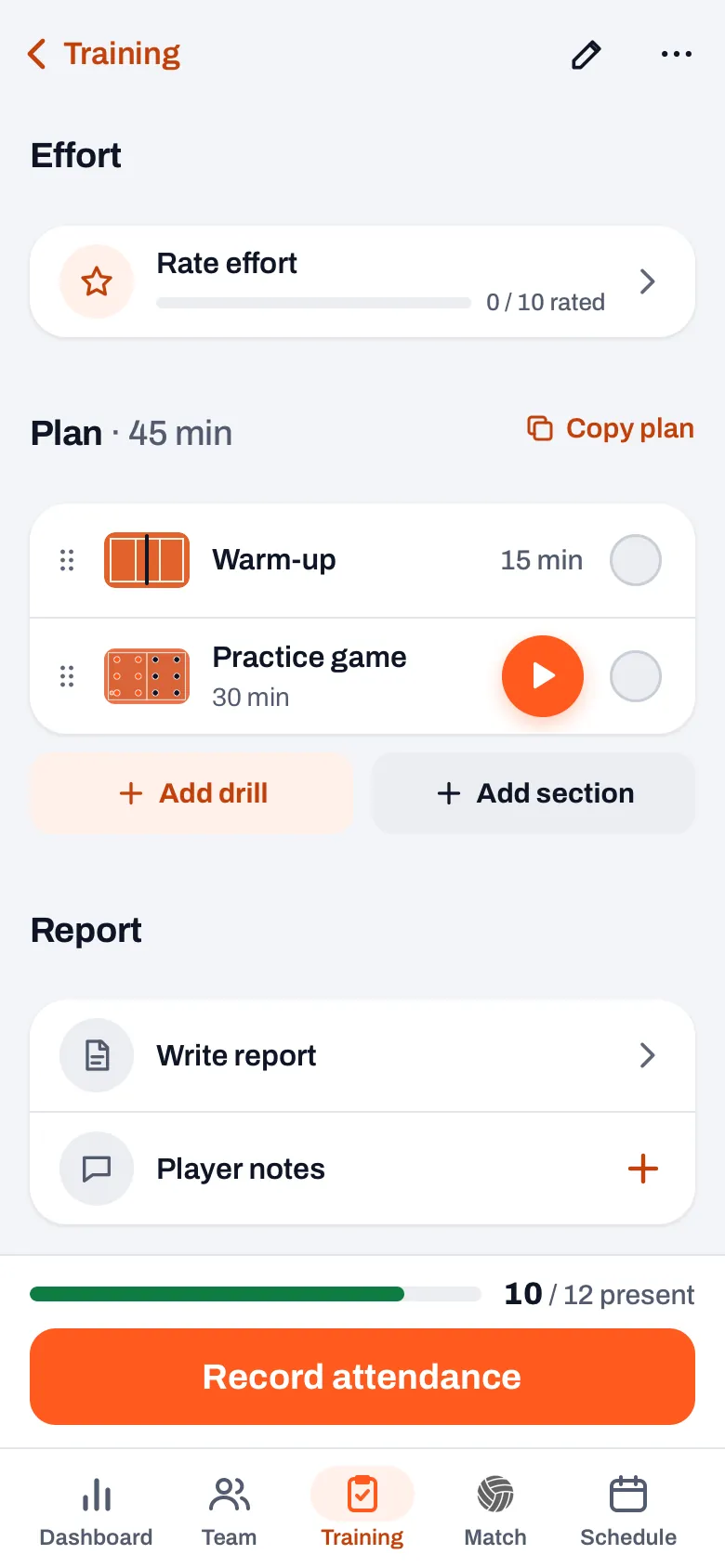
At every practice you track attendance, and with player notes you write down briefly what worked for a player. Keep those notes factual and free of medical information: they are for coaches, but at a club the club's leadership can read them. What Koach costs after the 14 free days is on the pricing page.
14 days free, no credit card. Set up your adapted practice as a plan and use the same structure for a few weeks in a row.
Plan your practice in KoachFrequently asked questions
What is the difference between adaptive volleyball and sitting volleyball?
Sitting volleyball is one form of adaptive volleyball, with its own rules from World ParaVolley: you play seated on a smaller court with a lower net. Adaptive volleyball is broader: any form in which you change the ball, net, court or rules so that players with a disability can take part. That can also be standing, on a regular team or in a group of their own.
Can a child with a disability play on a regular volleyball team?
Often, yes. Many children with a physical or intellectual disability play on a regular team, with a few adaptations in practice. Start with a conversation with the child and the parents about what goes well and what is difficult, and if you are unsure about the physical load, ask their own doctor or physiotherapist. In matches the federation's rules apply; ask in advance what is possible.
Which ball do you use for adaptive volleyball?
That depends on the player. A lighter or softer ball helps someone with little strength in the arms or hands, and a bigger ball or a beach ball falls more slowly, so there is more time to get under it. A ball in a striking color helps someone who sees less well. Try a few balls and ask the player which one plays best.
Can you play volleyball with one arm?
Yes. Under the official rules the ball may touch any part of the body, so playing with one arm is not a fault as long as the ball is not caught or thrown. Whether a prosthesis is allowed in an official match is decided by the federation or the organizers; ask in advance.
Set up your adapted practice
14 days free, no credit card. After a few weeks you know which structure works.
Get started with KoachOr read first what the volleyball coaching app does.