
Sitting volleyball rules: court, net and what is different
The short answer
Sitting volleyball rules in short: six against six on a court of 10 by 6 metres, the net at 1.15 metres for men and 1.05 metres for women, and on almost every ball contact your body between buttocks and shoulders touches the floor. You may block and attack the serve. Scoring, rotation and the libero are as in indoor volleyball.
Sitting volleyball rules look a lot like the indoor rules, with a smaller court, a lower net and one rule that changes everything: you play seated. Here is the World ParaVolley rulebook for 2025-2028 in one place, with the differences from indoor volleyball and the rule numbers alongside.
Sitting volleyball in short
Sitting volleyball is volleyball played sitting on the floor. It has been a Paralympic sport since the Arnhem Games in 1980, and the international federation is World ParaVolley. The rulebook is based on the FIVB indoor rules, adapted for playing from a seated position. Each team has six players on court, every rally scores a point, a set goes to 25 with a two-point lead, and whoever wins three sets wins the match. At 2-2 a fifth set to 15 follows (rules 6.2 and 6.3).
A team has at most 14 players, with no more than two liberos (rules 4.1.1 and 19.1). In international competition only players who have gone through classification may play. There are two sport classes: VS1 and VS2, where VS2 stands for a minimal impairment. A maximum of two VS2 players may be on the scoresheet, and no more than one on court at a time (rules 4.1.1 and 7.3.1). Who may take part in national and recreational competitions is decided by the federation in your country; in a number of countries people without an impairment play there too. The indoor rules that stay the same are in volleyball rules at a glance.
Court, net and ball: the measurements next to indoor
The court is much smaller than indoors, and the attack line is closer to the net. The net is lower and narrower, and the ball is exactly the same as indoors.
| Item | Sitting volleyball | Indoor volleyball |
|---|---|---|
| Court (rule 1.1) | 10 x 6 m | 18 x 9 m |
| Each half | 5 m deep, 6 m wide | 9 x 9 m |
| Attack line (rule 1.3.4) | 2 m from the centre line | 3 m from the centre line |
| Net height men (rule 2.1) | 1.15 m | 2.43 m |
| Net height women | 1.05 m | 2.24 m |
| Net (rule 2.2) | 0.80 m wide, 6.5 to 7 m long | 1 m wide, 9.5 to 10 m long |
| Antenna (rule 2.4) | 1.60 m, of which 80 cm above the net | 1.80 m, of which 80 cm above the net |
| Ball (rule 3.1) | 65 to 67 cm, 260 to 280 g | Same |
You measure the net height in the middle of the court; above the sidelines it must be the same height and may hang no more than 2 centimetres higher (rule 2.1). The posts stand 0.5 to 1 metre outside the sidelines and are at most 1.25 metres high (rule 2.5). Around the court there is a free zone of at least 3 metres. All net heights for indoor, beach and youth are in how high a volleyball net is, and the lines of the indoor court in volleyball court dimensions.
The core rule: sitting on every ball contact
In every playing action, the part of your body between your buttocks and your shoulders must stay in contact with the floor (rule 9.4). If you lose that contact while playing the ball, it is a fault, called lifting (rule 9.3.5). Your legs, feet and hands do not count here. What that means in practice:
- In defence, a brief lift is allowed. If you play the ball in a defensive action, as the first, second or third contact, and the ball is not completely higher than the top of the net, you may lift (rule 9.4).
- Lifting briefly away from the ball is allowed. Your buttocks may briefly leave the floor anywhere on court, except during an attack. Lifting as a reaction after your action is also permitted (rule 9.4).
- You attack seated. If you lift at the moment you hit the ball, your attack is a fault (rule 13.3.4). Rising onto your knees counts as lifting.
- Blocking with a lift is allowed, as long as you do not touch the ball. A blocker who lifts and touches the ball commits a fault. If you lift during a block without touching the ball, it is not a fault (rule 14.6.3).
- Standing up and stepping are forbidden. You move by sliding on your buttocks and hands. Standing up, raising your body or taking steps is a fault (rule 9.4); the definitions at the back of the rulebook also mention "walking" on hands and feet.
Positions are also judged from the seated position: not your feet but your buttocks count. A front-row player must have part of his buttocks closer to the centre line than the back-row player behind him, and a player on the right must be closer to the right sideline than the middle player of his row (rule 7.4.3). After the serve everyone may sit anywhere.
Refereeing a sitting volleyball match for the first time? Watch the buttocks, not the ball. Most arguments are about lifting during the attack and the block. Agree beforehand with the captains what you will call, and let the natural bounce in a defensive action go: the rules allow it.
Serve, block and attack: where it differs
- The server sits. At the moment of the hit, your buttocks may not touch the court or the floor outside the service zone. Your feet, legs and hands may be on the court or in the free zone (rule 12.4.3). If you lift during the serve, it is a service fault (rule 12.6.1.3). As indoors, you have 8 seconds after the whistle.
- One toss, with one exception. You toss or release the ball once. Only players with a classified impairment of the hand may serve without tossing the ball (rule 12.4).
- No hands up during the serve. Players of the serving team may not raise their hands above their heads until the hit, and back-row players may not raise their arms above their shoulders (rule 12.5). That prevents a screen.
- Blocking the serve is allowed. Indoors that is a fault, in sitting volleyball it is permitted (rule 14.5). You may also attack a serve directly (rule 13.1.4). On a net of 1.15 metres, a block on the serve is a real weapon: a serve that skims the net tape can be hit straight back by an opposing front-row player. Servers therefore often choose a path above the reach of the front-row players, deep into the court.
- Back-row players and the attack line. A back-row player may attack above the top of the net if his buttocks do not touch or cross the attack line at the hit (rule 13.2.2). After the hit he may slide forward.
At and under the net
Because everyone sits close to the net, the legs of both teams often reach under the net. That is allowed: you may enter the opponent's court with any part of your body, as long as you do not interfere with their play (rule 11.2). Indoors, part of your foot has to stay on or above the centre line. Touching the net is not a fault, unless it interferes with play, for example by touching the net tape between the antennae while playing the ball, or by leaning on the net (rules 11.3 and 11.4.4). Touching the net outside the antennae is not a fault.
Substitutions, timeouts and the libero
Each team has two timeouts and six substitutions per set (rule 15.1). A timeout lasts 60 seconds, twice as long as indoors (rule 15.4). The substitution rules are otherwise the same: a starting player may leave the set once and come back once to his own position; see the substitution rules. The libero replaces a back-row player, may not serve, block or attack above the top of the net, and wears a shirt in a different colour (rule 19). Players may play without shoes, but may not sit on thick material or in specially padded shorts.
For youth, World ParaVolley publishes its own youth rules, and national federations may deviate for their competitions. The full text is in the World ParaVolley rules and regulations. How to train sitting volleyball, including as a variation for an indoor team, is in sitting volleyball drills.
Tracking a sitting volleyball match in Koach
Koach is built for indoor volleyball, and that is why live scoring also fits sitting volleyball: scoring to 25, the fifth set to 15, the rotation and the serving order are the same, and the counters are set to two timeouts and six substitutions per set. There is no separate sitting volleyball mode, and the app does not know whether someone lifted. If the referee calls a lift, you choose Other error and the player on the opponent's point. After the match you see the points and errors per player, just like in an indoor match.
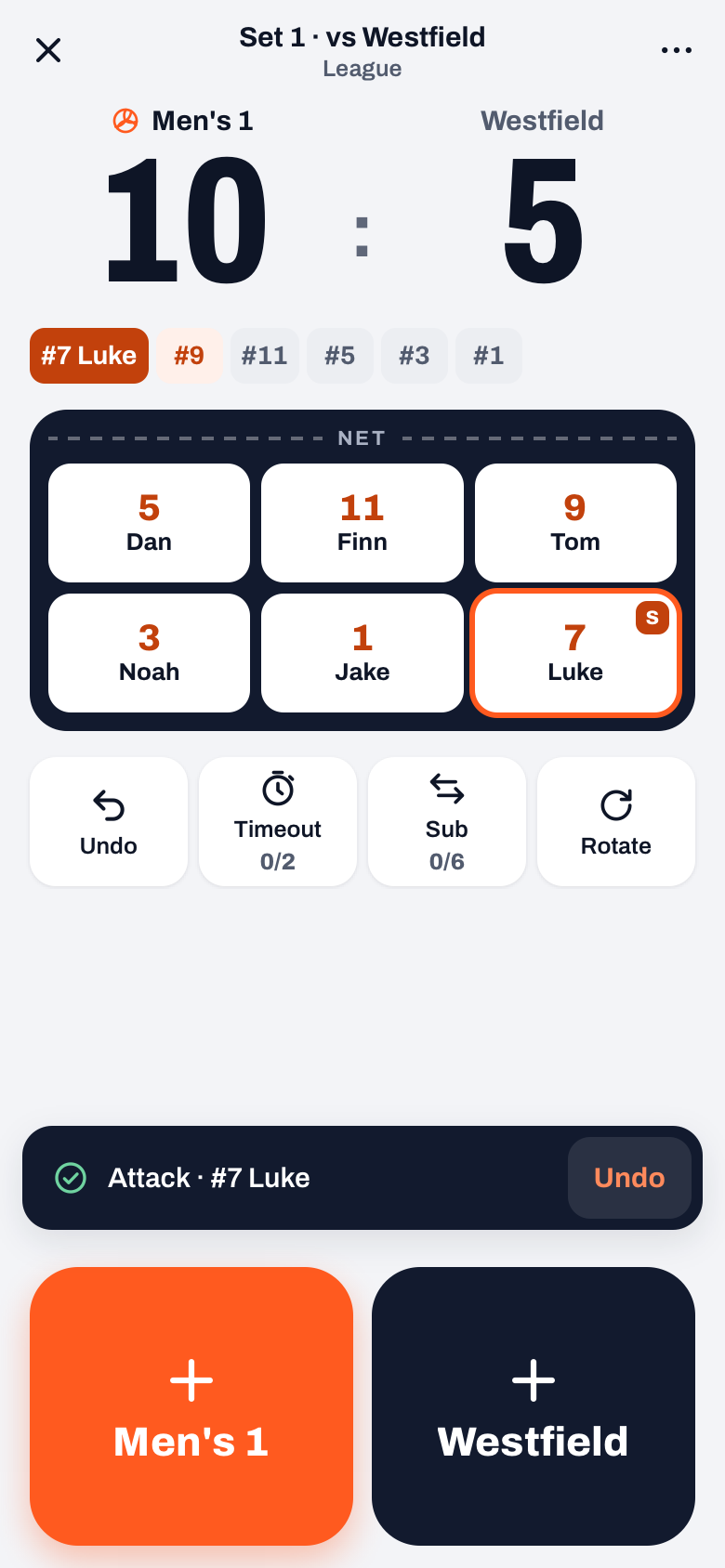
14 days free, no credit card. Add your sitting volleyball team and score your next match live.
Try Koach with your teamWhat Koach costs after the trial is on the pricing page.
Frequently asked questions
How high is the net in sitting volleyball?
According to the World ParaVolley rules, the net hangs at 1.15 metres for men and 1.05 metres for women, measured in the middle of the court. Above the sidelines it must be the same height and may hang no more than 2 centimetres higher. The net is 80 centimetres wide, and the antennae stick out 80 centimetres above the net tape.
Can you block the serve in sitting volleyball?
Yes. Unlike indoors, in sitting volleyball you may block a serve and also attack it directly. Because of the low net that is a real threat to the server. A blocker does have to stay seated when he touches the ball: lifting off the floor while you block the ball is a fault.
Who can play sitting volleyball?
In international competition only players with a physical impairment who have gone through classification, in sport class VS1 or VS2. Each team may have two VS2 players on the scoresheet and one at a time on court. For national and recreational competitions the federation in your country sets the rules; in a number of countries people without an impairment play there too.
Can you lift off the floor in sitting volleyball?
Sometimes. Your buttocks may briefly leave the floor, except during an attack, and in a defensive action on a ball that is not completely above the net you may lift. During the serve, an attack and a block in which you touch the ball, the part between buttocks and shoulders must touch the floor. Standing up or taking steps is always a fault.


Score your next sitting volleyball match live
14 days free, no credit card. After one match you see who scored.
Get started with KoachOr read first what the volleyball coaching app does.