
Sitting volleyball drills: how to train on the floor
The short answer
Sitting volleyball drills revolve around three things: moving quickly on your hands and buttocks, playing the ball while your torso stays in contact with the floor, and reacting to a ball that reaches you fast over a net of 1.05 or 1.15 meters. Start with movement, build up to technique and finish with game formats.
Sitting volleyball drills are hard to find, and often they are indoor drills with someone simply sitting down for them. On the floor things work differently: you move with your hands, the ball reaches you faster and the net is low. Here are drills made for that, from movement to game formats, plus a one-hour practice.
What is different when you play on the floor
Sitting volleyball is played with six players per team, on a smaller court and under a lower net. The rules come from World ParaVolley and largely follow those of the FIVB. For your practice these matter most, from the World ParaVolley Official Sitting Volleyball Rules 2025-2028:
- Court and net. The court measures 10 by 6 meters (rule 1.1), the attack line is 2 meters from the center line (rule 1.3.4) and the net is set at 1.15 meters for men and 1.05 meters for women (rule 2.1.1).
- Contact with the floor. While playing, part of your body between the buttocks and the shoulders touches the floor. Standing up, lifting your body or taking steps is forbidden (rules 9.4.1 and 9.4.2).
- A brief lift in defense. If you play the ball defensively while it is not completely above the top of the net, you may come off the floor briefly. In an attack hit, and in a block in which you touch the ball, lifting off is a fault (rules 13.3.4 and 14.6.3).
- Blocking or attacking the serve is allowed (rules 13.1.4 and 14.5). Indoors, blocking a serve is always a fault, and so is attacking a serve in your front zone while the ball is above the top of the net.
- Under the net. You may touch the opponent's court with any part of your body, as long as you don't interfere with their play (rule 11.2).
- The serve. At the moment of contact your buttocks don't touch the court or the floor outside the service zone; feet, legs and hands may come into the court (rule 12.4.3).
The full rules are in the sitting volleyball rules. For your practice it mainly means this: distances are short, the ball reaches you fast, and many balls come at or above head height. Moving with your hands and setting therefore matter more than indoors.
Moving: the basis of every sitting volleyball practice
Indoors you move with your feet, on the floor with your hands. A good ready position: buttocks on the floor, legs bent in front of you, hands beside or slightly behind your hips to push off, torso upright and leaning slightly forward, eyes on the ball. When the ball comes, the hands come up off the floor. A player who leans back too far can't get forward any more; a player who doesn't free the hands in time plays the ball too late. Players with a leg amputation or another impairment often find their own position. Look at what works for the player instead of imposing one position.
1. Line runs on the floor
Setup: all players on the end line. Rules: move to the attack line and back, then to the center line and back, and then sideways across the full width of 6 meters. Progression: then backward, and then with a ball on your lap that must not fall off. Two rounds are enough; this is also your warm-up for wrists and shoulders.
2. Mirroring at the net
Setup: pairs facing each other on either side of the net. Rules: player A moves along the net, B follows as a mirror image. At a hand clap both bring their hands above the net in blocking position, with their buttocks on the floor. Progression: the coach tosses a ball over the net between them; whoever touches it first wins the round. Switch roles after thirty seconds.
3. Point and catch
Setup: one player in the middle of one half of the court, the coach two to three meters away with a ball. Rules: the coach points in a direction and tosses the ball one to two meters that way. The player moves and catches the ball with two hands above the head. Progression: then don't catch but set it back, and then pass it back with the forearms. Ten balls per player, then switch.
Technique: passing, attacking and blocking
4. Partner passing
Setup: pairs three to four meters apart, one ball. Rules: set back and forth and shift a little sideways after every contact, so the ball never comes straight at you. Progression: then forearm passes, and then alternating. Count how many contacts the pair gets in a minute without the ball touching the floor.
5. Passing a flat serve
Setup: a server behind the end line, two passers in the back court and a catcher at the net in the setter's spot. Rules: ten serves; the passers call out loud who takes the ball and pass it to the catcher. A pass the catcher can catch without moving counts. Progression: have the server serve harder and flatter, and switch roles after ten serves.
6. Attacking from a seated position
Setup: a setter at the net, hitters on the attack line. Rules: the setter sets high and slightly off the net; the hitter slides forward while the ball comes and hits with a straight arm, buttocks on the floor. Contact the ball in front of your hitting shoulder and let the torso rotate with it. Progression: put two towels on the other side as targets, and have the hitter call out which towel before the set.
7. Blocking the serve
Setup: three front-row players at the net, a server on the other side. Rules: the server hits a flat serve; the front-row players try to block it, with their buttocks on the floor at contact. A blocked serve is a point for the blocking team. Progression: give the server two points for a serve that goes over the block and lands in the back court. That way blockers learn their timing and servers learn a higher, deeper serve, because a flat serve is a risk in this sport.
Watch the hands, not the ball. With almost every late ball, the player's hands were still on the floor when the ball left the opponent. Have players in the ready position free their hands as soon as the opponent plays the ball, and only push off again when they need to move.
Game formats: from two against two to six against six
- Two against two lengthwise. Play on half the court width, 3 meters wide and the full length. Rallies keep going and everyone touches the ball every rally.
- Three against three, winners stay. The winning trio stays, the losing trio is replaced by the waiting one. Play to five points, so nobody waits long.
- Six against six with a task. A point only counts after three contacts, or a blocked serve counts double. That way you put one theme of the practice into the game.
Court and net in your own gym
A sitting volleyball court is easy to mark out on a badminton court. The doubles sidelines are 6.10 meters apart, and the short service line is 1.98 meters from the net: almost exactly the width and the attack line of a sitting volleyball court. Tape the end line yourself at 5 meters from the center line. A badminton net is too high, so use volleyball posts that go low enough, or stretch an elastic band or rope at 1.05 or 1.15 meters. The net heights for the other forms of the game are in how high a volleyball net is.
Make sure the floor is clean and have players wear long pants; sliding over a gym floor scrapes the skin. The rules allow long pants, but not thick or specially padded pants and no padded compression shorts underneath (rule 4.3), so train without extra padding as well. Wrists, shoulders and buttocks aren't used to the load the first time. Build up the duration gradually, and if complaints don't go away, have the player see a doctor, a sports physician or a physical therapist.
A one-hour practice
- 0 to 10 minutes: loosening up wrists and shoulders, then the line runs.
- 10 to 20 minutes: mirroring at the net and point and catch.
- 20 to 35 minutes: partner passing and passing a flat serve.
- 35 to 45 minutes: attacking from a seated position, then blocking the serve.
- 45 to 60 minutes: three against three, winners stay, and to finish six against six.
Sitting volleyball is also a strong variation for a regular indoor team, for example in the last practice before a holiday or on a club day together with a sitting volleyball team. Players have to read the ball earlier and talk to each other more, because nobody can make up for a poor pass with a few quick steps. Start with a block of twenty to thirty minutes rather than a whole practice. How such a block fits into your practice structure is covered in running a volleyball practice; another format with small teams and lots of ball contact is in beach volleyball drills for your indoor team.
Your sitting volleyball practice in Koach
The Koach drill library is made for indoor volleyball; it has no sitting volleyball drills. So you add them as your own sections in the practice plan: with Add section you give a name and a duration, and in the description you write the setup and the rules. If the plan worked, you bring it back for the next practice with Copy plan.
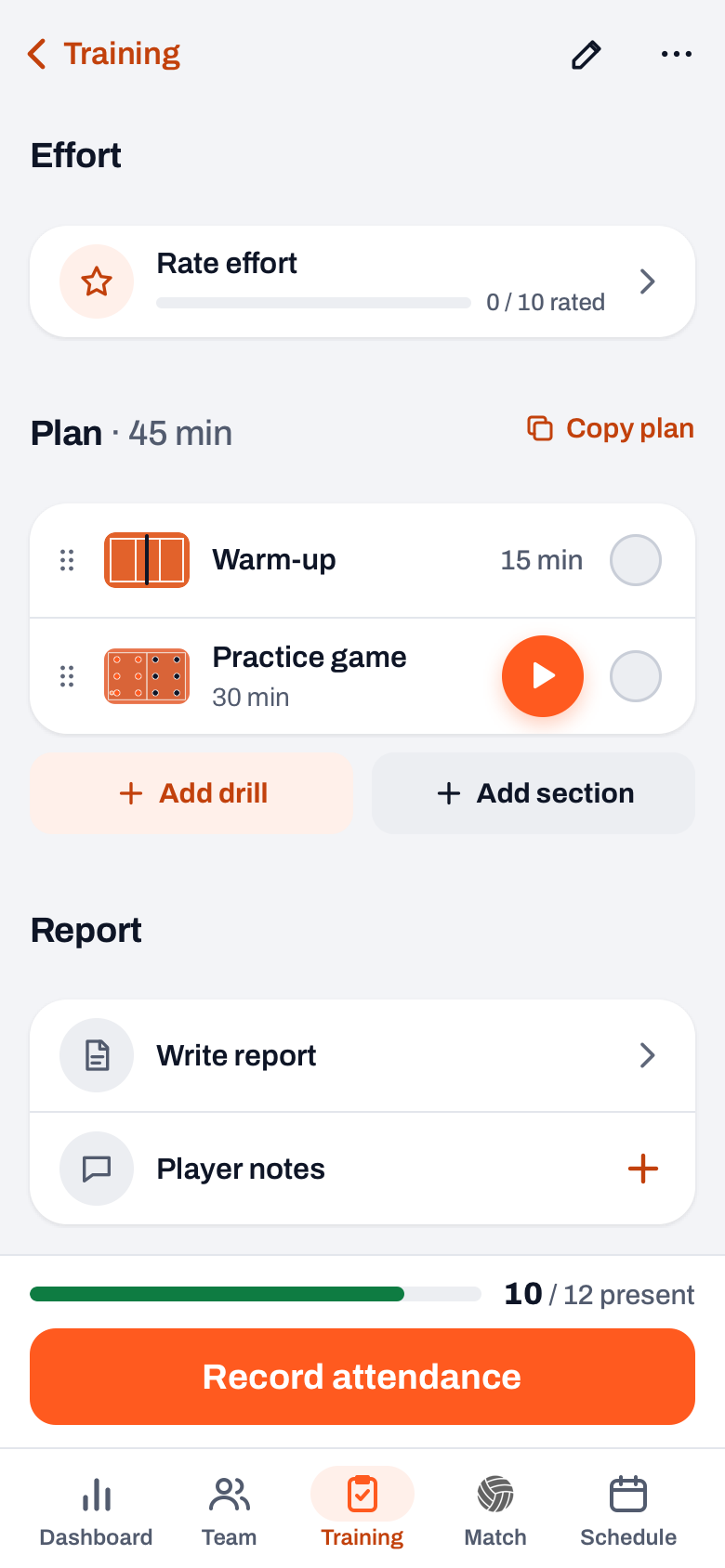
After practice you mark for each section whether it was done and you record attendance. If you play six against six within your own group, you can track it as a practice game: for each rally who scores and who makes the error. What Koach costs after the 14 free days is on the pricing page.
14 days free, no credit card. Put your sitting volleyball practice in a plan tonight and copy it to next week.
Plan your practice in KoachFrequently asked questions
How high is the net in sitting volleyball?
Under the World ParaVolley rules the net is set at 1.15 meters for men and 1.05 meters for women, measured in the middle of the court. The net is 80 centimeters wide. If you don't have a sitting volleyball net, an elastic band or rope at the same height works for practice.
Can you lift your buttocks in sitting volleyball?
While playing, part of your body between the buttocks and the shoulders must touch the floor, and standing up or taking steps is forbidden. In a defensive action you may come off the floor briefly if the ball is not completely above the top of the net. In an attack hit and in a block in which you touch the ball, lifting your buttocks is a fault.
Can you play sitting volleyball without an impairment?
In practice anyone can join in, and for indoor teams it is a good variation. In international competition only athletes classified with an impairment play, with at most two players with a minimal impairment per team and no more than one of them on court at a time, according to World ParaVolley. How it works in national and recreational competitions is up to your own federation.
How big is a sitting volleyball court?
The court is 10 by 6 meters, with a free zone of at least 3 meters all around. The attack line is 2 meters from the center line. In your own gym you can use the lines of a badminton court: the doubles sidelines are 6.10 meters apart, and the short service line is 1.98 meters from the net.

Put your sitting volleyball practice in a plan
14 days free, no credit card. Next week you copy the plan with one tap.
Get started with KoachOr read first what the volleyball coaching app does.