
Volleyball for seniors: playing and training over 50
The short answer
Volleyball for seniors works at every level: in a regular recreational or masters team, or in an adapted format without jumping, seated or with a lighter ball. After 50, tendons and muscles recover more slowly, so build up your jumps gradually, warm up longer and train strength and balance on the side.
Volleyball for seniors is simply volleyball, with a few smart adjustments. This article is for players and for clubs: which formats exist, what changes in your body after 50, and what a practice looks like that suits a body of fifty, sixty or seventy.
Can you still play volleyball after 50?
Yes. Volleyball is a sport without physical contact with the opponent, a rally usually lasts only a few seconds, and in a recreational group you largely decide how hard you go. Then there is the team: people who play with the same group every week keep showing up, in winter too. That makes volleyball a sport you can keep up for a long time, even if you only pick it up later in life. How to start as an adult is covered in starting volleyball as an adult.
One evening of volleyball is not a complete week of activity, though. The WHO advises adults, including those over 65, to do 150 to 300 minutes of moderate-intensity activity or 75 to 150 minutes of vigorous activity per week, plus muscle-strengthening activities on at least two days. For people over 65 it adds a varied mix with an emphasis on balance and strength on at least three days a week, to prevent falls (WHO guidelines on physical activity, 2020). Volleyball counts, but walking, cycling and a short strength routine at home complete the week.
If you have not been active for a long time, if you have heart or vascular disease or diabetes, or if you get chest pain, dizziness or unusual shortness of breath during exercise, talk to your doctor or a sports physician before you start.
What kinds of volleyball are there for seniors?
You don't have to choose between a regular league and nothing. These are the formats you come across in clubs and in care settings:
| Format | What is different | For whom |
|---|---|---|
| Recreational group | Normal rules, your own pace, often mixed | Players who are fit and want to keep jumping |
| Masters or veterans | Normal rules, teams by age group | Players who want matches against people their own age |
| Volleyball without jumping | No jumping, one foot on the ground, no diving | Players who want to spare their knees or Achilles tendon |
| Sitting volleyball | On the floor, low net, smaller court | Players who want to spare their legs and have strong arms |
| Chair volleyball | Seated on chairs, balloon or soft ball, low net or rope | Older adults in care or after rehabilitation |
| Light, large ball | Soft ball, smaller court, often four against four | Older beginners and mixed groups |
A few notes. Whether the net is lower in a masters category differs by competition: check the rules of your own federation. There is no international rulebook for volleyball without jumping, also called walking volleyball; clubs that offer it make their own agreements on net height, the ball and what counts as a jump. Sitting volleyball is a Paralympic sport with its own rules, and in many countries people without a disability also play it recreationally. It spares the legs but asks a lot of the shoulders and wrists, and you need to be able to get up from the floor easily; the rules are in sitting volleyball explained. With a light, large ball, volleyball is played as a format of its own in some countries, such as soft volleyball in Japan, four against four on a badminton court.
What changes in your body after 50?
What follows is general knowledge about aging and sport, not a diagnosis or treatment advice. It does help to understand why the same practice lands differently at fifty-five than at twenty-five.
- Muscle strength and jumping power decline. Without strength training you gradually lose muscle mass, and the fast, explosive power you need for a jump declines sooner than your endurance.
- Tendons get stiffer and recover more slowly. The Achilles tendon and the calf have a hard time with an explosive take-off, especially after a period without sport. A sudden snap in the calf or heel is a well-known injury in middle-aged athletes.
- Recovery takes longer. Muscle soreness comes later and lasts longer. Two hard sessions on consecutive days often turn out badly.
- Shoulders have less reserve. The tendons around the shoulder joint wear with the years, and dozens of hard swings in one evening add up.
- A fall weighs more heavily. With less balance and, for some, osteoporosis, a fall when diving is riskier than it used to be. If you know you have osteoporosis, ask your doctor what is sensible.
The best-known acute injury in volleyball is an ankle that rolls on landing, often on someone else's foot at the net. Knees and shoulders also get overloaded. That applies at every age; how to prevent it is in injury prevention in volleyball. If you have pain that persists, swells or comes back every practice, see your doctor, a sports physician or a physiotherapist, and don't play through pain.
How to train volleyball after 50
- A fifteen-minute warm-up. Start with movement without the ball, then ball contact, and only at the end jumps that build up: small ones first, then half, then a few full ones. The first hard attack comes after that.
- Jumping in the first half. Put blocking and attacking drills early, while everyone is still fresh. Tired jumping leads to sloppy landings.
- Count the jumps. Agree on a number of attacks per drill instead of a time. That way nobody keeps going until something goes wrong.
- Land on two feet. With the knees slightly bent and over the toes, and never with one foot under the net.
- Only dive and roll if you have learned how. Agree in the group that letting a ball go is fine. That prevents more injuries than any other rule.
- Build up after a break. Anyone who was away for three weeks because of holidays or illness plays along the first evening without jumping all out.
- Strength and balance on other days. A few exercises at home, two or three times a week: rising onto your toes and lowering slowly, standing up from a chair without using your hands, a lunge, standing on one leg, and rotating the shoulder outward with a resistance band.
Agree that letting a ball go is fine. In a group of over-50s, the worst damage rarely comes from a missed ball, and often from the dive to get it anyway. Say it out loud at the start of the season, so nobody feels obliged to hit the floor.
Setting up an over-50s group at your club
A club that wants to bring in a group of older players starts with the time slot. Gyms are often free during the day and early in the evening, and many people over 50 don't want to be playing at ten at night. A fixed morning or an early evening with coffee afterwards attracts a different group than a late practice.
In terms of content, such a group resembles a regular recreational group: changing attendance, different levels, and people who come for the game and the company. The structure with short games on half a court from volleyball drills for recreational players works just as well here, with fewer jumps and more rest between the games. A four-on-four game on half a court gives a lot of ball contact and little running.
The coach doesn't have to be a former international, but does need to be able to dose the load and keep everyone in the same game. If you are standing in front of such a group for the first time, starting as a volleyball coach gives you the basics. And ask your federation whether there is a masters league or veterans tournaments: for part of the group, a match against people their own age is exactly the reason to keep training.
Tracking attendance for an older group
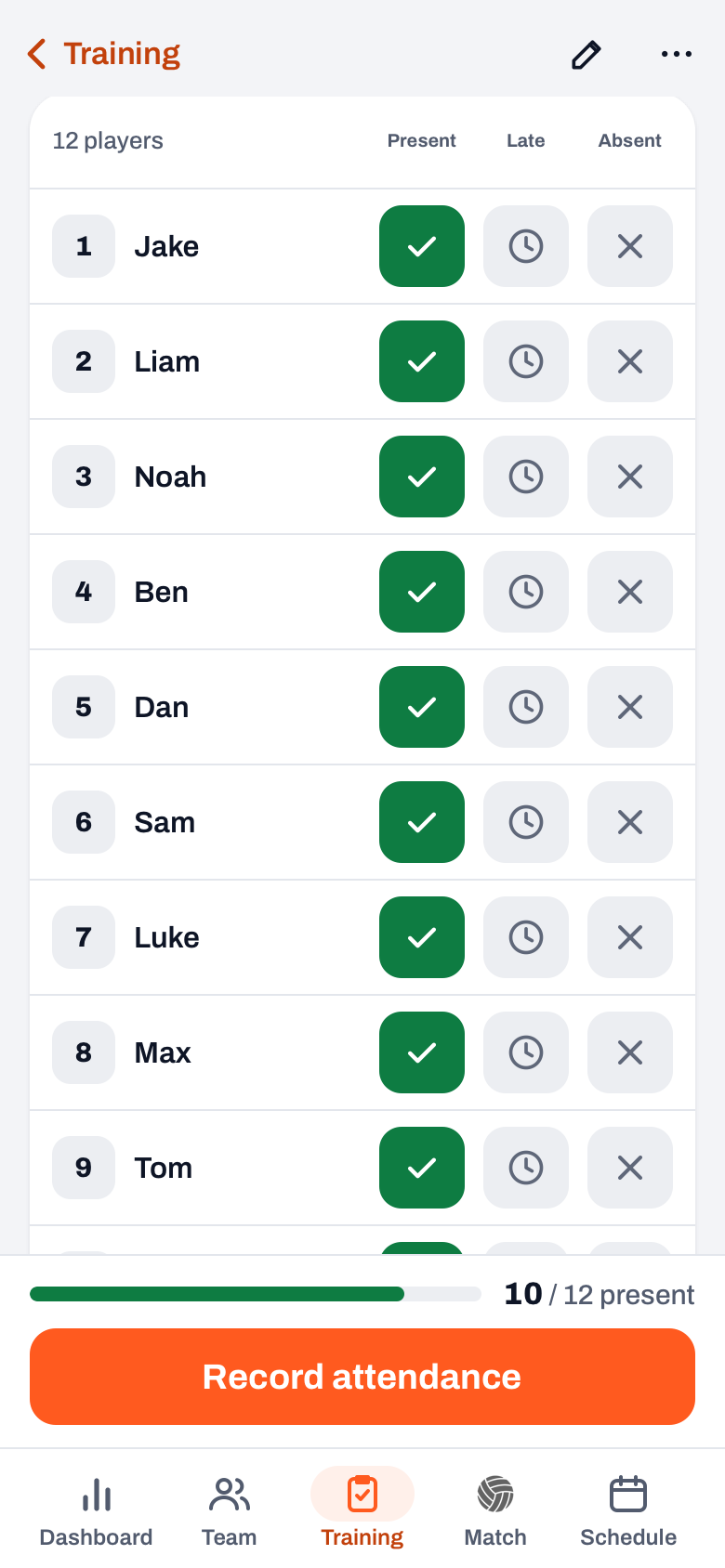
With an older group, attendance has a second purpose. You don't only want to know whether you need half a court or a full one, but also who is coming back after a few weeks away, because you build that player up gently on the first evening. In Koach players sign up or cancel for each practice, and afterwards you check off who was Present, Late or Absent. In a player's profile you see their recent practices under History, so you can tell at a glance who was away for a long time. With Recurring trainings you put the fixed morning in the calendar for the whole season in one go.
What Koach costs after the 14 free days is on the pricing page.
14 days free, no credit card. Add your group, let everyone sign up and see after a month who comes regularly.
Try Koach with your groupFrequently asked questions
Up to what age can you play volleyball?
There is no fixed limit. In many countries, masters leagues and veterans tournaments have teams with players of sixty and older, and in adapted formats such as volleyball without jumping, sitting volleyball or chair volleyball you can play even longer. What counts is how your body recovers and whether you build up the load. If in doubt, talk to your doctor or a sports physician.
Is volleyball good for your knees as you get older?
Volleyball loads the knees mainly when jumping and landing. With a good warm-up, fewer jumps, landing on two feet and strength training for the thighs and hips, many people can keep playing. With knee problems, volleyball without jumping is a gentler alternative, or playing on sand, which gives a softer landing but asks more of your calves. Have persistent or recurring knee pain checked by a doctor, sports physician or physiotherapist.
What is walking volleyball?
Walking volleyball is volleyball without jumping: you always keep one foot on the ground, you don't dive, and you often play with a lower net and a softer ball. There is no international rulebook for it, so each club makes its own agreements. It is meant for people who want to keep playing the game without the load of jumping and landing.
Can you start playing volleyball at 60?
Yes. Start in a recreational group or a group for older players, where the pace and the load suit you. Learn the forearm pass and the overhead ball first, and wait with hard attacks and jumping until your body is used to the game. If you have not been active for a long time or have a heart condition or diabetes, talk to your doctor first.


Put your group in Koach tonight
14 days free, no credit card. After a month you see who comes regularly.
Get started with KoachOr read first what the volleyball coaching app does.