
How to start playing volleyball as an adult: where to begin
The short answer
You can start playing volleyball as an adult at any age. Choose a beginners' group or recreational team with a coach, expect a few months before rallies flow, and build up your jumping gradually. Good indoor court shoes and patience with your fingers and forearms matter more than talent.
How to start playing volleyball as an adult is less strange a question than it feels: many clubs have recreational groups, and people who start at thirty or forty rarely do it alone. This article is for you as a player: how to choose a group, what you need, what the first months bring and how to avoid injuries.
Can you still learn volleyball as an adult?
Yes. Adults have one advantage over children: they quickly understand why something has to be done a certain way. The downside is that the body only follows that explanation after hundreds of repetitions, and that makes you impatient. Volleyball also has a tricky start: you cannot hold the ball, so at first every rally seems to be over after one contact. If you know that, you stick with it. How a coach builds up a group of adult beginners is in volleyball drills for adult beginners; this article is about your side of it.
You do not need to be fit to start, either. Volleyball is not an endurance sport: you make short efforts with rest in between, and your fitness grows along with the playing. What does matter is how long you have not done any sport. If you have been inactive for years, build up jumping and hard hitting more slowly than someone who already runs or cycles. If you have a medical condition or are unsure whether exercise is wise, talk to your doctor first.
Club, recreational group or course: where do you start?
Which options exist differs by country and by city. These are the four you come across almost everywhere:
| Option | For whom | Ask beforehand |
|---|---|---|
| Beginners' course or clinic | People who have never played and want to learn the basics in a group of equals | What happens after the last session: can you move on to a group? |
| Recreational group at a club | People who want to play weekly, without a league or with a light league | How big the gap in level is, and whether there is a coach or only scrimmages |
| League team at the lowest level | People who want matches and already have some ball control | Whether new players get playing time, and when the matches are |
| Beach or grass in summer | People who want to play outdoors, with two to four players per team | Whether there are beginner sessions; with few players you touch the ball often, but you also run a lot |
For almost everyone, a group with a coach is a good start. In a group that only plays scrimmages, a beginner touches too few balls and picks up habits that are hard to unlearn later. A league team works fine as a second step, after a season of recreational play or a course.
At a club, ask these questions in particular: is there a group for beginners, how often and how long do you practice, can you join in a few times first, what does membership cost and what is included, and are there volunteer duties such as refereeing, scorekeeping or working the bar? How to prepare for that first time is in the volleyball trial practice.
What do you need to get started?
- Indoor court shoes. The only thing you really have to buy. An indoor court shoe has a sole that grips and does not leave marks on the floor. Running shoes are made for running straight ahead and give less support on side steps and landings. What to look for is in buying volleyball shoes.
- Knee pads. Not mandatory, but nice to have as soon as you dive for a ball or land on your knees. Many beginners buy them after a few weeks, once they know how often they end up on the floor.
- Sportswear and a water bottle. Nothing more. A ball of your own is for later, when you want to practice at home.
The first months: what can you expect?
- The first weeks: pass and serve. You learn the forearm pass and the underhand serve. Your forearms get red and sometimes bruised; that is part of it and fades once the ball lands in the right spot. Overhand passing hurts your fingers at first, and a lighter ball or fewer repetitions helps then.
- After a month or two: real rallies. Three contacts work out more often, you know where to stand when the ball goes to the other side, and the scrimmages become more fun than the drills.
- After that: attacking, rotation and positions. An attack with an approach and a jump only comes once the landing is solid. You understand rotation and positions best after playing them for a few weeks, not when someone explains them beforehand.
Everyone hits a plateau at some point: a month in which nothing seems to get better. That is normal, and it says nothing about your talent. Compare yourself with who you were three months ago, not with the player next to you who has been playing for fifteen years.
Go to every practice for the first two months. If you skip one session a week at the start, you start over every week. Regular attendance in the first weeks gives you more than any extra drill, and you get to know the group faster.
Avoiding injuries when you start later
Volleyball has fewer injuries than many other team sports, but the injuries it does have follow a set pattern. A review in the British Journal of Sports Medicine calls the injury risk in volleyball relatively low, with acute ankle injuries as the biggest risk and overuse of the knee and shoulder as the best-known gradual complaints (Reeser and colleagues, 2006). In a Norwegian study of players from the two highest divisions, the ankle accounted for 54 percent of acute injuries, and an ankle that had been sprained before ran almost four times the risk (Bahr and Bahr, 1997).
- Take every warm-up seriously. Especially if you come straight from work and have been sitting all day.
- Land on two feet, on your own side. In volleyball a sprained ankle often happens on the landing at the net, on the foot of an opponent or a teammate. Jump straight up instead of toward the net.
- Have you sprained your ankle before? In volleyball players with a previous ankle sprain, a program of balance exercises reduced the number of new sprains (Verhagen and colleagues, 2004). In the same study, players with a previous knee injury actually had more knee complaints, so discuss such a program with a physical therapist.
- Build up jumping and hitting. Do not attack full out at every practice in your first month. Knees and shoulders need time to get used to that load.
How to protect your knees and shoulders further is in injury prevention in volleyball. Have pain that does not settle within a few days after practice, or comes back as soon as you play again, checked by a doctor, a sports physician or a physical therapist. Playing on through a complaint that keeps getting worse is a well-known route to a long break for late starters.
Learning faster outside practice
One practice a week is enough to have fun, but progress is slow. Ten extra minutes a week, against a wall or with a friend, make a big difference in the first months. After practice, ask your coach for one thing you can work on that week, and watch a match once with the question of where players stand when they are not playing the ball. A complete plan is in how to get better at volleyball.
Your team in Koach: attendance and your own season
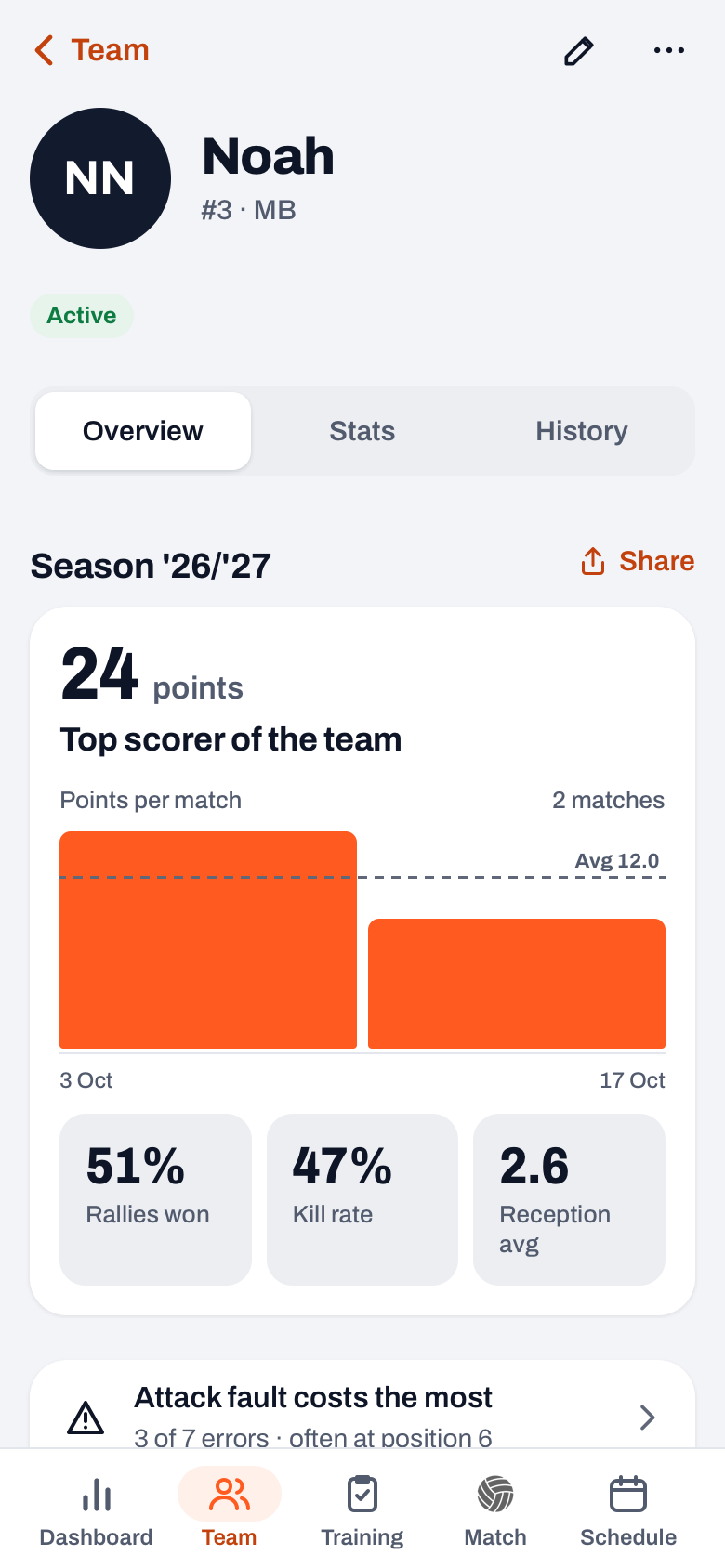
If your club or coach uses Koach, you pay nothing as a player: your account is covered by the team's subscription. For each practice you tap I'm in or Can't make it, with a reason like Work or Injured if you want, and with I'm in for all you sign up in one go for all upcoming practices you have not responded to yet. On your dashboard you see how many practices you made and which drills your coach gave you as homework. If you play matches and your coach tracks them live, your own profile shows how your season is going: your points per match and, once enough has been tracked, how many rallies your team won with you on the court. How your coach uses those figures is in tracking player development.
Your coach tries Koach free for 14 days; what it costs after that is on the pricing page.
14 days free, no credit card. Does your group still organize practices in a group chat? Put the roster in Koach and see after a week who is coming without reading back through a single message.
Try Koach with your teamFrequently asked questions
Are you ever too old to start playing volleyball?
No. There are recreational groups and leagues for all ages, and people who start after fifty learn the basics too. The later you start, the more gradually you build up jumping and hard hitting. If you have a medical condition or have not exercised for a long time, talk to your doctor beforehand, and have persistent complaints checked by a doctor, a sports physician or a physical therapist.
Can I join a league team straight away as an adult beginner?
At the lowest level that is sometimes possible, but most beginners get more out of a season in a recreational group or a course with a coach. There you touch more balls and learn the basics without match pressure. Ask the coach of the league team honestly whether you can keep up and whether new players get playing time.
Do I need to be fit to start playing volleyball?
No. Volleyball consists of short efforts with rest in between, and your fitness grows along with the playing. More important is building up jumping and hard hitting, especially if you have not exercised for years. Take the warm-up seriously and do not go full out at the net at every practice in the first weeks.
Which position should you choose when you start as an adult?
None at first. Play every spot for the first months, so you learn passing, setting and attacking. After that the coach picks a position with you that suits your height, your jump and what you are good at; in a recreational group you often simply rotate through all the positions.
Put your group in Koach
14 days free, no credit card. After a week you know who is coming without reading back through a single message.
Get started with KoachOr read first what the volleyball coaching app does.