
How to prepare for volleyball tryouts as a player
The short answer
When you prepare for volleyball tryouts, know that coaches look less at your hardest spike than at your basics, your effort and how you react to a mistake or a correction. Use the weeks before for extra ball contacts, rest in the last days and pack gear you trust. Arrive early, talk on the court and ask afterwards when you will hear back.
Knowing how to prepare for volleyball tryouts takes some of the nerves away, whether you are walking into a new club or trying out for a spot on a higher team. Here you read what coaches look for on that evening, how to use the weeks before, what to bring and how to show what you can do on the court without forcing it.
Which kind of tryout is it: a trial practice or a selection?
The word tryout covers two very different evenings. At a trial practice you join a club for one or more sessions to see whether it suits you, and whether you suit the club. The coach does watch, but mostly to put you in the right group. At a selection tryout you compete for a spot where there are more candidates than places: a higher team, a select team or a regional squad. Then coaches rate you on fixed points, often with more than one evaluator and a sheet.
If you do not know which of the two it is, ask beforehand. Send the coach or the contact person a short message with four questions: what time should I be there, what should I bring, which positions are you looking for, and when will I hear something? That alone shows you take it seriously. How coaches set up such a day on their side is covered in running volleyball tryouts. It helps to have read that side once.
What do coaches look for at volleyball tryouts?
Players often think it is all about the hard attack. Coaches usually look at something else: what they will get from you over a whole season, and how much room you still have to grow. At a well-run tryout it comes down to a handful of fixed points, roughly these:
- Your basics. Does your pass reach the setter, does your serve go in, is your overhead contact clean? A pass that is playable every time tells a coach more than one beautiful spike.
- How you move. Are you low and ready before the ball arrives, or do you only start moving once it is on its way? Footwork shows in every drill, even when nobody mentions it.
- Coachability. A coach gives you a cue and watches whether you try it on the next ball. It does not have to work straight away, but it has to be visible that you are trying.
- How you react to a mistake. Head down and grumbling, or ready again for the next ball? That stands out more than the mistake itself.
- Talking on the court. Do you call "mine" or "me", do you say who takes the ball? In a group of strangers almost nobody talks, so whoever does stands out.
- What the team needs. If the coach is looking for a setter or a middle blocker, your position counts. With youth players, what you can do in two years often weighs more than your height or strength today.
The weeks before: how to prepare
You will not become a different player in three weeks. What you can do is make sure that on the evening itself you show what you already can. Split the time like this:
| When | What you do |
|---|---|
| Three to four weeks before | As many ball contacts as possible: extra practices, pepper with a friend, passing and setting against a wall on your own. Pick one serve you hit reliably and hit it twenty times every day. |
| Two weeks before | Play game-like drills and small-sided games, so you are used to making decisions under pressure again. Do not learn a new serve or technique now: under pressure that is the first thing to go wrong. |
| The last week | Ease off. No sudden extra jumping or heavy strength work, because with heavy legs you show less. Get to bed on time and eat and drink the way you are used to. |
| The night before | Pack your bag, check the route and the time, and decide what you want to show: three things, not ten. |
A plan for extra reps outside practice, even when you are on your own, is in getting better at volleyball. If you are just back from an injury, only go when you are training fully again without complaints, and tell the coach beforehand. If you have pain that keeps coming back, have a doctor, sports physician or physiotherapist look at it first.
What to bring to volleyball tryouts
- Indoor court shoes that you do not wear outside and that do not leave marks on the floor.
- Knee pads, if you are used to them. Do not wear a new pair for the first time on this evening.
- Sportswear and a spare shirt. A gym is often cold when you walk in and warm an hour later.
- A water bottle and something small to eat afterwards.
- Tape or a brace, if you normally wear one.
Arrive fifteen minutes early. Introduce yourself to the coach, say which position you play and at what level, and be honest about it: whoever overstates their level gets found out in the first drill and spends the rest of the evening making up for it. Use the warm-up for real. A cold shoulder does not hit a good serve.
On the court: show what you can do
- Talk from the first ball. Call every ball you take, even in the warm-up. It costs nothing and it is noticed right away.
- Do the ordinary things well. A high, playable pass is worth more than a hard one that just misses. Hit your reliable serve, not the serve you are learning this month.
- Move between drills. Jog to your spot, help shag balls, do not always stand last in line. Coaches also notice who talks to new teammates.
- Have a routine after a mistake. One short gesture, for example a hand clap and "next", and then get ready again. How to stay on top of nerves is in nerves before a match, and it works the same way at tryouts.
- Ask when something is unclear. A short question about a drill is not a weakness. Doing a drill wrong because you did not dare to ask costs you more.
- Play another position if you are asked to. Say where you prefer to play, but show that you can be used elsewhere. If you are unsure yourself, read which volleyball position suits you.
- Make your teammates better. In a game-like drill the player who stands out is the one who turns a bad pass into a playable ball, not the one who only wants to score.
Pick three things to show before you go. For example: call every ball, get every serve in, be ready again right after every mistake. Afterwards, count for yourself how often you managed it. Then the evening is in your own hands, whatever the coach decides.
Afterwards: two questions, then wait
Thank the coach and ask two questions: when will I hear something, and what do you think I should work on first? You need the answer to the second question even if you do not make the team. After that, do not ask every day how things stand; the coach often still has other candidates to see.
If you are not picked, that is not a verdict on your whole future in the sport. Ask for one or two concrete points and for an alternative, such as another team or training along. How a coach should handle that conversation is in telling a player they did not make the team. Work on those points for a season and try again. For youth players there is one more thing: let parents watch, but not give instructions during practice, and let the player ask the questions afterwards.
A tryout at a club that uses Koach
If your new club works with Koach, the coach puts you on the attendance list for that practice with Add guest player, even if you are not on the team yet. A guest player is a one-time guest: you do not count towards the team's attendance or statistics, so a tryout evening does not produce any numbers about you yet. Players who keep training with the team are added to the roster by the coach.
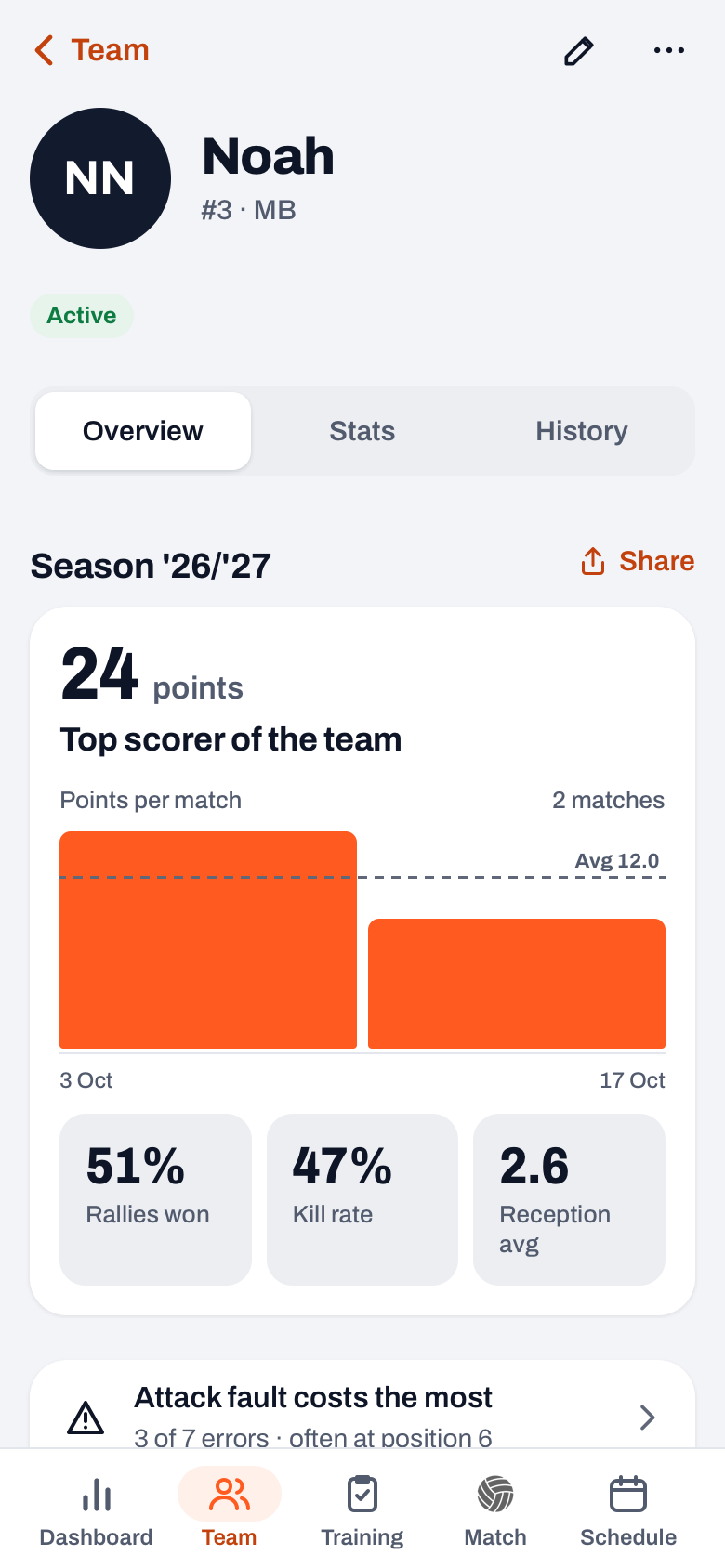
If you make the team, the coach invites you to a player account. As a player you pay nothing for it: your account falls under the team's subscription. In it you see your own profile with Overview, Stats and History: your points per match, your numbers if your coach scores in Expert mode, and a personal goal you fill in yourself. That way you can see over a season whether you are improving on the points the coach mentioned after the tryout. How coaches follow that development is in tracking player development in volleyball.
Is your coach still working with lists on paper? Koach can be tried free for 14 days; what it costs after that is on the pricing page.
14 days free, no credit card. Let your coach track the season in Koach; as a player you see your own numbers and pay nothing.
Take a look at KoachFrequently asked questions
Do you need to know how to play volleyball before a tryout?
Not for a trial practice: the coach mainly looks at which group you fit in, and many clubs have groups for beginners. Say honestly beforehand that you are just starting, so you are not put in a drill for advanced players. For a selection tryout for a higher team you do need the basics: forearm passing, overhead setting and a serve that goes in.
How many trial practices can you do at a volleyball club?
That is up to the club. Often you can train along one or more times before you have to become a member. Ask beforehand how many times, whether you pay for it and what the club arranges if you get injured during such a practice. For a selection tryout the number is usually fixed, for example one evening or a short series of sessions.
What should you do if you are nervous before volleyball tryouts?
Nerves are normal and coaches expect them. Pick three things you want to show beforehand, such as calling every ball and getting every serve in, and focus on those instead of on the result. A fixed routine after a mistake helps you to be ready again for the next ball. Sleep well in the nights before and eat the way you are used to.
Should you pick one position at volleyball tryouts?
Say honestly where you prefer to play and what you have played before, but be open to another spot. Coaches are sometimes looking for a player for a position that is still open, and whoever shows they can be used there has an edge. A player who only wants to play their own position makes the coach's choice harder.



Make your season count
14 days free, no credit card. As a player you pay nothing: your account falls under your team's subscription.
Get started with KoachOr read first what the volleyball coaching app does.