
What volleyball position should I play? How to pick your spot
The short answer
What volleyball position you should play depends more on what you enjoy and do well than on your height. If you like running the game, look at setter; if you want to score, outside hitter or opposite; if you are quick and explosive at the net, middle; and if you stay calm under a hard ball, libero.
What volleyball position should I play? Players often only ask once the coach has already decided. This article helps you think it through yourself: five questions about what you like doing, a profile for each position, an honest answer about the easiest and the hardest spot, and how to try out a position.
Start with what you enjoy, not with your height
Teams often hand out positions by height: the tallest to the middle, the shortest to the back. Height counts, but a position is made up of hundreds of small actions per match, and you have to enjoy doing them. Ask yourself these five questions first:
- Do you want to be involved in almost every rally? The setter plays almost every second ball. The libero and the outside hitters take most of the serves. If you would rather wait for the moment to strike, you belong at the net.
- Would you rather score, or make someone else better? Scoring is the job of the outside hitter, opposite and middle. Making someone else better is the job of the setter and the libero: their good ball becomes someone else's point.
- Which technique comes easiest to you? Overhead passing suits the setter. Forearm passing and defense suit the libero and the outside hitter. Jumping and hitting suit the attackers, and blocking mainly the middle.
- How do you handle errors and pressure? The opposite gets the difficult balls that still have to be put away. The setter has to turn a bad pass into something usable. The libero is ready for the next serve straight after a missed pass.
- Do you like talking and making decisions? The setter runs the offense and the libero calls serve receive. If you would rather do your own job well without directing others, you often feel more at home on a pin.
Only then do height and jump come in. They mainly decide how far you can go in a position, not whether it suits you.
Five positions, five kinds of players
| Position | Suits you if you | What you need to be able to do |
|---|---|---|
| Setter | like running the game and giving the ball to someone else | clean overhead passing, quick feet, choosing under pressure |
| Outside hitter | want to do everything and look for lots of touches | passing and attacking, also on a set that isn't perfect |
| Opposite | want to finish and want the ball when it gets hard | hitting hard and with aim, blocking their outside hitter |
| Middle blocker | like being at the net and are explosive | timing, quick lateral movement, a quick attack |
| Libero | like defending and don't need to score to be happy | passing and defense, reading the game, composure |
What each position does in a rally is covered in volleyball positions explained. Torn between the two pins? Read the difference between an outside hitter and an opposite. And remember that the libero is a position with its own rules: you don't serve, you don't block and you don't attack when the ball is entirely above the top of the net (Rule 19.3.1 of the FIVB Official Volleyball Rules).
Which position suits your height?
At the net height helps, in blocking and attacking. At the top level middle blockers are the tallest on average and liberos and setters the shortest; the numbers per position are in do you have to be tall to play volleyball. On a club team the spread is much wider, and a quick middle of average height is often worth more there than a tall one who arrives late.
If you are left-handed, you often end up at opposite. A set to the right side then arrives on your hitting side, without the ball first having to cross in front of your body. How that works and what it means for your approach is covered in playing volleyball left-handed.
Don't ask for a position, ask for a chance. Tell your coach which position you want to learn and why, and ask if you can practice it for a few weeks in training. A coach says yes to a trial period more easily than to a fixed spot in the match.
What is the easiest and the hardest volleyball position?
There is no easy position. There are positions with fewer different tasks:
- Middle blocker and opposite are usually out of serve receive in a 5-1. That means you take fewer serves. On the other hand, the middle blocks on almost every attack by the opponent, and the opposite also has to put away the difficult balls.
- Libero has the fewest kinds of actions: no attack above the net, no serve, no block. On the other hand, you get the most serves and defensive balls, and every error is visible.
- Setter is often called the hardest position. You play almost every second ball, you decide on every attack who gets it, and your technique has to stay clean even after a bad pass.
- Outside hitter is the most complete role: passing, attacking, blocking and defending, and often against the opponent's strongest block.
If you have just started, don't pick the position with the fewest tasks: learn everything first. A player who can pass, set and attack fits any spot later.
How to try out a new position
- Talk to your coach. Name the position and what draws you to it. A coach knows the team and knows where the gap is.
- Train it in drills first. For a few weeks, the tasks of that position in the practice plan: setting different kinds of balls, passing hard serves, or blocking with footwork.
- Play it in a scrimmage. One set in the new spot tells you more than ten drills, precisely because you have to make decisions there.
- Keep a second position. Players who can handle two spots play more often, also when someone is out sick.
If you are younger than about fourteen, the best answer to the question of which position suits you is: all of them. Why specializing early holds young players back is covered in when a youth player should specialize in one position. How a coach uses match numbers to see which role suits someone is covered in determining a player's strongest role.
Your position and your numbers in Koach
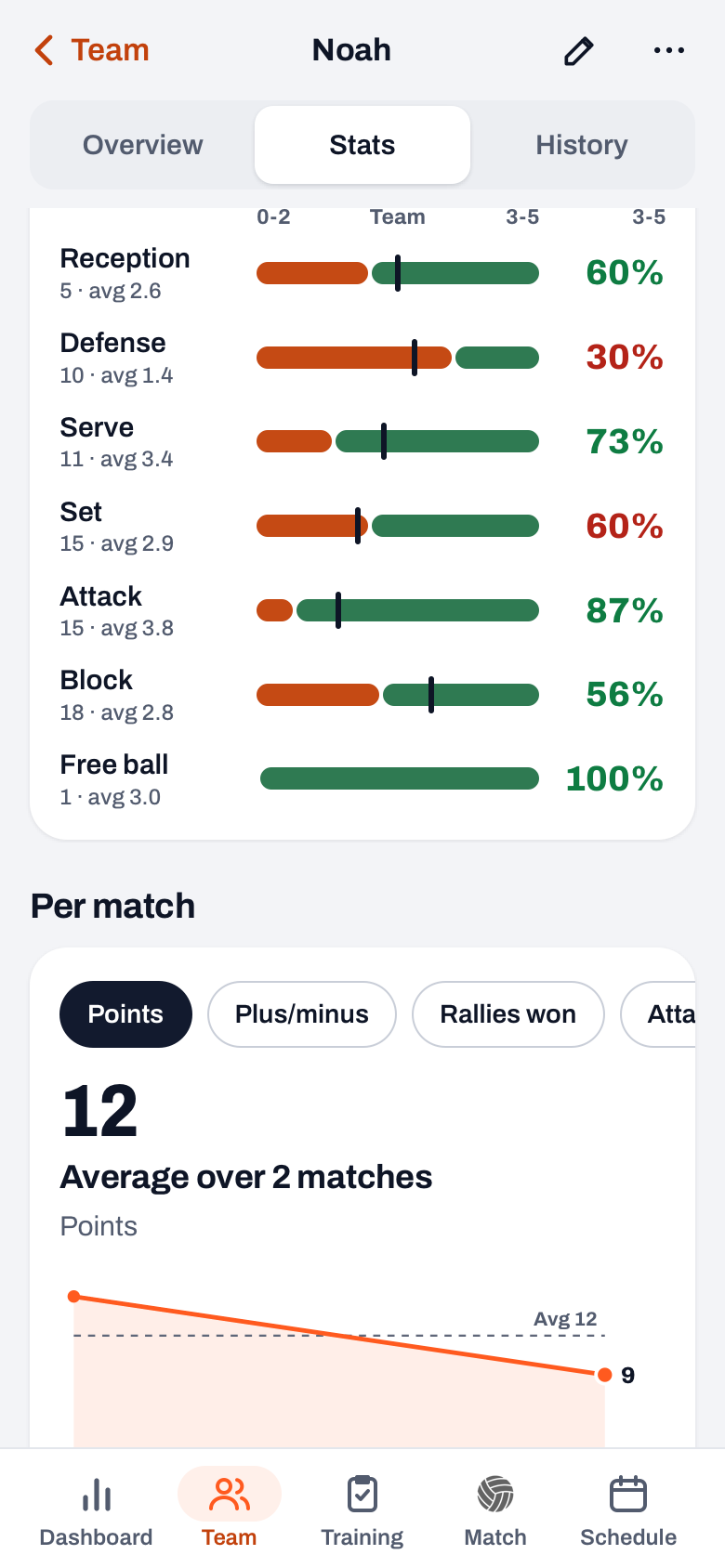
If your team uses Koach, every player has a position, and if the coach fills it in, a second position too. With your own player account you see your own profile. As a player you pay nothing for it: your account falls under your team's subscription. Under Stats, the Ratings 0-5 section shows for each skill (reception, defense, serve, set, attack, block and free ball) the share of good ratings, a 3, 4 or 5, from the matches your coach tracks in Expert mode. That shows you in black and white whether your pass is stronger than your attack, and that is a better start to the conversation about a position than your height.
For the coach this is part of the bigger job: who plays where, who comes to practice, who is improving. How that fits together is covered in managing a volleyball team, and what Koach costs after the 14 free days is on the pricing page.
14 days free, no credit card. If you are a coach, add your team; your players see their own numbers with a player account that falls under your subscription.
Try Koach with your teamFrequently asked questions
What is the easiest position in volleyball?
There is no easy position, but some have fewer different tasks. Middle blockers and the opposite are usually out of serve receive in a 5-1, and the libero doesn't serve, block or attack from above the top of the net. On the other hand, the middle blocks on almost every attack by the opponent and the libero gets the most serves and defensive balls.
What is the hardest position in volleyball?
Setter is named most often. You play almost every second ball, you choose on every attack who gets it, and your technique has to stay clean even after a bad pass. The outside hitter has the most complete role: passing, attacking, blocking and defending, often against the opponent's strongest block.
What volleyball position is best for a short player?
Libero, setter and outside hitter with a strong pass are the usual routes. Height counts most at the net, in blocking and attacking, and least in defense and setting. On a club team shorter players also play at the net, as long as they are quick and time well.
Can I still switch positions as an adult?
Yes. Players switch as adults too, for example from attacker to libero or from outside hitter to setter. Talk it over with your coach, train the new tasks in drills for a few weeks first, and then play a set in the new spot in a scrimmage. Expect it to take time before the new position feels as natural as the old one.

Let your players see their own numbers
14 days free, no credit card. Players pay nothing: their account falls under your subscription.
Get started with KoachOr read first what the volleyball coaching app does.