
Do you have to be tall to play volleyball? Height by position
The short answer
No, you don't have to be tall to play volleyball. Height helps mainly at the net, in blocking and attacking, and counts for more the higher the level. At the top level middle blockers are the tallest and liberos and setters the shortest; on a club team every height has a place.
Do you have to be tall to play volleyball? It is often the first question young players and their parents ask. Here are the averages per position at the top level, what height does and doesn't do at the net, and which routes are open to players who aren't the tallest on the team.
Why height matters in volleyball
The net is at 2.43 meters for men and 2.24 meters for women. At the net it is about the highest point your hand reaches, and that is your standing reach plus your jump. A taller player has a higher reach before they even leave the floor. In blocking that means reaching over the net earlier and further. In attacking it means a higher contact point, and so more room to hit over or around the block.
Further from the net, height counts for much less. Passing, defense and setting are mainly about reading the game, footwork and ball control. A tall player even has to bend deeper to defend low. And for the libero height hardly matters at all: the libero may not serve, block or attack a ball that is entirely above the top of the net (FIVB Rule 19.3.1).
Average height by position at the top level
The most useful numbers come from a study by Palao, Manzanares and Valadés (2014), who analyzed the players at the Olympic Games from 2000 to 2012 and the World Championships from 2002 to 2010: about 2,900 men and women. This was their average height per position:
| Position | Men | Women |
|---|---|---|
| Middle blocker | 2.02 m | 1.86 m |
| Opposite | 1.99 m | 1.85 m |
| Outside hitter | 1.97 m | 1.84 m |
| Setter | 1.92 m | 1.77 m |
| Libero | 1.86 m | 1.71 m |
Source: Palao, Manzanares and Valadés, Journal of Human Kinetics 2014, averages across all participating teams.
The order is the same for men and women: middle blockers the tallest, then opposites, outside hitters, setters and liberos. In feet and inches, the average men's middle blocker is about 6 ft 7.5 in and the average women's libero about 5 ft 7 in. Between the middle and the libero there are 16 centimeters on average for the men and 15 for the women. The average spike reach in the same study was 3.43 meters for the men and 3.01 meters for the women: exactly one meter and just over three quarters of a meter above the top of the net. What spike reach and block reach are exactly is covered in how high volleyball players jump.
A second finding shows that height doesn't explain everything. Among the women, the teams that finished at the top stood out from the rest in height, weight and reach. Among the men it was mainly age: the best teams played with older, experienced players. At a level where everyone is tall, something else decides.
Keep in mind that this is the absolute world elite. In a regional league, a college club team or a recreational group the averages are lower, and you see players of very different heights in every position.
Do you have to be tall to play volleyball?
Not to start, and on most club teams not later either. There is no minimum height in the rules, and at club level the pass, the serve and the number of unforced errors often decide. The higher the level, the more height counts, and not equally in every position:
- Middle blocker: blocking is the main job, so height counts most here. But without quick lateral movement a tall middle arrives too late to block the outside attack.
- Opposite and outside hitter: attacking and blocking need height. The outside hitter also has to pass, and height doesn't help there.
- Setter: height helps in blocking and on a second ball you tip over the net yourself. Hands, feet and decisions count for more.
- Libero: height plays almost no role. Reading, reaction and a stable platform do.
In beach volleyball, with two players per team, the split is often even clearer: one blocks at the net, the other defends the court behind, and the defender is usually the shorter of the two. So there too a shorter player has a role of their own.
What gives a club player more than ten extra centimeters of height: timing, a good approach, smart shot placement and a pass that is the same every week. How a shorter attacker still scores is covered in spiking when you are short.
Measure reach, not just height. If you want to know what a player gets to at the net, measure standing reach and spike reach against a wall. Two players of the same height can differ a lot because of arm length and jump, and you won't see that difference on a height chart.
Not tall? These routes work
- Libero. The position that asks least for height and most for passing and defense. Many teams look for a libero who carries serve receive; the rules are in the libero: rules and role.
- Setter. Touches almost every second ball and decides who attacks. At the top level clearly shorter on average than the attackers, and at club level often the player with the best overview, not the tallest.
- Outside hitter with a strong pass. Teams always need passers. An outside hitter who can handle serve receive and attacks smartly plays a lot, even when the block is bigger.
- Get higher. You can't change your height, but you can change your jump. A better approach and targeted jump training gain you centimeters; see how to jump higher in volleyball.
Not sure which of these spots suits you? Read what volleyball position you should play. That one also looks at personality and what you enjoy doing, not just height.
Youth players: never pick on height alone
Kids don't all grow at the same time. The tallest player on a team of twelve-year-olds is often just an early grower, and classmates who grow later can catch up a few years on. If you give youth players a fixed spot based on their height right now, you put the tall player at the net without them learning to pass, and the short player in the back without them learning to attack. That gap is hard to close by the time they reach senior volleyball.
So let youth players keep training every skill, even if they mostly play in one spot in matches. And expect a temporary dip in timing and coordination during a growth spurt; what happens then is covered in what a growth spurt does to a young player. Questions about growth itself belong with the family doctor or pediatrician, not the coach.
Look at what a player does, not at their height
Height is one number you write down once. What a player does with it you only see when you track what happens in matches. In Koach every player has a profile with their position, jersey number and a season card: points per match and the share of rallies won while they were on the court, and for matches you track in Expert mode also the kill rate and the reception average. That shows you whether the short passer is carrying serve receive, and whether the tall middle's block really counts.
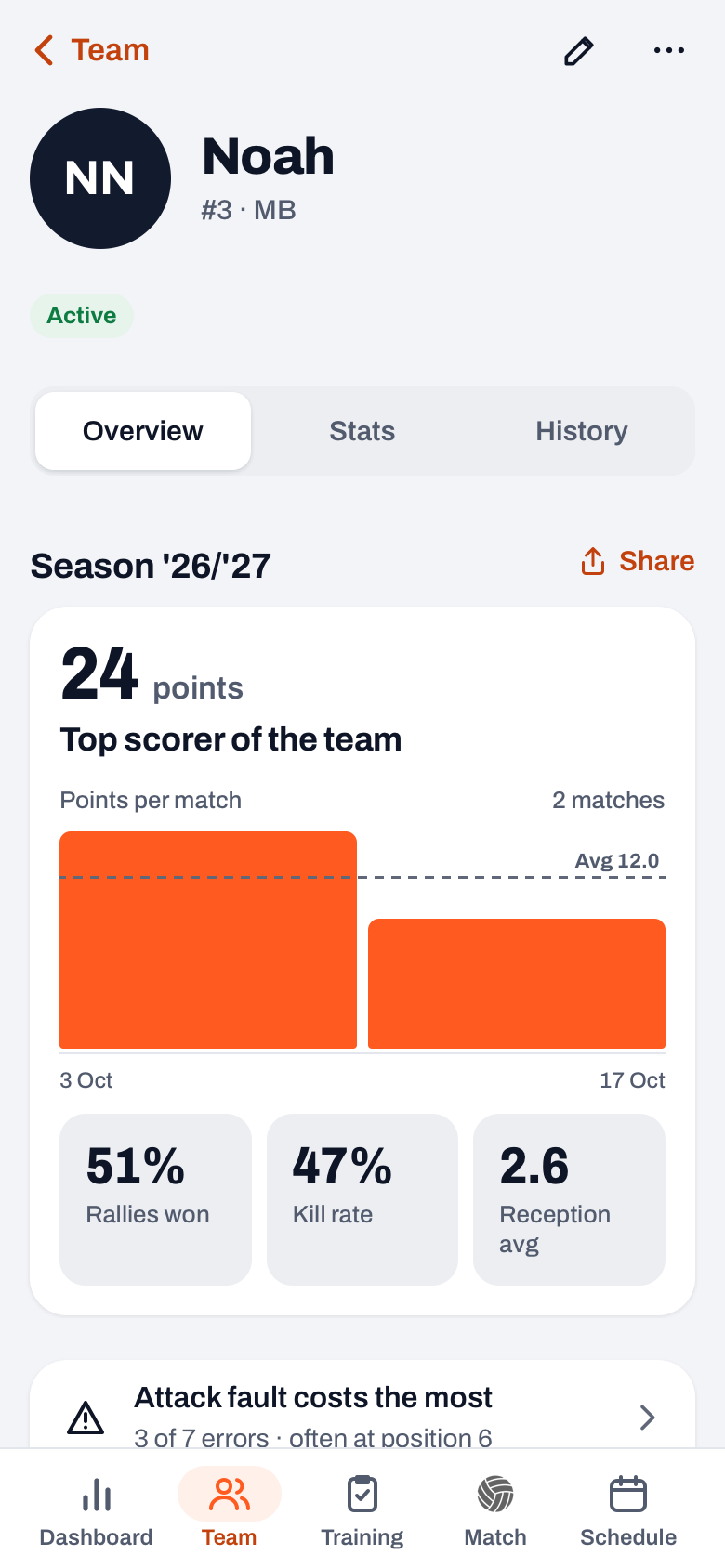
How to use numbers like these over a season without reading too much into them is covered in tracking player development. What Koach costs after the 14 free days is on the pricing page.
14 days free, no credit card. Track a few matches and see who really scores points, regardless of height.
Try Koach with your teamFrequently asked questions
How tall do you have to be to play volleyball?
There is no minimum height: the rules set no requirement and club teams have players of every height. At the top level the differences are large. At the Olympic Games and World Championships from 2000 to 2012, men's middle blockers averaged 2.02 meters and liberos 1.86 meters; for the women it was 1.86 and 1.71 meters.
What volleyball position suits a short player?
Libero is the position where height counts least: you defend and pass, and you may not serve, block or attack a ball that is entirely above the top of the net. Setter and outside hitter with a strong pass are good routes too. At the net you make the difference with timing, a quick set and smart shots past or off the block.
Does volleyball make you taller?
No. As far as is known, volleyball doesn't change your adult height: that depends mainly on genetics, plus nutrition and health while growing up. It doesn't make you shorter either. What volleyball does change is your jump, your reach in the air and your timing. Talk to your family doctor or pediatrician about questions on growth.
Can a short player be a middle blocker?
At club level certainly, as long as they are quick, time well and can run a quick attack with the setter. A fast middle who gets to the outside block on time is worth more than a tall one who arrives late. At the top level it is rare: there middle blockers were on average the tallest players on the team.

See what your players really contribute
14 days free, no credit card. After a month you know who carries serve receive.
Get started with KoachOr read first what the volleyball coaching app does.