
Volleyball spike reach: how high do volleyball players jump?
The short answer
How high do volleyball players jump? At the Olympics and World Championships from 2000 to 2012, the average spike reach was 3.43 meters for men and 3.01 meters for women: about a meter and 77 centimeters above the net. Middle blockers and opposites reach highest, liberos lowest.
Volleyball spike reach is the number that shows how high volleyball players really get. Watch a top match and you see attackers hitting the ball far above the net. Here you read what spike reach and block reach mean, how high the top players get by position and what those figures say about your own jump.
Spike reach, block reach and jump height: three different numbers
In volleyball hardly anyone talks about jump height in centimeters. Teams, federations and scouts talk about reach: the highest point your hand gets to, measured from the floor. That is the number that counts, because the question is not how high you jump, but how far above the net you can hit the ball.
- Standing reach. Feet flat on the floor, one arm as high as possible. That depends on your height and arm length, and barely changes once you have stopped growing.
- Spike reach. The highest point with one hand, after a full approach with arm swing. That is your reach as an attacker.
- Block reach. The highest point with two hands, after a jump from standing or after a few side steps. It is always lower than your spike reach, because there is no approach.
Your jump height itself is the difference: spike reach minus standing reach. Say you are 1.80 meters tall, have a standing reach of 2.33 meters and touch 2.95 meters with an approach. Then you jump 62 centimeters, and your hand gets 52 centimeters above a men's net of 2.43 meters and 71 centimeters above a women's net of 2.24 meters. Those net heights are in rule 2.1 of the FIVB rules. How to measure your own numbers with a wall and chalk is in jumping higher in volleyball.
How high do volleyball players jump at the top level?
Good comparison figures come from a study by Palao, Manzanares and Valadés (2014) of all players at the Olympic Games and World Championships from 2000 through 2012, more than 1,400 men and more than 1,400 women. They used the player data from the FIVB databases. How those values were measured is not stated, so read them as a guide. Averages by position:
| Position | Men: spike / block | Women: spike / block |
|---|---|---|
| Middle blocker | 3.48 / 3.30 m | 3.07 / 2.95 m |
| Opposite | 3.48 / 3.29 m | 3.07 / 2.93 m |
| Outside hitter | 3.45 / 3.27 m | 3.05 / 2.92 m |
| Setter | 3.35 / 3.18 m | 2.94 / 2.82 m |
| Libero | 3.26 / 3.10 m | 2.82 / 2.71 m |
| All positions | 3.43 / 3.25 m | 3.01 / 2.89 m |
Source: Palao, Manzanares and Valadés, Journal of Human Kinetics, 2014.
Subtract the net and you see what those figures mean in the game. A top male player gets his hand on average a meter above the net (3.43 minus 2.43), a top female player 77 centimeters (3.01 minus 2.24). In feet and inches, that average spike reach is about 11 ft 3 in for men and 9 ft 10 in for women. With block reach it is 82 centimeters for men and 65 for women. Reach is the highest point of the hand. You contact the ball itself a little lower and in front of your body, but a player who gets that far above the top of the net can hit the ball steeply down and play it over the fingers of a block.
Why middles reach highest and liberos lowest
The differences by position follow the jobs. Middle blockers block in almost every rally and hit short, fast sets, and opposites are often the attacker who has to put away the difficult ball: that is where the tallest players with the biggest reach are. Outside hitters are just below them; they also pass and defend, and that takes more than height alone. The setter does block, but their value lies in the set. Under the rules the libero may not block and may not complete an attack with a ball that is entirely above the top of the net (rule 19.3.1), so reach hardly matters for them. Liberos are chosen for passing and defense. How height is spread across the positions and whether you have to be tall to play volleyball is in height and volleyball.
A striking finding in the same study: among the men, the reach of the top four teams of a tournament differed by only 3 centimeters from that of the teams from ninth place down (3.44 against 3.41 meters). What did set the best men's teams apart was the age of their players, and the researchers call experience a key factor there. Among the women, the best teams did have the bigger reach (3.06 against 2.98 meters). So among the men at that level, everyone jumps high, and the difference lies elsewhere.
And at club level?
There is no reliable international table for club players. Clubs measure in different ways, and what circulates online is often loose claims without a measuring method. What is clear is that level matters: in a Slovenian study of 253 players from the first and second division, first-division players jumped higher; among the men, outside hitters and setters differed in jump height (among the women they did not), and men got more out of their arm swing than women (Sattler and colleagues, 2015).
So do not compare yourself with World Championship figures, but with two things: the net you play at and your own previous measurement. For youth players the net hangs lower; which height that is differs by country and by age, so check the rules of your own competition. If your spike reach barely gets you above the top of the net, you win more with timing and placement than with hitting hard. How to go about that is in how to spike if you are short.
Work out your own room above the net. Measure your spike reach and subtract the net height of your competition. That number says more about what you can do as an attacker than your jump height in centimeters, and you see right away what ten extra centimeters would mean for you.
How do pros get so high?
- Height and arm length. Most of the reach is already in the standing reach. At the top level in the table, the men averaged 1.97 meters and the women 1.82 meters (Palao and colleagues, 2014). Players are selected on that, and you cannot train it.
- The approach and the arm swing. A good approach turns speed into height, and the arm swing helps the takeoff. Many club players have a lot to gain here; the rhythm is in the spike approach.
- Years of strength and jump training. A review of 32 studies concluded that players on better teams jump higher, that programs with plyometrics can improve the jump and that you need to keep that training going all season to hold on to the gains (Ziv and Lidor, 2010). How to build that up is in jumping higher in volleyball.
- Repetition and timing. A pro has attacked real sets at every practice for years. As a result they hit the ball at the highest point of their jump, and that is something other than just jumping high. A player who is early or late loses part of their reach.
Tracking your jump and your attack in Koach
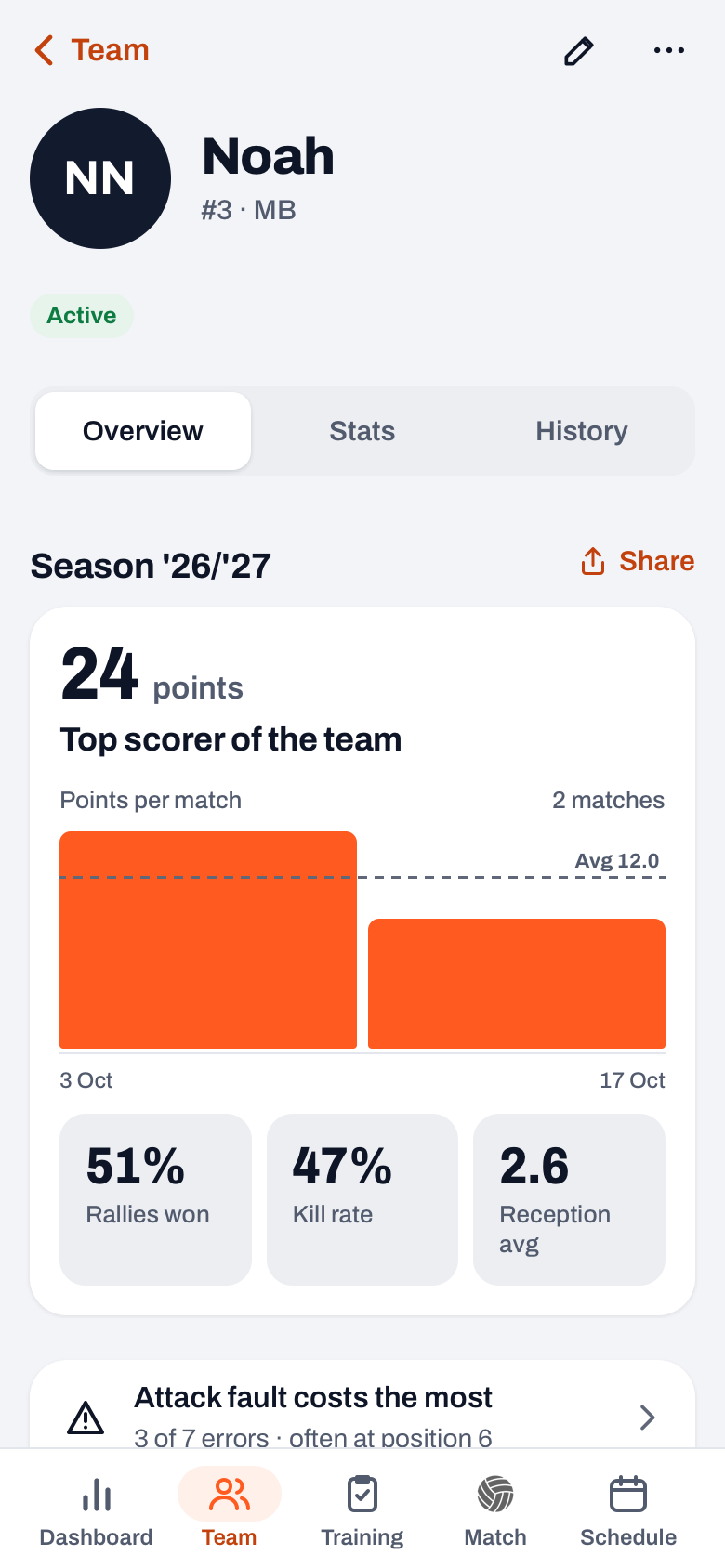
Koach does not measure jump height: for that you need a wall, chalk and a tape measure. What the app does show is whether that jump pays off in the match. If your coach tracks matches live, your player profile shows your points per match, and under Stats your points from attack and block. If your coach scores in Expert mode, you also see your kill rate. You can put your measurement on your profile as a Personal goal, for example a spike reach you want to hit by the end of the season; as a player you edit that goal yourself. That way you keep track of the line of your development, as described in tracking player development.
As a player you pay nothing: your account is covered by your team's subscription. Your coach tries Koach free for 14 days; what it costs after that is on the pricing page.
14 days free, no credit card. Track your matches live and see for each player whether more jump also brings more attack points.
Try Koach with your teamFrequently asked questions
How high does a volleyball player jump on average?
That depends a lot on level and position. At the Olympics and World Championships from 2000 to 2012, men reached an average of 3.43 meters with their hand after an approach and women 3.01 meters, according to a study by Palao and colleagues (2014) based on FIVB data. How many centimeters of jump that is depends on standing reach. There is no reliable international average for club players.
What is the difference between spike reach and block reach?
Spike reach is the highest point you reach with one hand after a full approach with arm swing. Block reach is the highest point with two hands after a jump from standing or after a few side steps. Block reach is lower because you jump without an approach; among the top players in the Palao study the difference averaged 18 centimeters for men and 12 for women.
How far above the net does a volleyball player hit the ball?
At the top level, a man's hand gets on average about a meter above the 2.43-meter net, a woman's about 77 centimeters above the 2.24-meter net. You contact the ball itself a little lower and in front of your body. At club level that is often much less, and there timing and placement win more points than pure height.
Why does a libero jump less high?
A libero does not need to jump high. Under the rules the libero may not block and may not complete an attack with a ball that is entirely above the top of the net. Liberos are chosen for passing, defense and reading the game, and are therefore usually shorter than the attackers. At the top level the libero accordingly had the smallest reach of all positions.


See whether your jump earns points
14 days free, no credit card. After a few matches you see the attack and block points for each player.
Get started with KoachOr read first what the volleyball coaching app does.