
Left-handed volleyball players: position, approach and serve
The short answer
In left-handed volleyball everything you do with one arm is mirrored: the approach becomes right-left-right and the ball belongs in front of your left shoulder. On the right side the set arrives on your hitting side, which is why a lefty often plays opposite. Passing and setting stay the same, because you do those with two hands.
Left-handed volleyball is not harder, just different: nearly all the explanations, drills and coaches assume a right-hander. This article sets out what a left-hander mirrors, where on the court a lefty adds the most, what makes their attack and serve awkward for the opponent, and how you guide them as a coach.
What changes when you play volleyball left-handed?
Less than you think. The forearm pass, the overhead set and the block are played with two hands, so there a left-hander is simply a volleyball player. If you are still learning the basic skills, you find them in learning volleyball technique. The difference is in everything you do with one arm: the attack and the serve. And it is in where the setter stands.
The setter stands in the right front, between position 2 and 3, facing left. A set to position 4 therefore travels from right to left across the court, a set to position 2 from left to right. For a hitter it matters on which side of the body the ball arrives:
| Where you attack | Right-hander | Left-hander |
|---|---|---|
| Left front (position 4) | The ball arrives on the hitting side | The ball has to cross in front of the body to the hitting shoulder |
| Right front (position 2) | The ball has to cross in front of the body to the hitting shoulder | The ball arrives on the hitting side |
| Right back (position 1) | Less natural side | Natural side for the back-row attack |
Why a left-handed volleyball player often plays opposite
On the right side, the set comes to a left-hander exactly the way it comes to a right-hander on the left side: from the setter toward the hitting arm. A lefty can approach at an angle from outside the sideline in, keep the ball in front of the left shoulder and contact it at the highest point, without waiting for the ball to cross in front of the body. A right-hander in that spot has to let the ball come through or hit it early and in front of the head, and that costs height and angles.
That is why the opposite, the hitter on the right who is across from the setter in the rotation, is the classic spot for a left-hander. What else the role asks, from blocking their best outside hitter to setting when the setter plays the first ball, is in the opposite hitter's responsibilities. The difference with the outside hitter, who also passes, is explained in outside hitter or opposite.
A left-hander doesn't have to be an opposite. The left side works too, with two adjustments: approach more square to the net, so the ball can travel to the front of your left shoulder, and ask the setter to put the ball a little further from the antenna, so you have that room. A left-handed middle blocker often finds a quick set behind the setter more natural than one in front, because that ball comes from the left.
The approach of a left-hander: everything mirrored
The rhythm of the approach is the same, the feet are reversed. How the rhythm works and why the last step is short and quick is in the three-step attack approach; for a left-hander you flip every foot:
- Three steps: right, left, right. The first step picks the direction, the second is long and fast, the third closes.
- Two steps: left, right, for a short approach or a quick set.
- Four steps: left, right, left, right, for players who want extra approach speed.
- Arms: the right arm goes up and points at the ball, the left arm swings. After contact the right arm pulls down and in.
A common mistake is not a technical error but a teaching error: the coach demonstrates the right-handed version and says "left foot forward". A left-hander who copies that neatly ends up with the hitting shoulder in front and can no longer swing freely and rotate through. When you demonstrate, stand facing them so they see your mirror image, or let a left-handed teammate show it.
Line or angle: hitting direction for a left-hander
Direction comes from your shoulders and your torso, not from your wrist. That is true for everyone, and the explanation in hitting line or cross-court can be mirrored one to one. For a lefty on the right side it means: the deep and the sharp angle follow naturally from an angled approach with a rotating torso, and the line along the right sideline requires closing the shoulders earlier.
On top of that they have an advantage that has nothing to do with technique. Blockers and defenders mostly see right-handed hitters. In a study by German and Canadian sport scientists, experienced volleyball players and novices predicted the direction of attacks by left-handers on video less accurately than those of right-handers, especially when the footage stopped before ball contact (Loffing and colleagues, 2012). A blocker focuses on the hitting shoulder; against a left-hander, it is on the opposite side from what they are used to.
Let your left-hander attack from the right in every practice too. In many drills the line of hitters is on the left side, and then a lefty only practices their difficult side. Set up a second line on the right and have your setter play the back set there.
Serving as a left-hander
You mirror the serve completely as well. For an overhand serve the right foot is forward, the ball rests on the right hand and you toss it in front of your left shoulder. For an underhand serve you hold the ball in your right hand and swing with the left. For the jump serve and the jump float you mirror the approach, just like in the attack. Which serves there are and when to pick which is in the types of serve.
For the passers on the other side, more changes than for you. If your serve has sidespin, the ball breaks the other way from what they are used to from right-handed servers, and the path from your left shoulder is different too. The effect is biggest on players who rarely face left-handers. So let your own passers receive your lefty's serve now and then, so they recognize that ball in a match.
Tips for the coach of a left-handed player
- Look at the throwing arm. Some kids write with the right hand and throw with the left. The arm someone throws a ball farthest with is their hitting arm. Never force a switch: a learned hitting arm rarely reaches the speed of the natural one.
- Train the set to the right. A left-handed opposite is only as good as your setter's back set. Give that set its own block in every practice.
- Teach your blockers to mirror. If the opponent has a lefty, say so in the team talk. The block lines up on their left shoulder; when they attack from the right, that shoulder is on the inside, so your block stands further inside than against a right-hander. Agree who then covers the line.
- Decide where they play. If you try them on the right and on the left, track how they score in each match. A few weeks of numbers tell you more than an impression from one evening.
Seeing where your left-hander adds the most
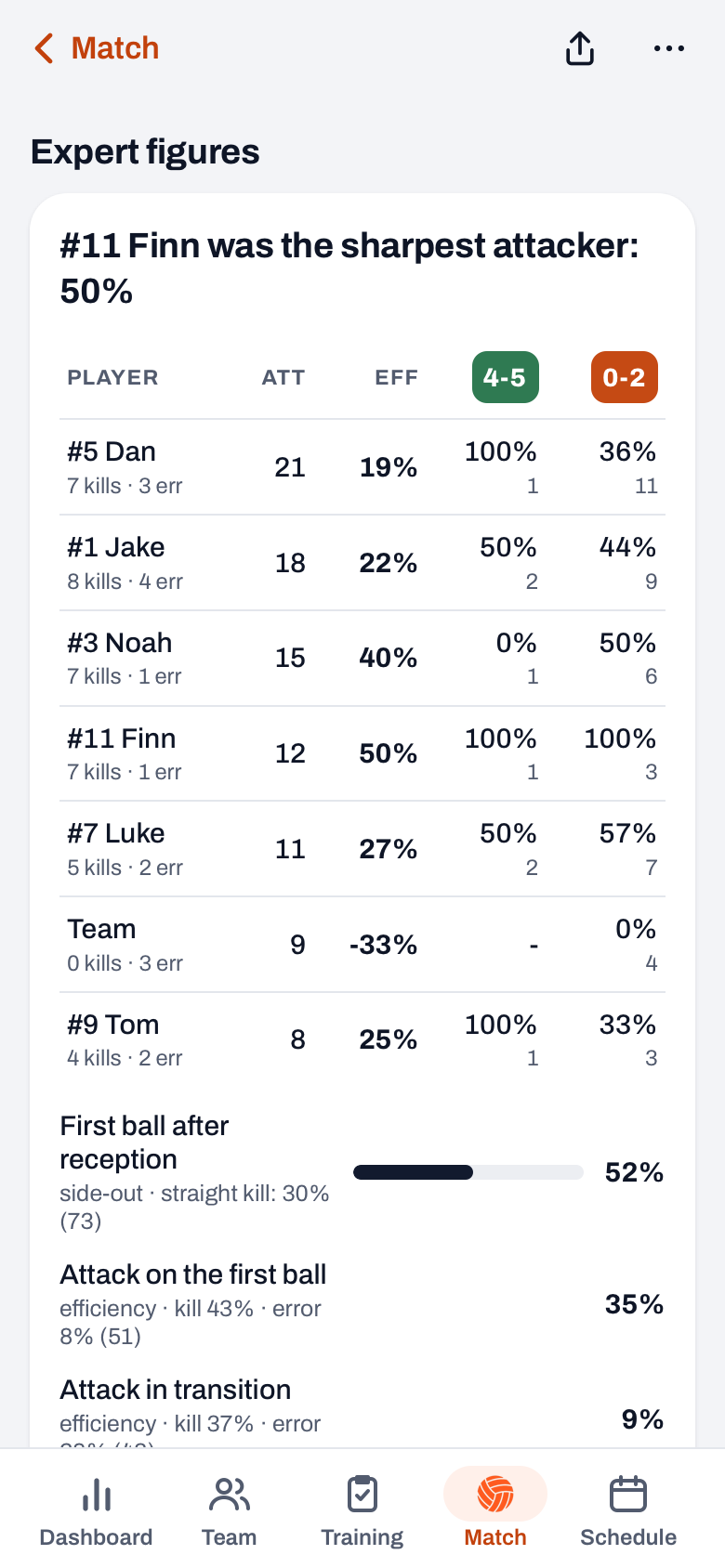
That last tip is something you can measure in Koach. If you track a match in Expert mode, afterwards under Stats, in the Expert figures block, you see for each hitter the attempts, the efficiency and how often they score after a good pass (4 or 5) and after a poor pass (0 to 2). That last one is especially interesting for an opposite: they get the messy balls when the pass fails. Put your lefty on the right for a few matches and on the left for a few, and compare their efficiency.
What Koach costs after the 14 free days is on the pricing page.
14 days free, no credit card. Track your next match in Expert and see whether your left-hander adds more on the right than on the left.
Try Koach with your teamFrequently asked questions
Is being left-handed an advantage in volleyball?
In attack and on the serve it often is. On the right side the set arrives on a left-hander's hitting side, and blockers and defenders read their attack less well because they mostly face right-handers. For passing, setting and blocking it makes little difference, because you use two hands. The advantage is biggest against players who rarely have a left-hander across the net.
What position should a left-handed volleyball player play?
The classic spot is opposite on the right side, because the set travels naturally toward the hitting arm there. But height, jump, passing and personality matter just as much. A left-hander who passes well can be a fine outside hitter, and you also find lefties playing middle or setter.
How does a left-hander approach for a spike?
Mirrored: right, left, right for a three-step approach, left, right for two steps. On the right side the approach starts outside the sideline and angles in, so the ball stays in front of the left shoulder. The right arm points at the ball, the left arm swings.
Should I teach a left-handed child to hit right-handed?
No. Let a child attack and serve with the arm they throw a ball farthest and hardest with. A switched hitting arm rarely reaches the speed and timing of the natural arm. Do make sure you demonstrate the technique mirrored, so the child learns to put the right foot forward.


See where your left-hander scores
14 days free, no credit card. After a few matches you know whether the right side is their spot.
Get started with KoachOr read first what the volleyball coaching app does.