
How to Hit Cross-Court vs Line in Volleyball
Most hitters swing wherever the ball happens to go. A hitter who can choose between line and cross-court is suddenly twice as hard to defend. The secret is not in your hand but in where your upper body is pointing at the moment of contact.
Direction comes from your torso, not your wrist
The classic cue "just steer it with your wrist" is wrong. The wrist puts rotation on the ball and buys you a few degrees of adjustment, no more. The actual direction comes from the position of your shoulders and the rotation of your torso at contact. Wherever your chest is pointing when you strike the ball, that is where the ball goes.
That is good news, because that position can be trained deliberately. And it explains the most common fault immediately: hitters who try to steer with the arm while their torso rotates the other way hit out over the sideline or straight into the block, over and over.
Cross-court: let your torso rotate through
Cross-court is the natural shot for most hitters, because it follows directly from an angled approach. You come from outside in, your torso keeps rotating through the swing toward the opponent's court, and the ball follows.
- Contact point: slightly on the outside of the ball (right side for a right-handed hitter at position 4).
- Torso: keeps rotating actively, with the non-hitting arm pulling down and in.
- Follow-through: the hand finishes diagonally across the body, toward the opposite hip.
The sharp version - a short cross that lands just behind the three-meter line - asks for the same thing, but with a steeper hand over the ball and contact slightly earlier in the jump.
Line: close your shoulders earlier
Line is the ball down the sideline, parallel to the edge of the court. It feels less natural because you have to brake the rotation of your approach. What changes:
- Close the shoulders earlier: turn your chest toward the sideline during the jump instead of toward the middle. This is the main correction - almost everything that goes wrong on line shots comes from here.
- Contact point: on the inside of the ball, and a fraction later than on a cross-court swing.
- Follow-through: straight forward toward the sideline, not across the body.
The margin is small: the strip along the line is often no more than a meter wide, and you are hitting across the narrowest part of the court. So do not hit line flat - hit it with plenty of topspin so the ball dives instead of sailing.
What your approach already decides
A detail that saves a lot of time: the angle of your approach determines which direction is easy. Run sharply from outside in and cross-court is almost automatic while line takes effort. Run straighter at the net and the line opens up while the sharp cross gets harder. Good hitters therefore keep their approach as neutral as possible, precisely so the block cannot read anything from it - because what you can read out of it, the defender on the other side can read too.
When do you choose what?
The choice does not depend on your preference but on what the opponent gives away. Three signals to watch, in the order you see them:
- Where is the block? A blocker with the outside hand well outside the ball is closing the line - hit cross. If that hand is turned in, the line is open.
- Where is the defense? Take one look across before your approach. If the line defender is deep, a short line shot is a gift; if they are up, a deep cross into the corner drops.
- What did you do last time? Twice in the same direction and the third one gets waited for. Switch deliberately, even when the first two were kills.
Which gaps a defense structurally leaves open depends on the system they play - see defensive systems.
The learning order
Learn it in this order and no other: first cross-court until it is stable, then line as a separate skill, and only then choosing in the air. Hitters who learn to "look and decide" too early lose their technique in both directions. Count on a few weeks per direction.
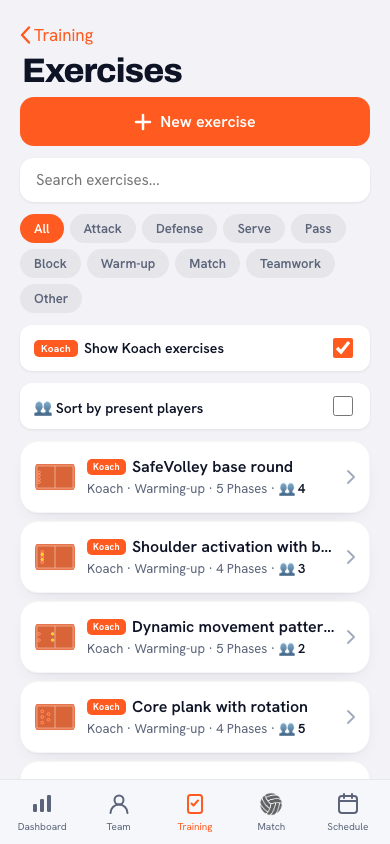
The drill that works fastest: put down two mats, one in the line corner and one deep cross, and have the hitter score alternately on one and the other in series of ten - called out loud by the coach one second before the set arrives. That trains the torso position under time pressure instead of from a standstill. Koach has 200+ built-in drills with animations, including target drills where hitters have to score line and cross-court in the same rally. More formats like it are in the drill library.
The three mistakes you can spot immediately
- Ball flies out over the sideline on a line attempt: you steered with your arm while your torso kept rotating. Close your shoulders earlier.
- Cross-court sails long over the end line: you contact too late and too flat. Contact earlier and get more hand over the top of the ball.
- Your direction is predictable: your approach angle gives you away. Take the same approach for both shots and decide in the air.
Frequently asked questions
How do you hit a ball down the line?
By closing your shoulders earlier: turn your chest toward the sideline during the jump instead of toward the middle, contact the inside of the ball and follow through straight forward. Steering with your wrist or arm alone does not work.
Why do I keep hitting out over the sideline?
Because your arm is steering one way while your torso rotates the other. Direction comes from the upper body - let your torso turn with the direction you choose and use the wrist only for topspin.
Is cross-court or line better?
Neither. Cross gives you more court and therefore more margin, line is shorter and more surprising. What counts is owning both: a hitter with two directions forces the block to choose and becomes more effective in both.
Can you still change direction in the air?
Yes, but only once you own the basics of both shots. Deciding in the air is the third learning step: first stable cross-court, then line as a separate skill, and only then choosing on what the block and defense show you.


Try it yourself in Koach
Less admin, more coaching.
Get started with KoachOr read first what the volleyball coaching app does.