
Outside hitter vs opposite: the difference in volleyball
The short answer
Outside hitter vs opposite: the outside hitter attacks from the left and passes in serve receive, the opposite attacks from the right, lines up opposite the setter and usually stays out of serve receive. The outside is the all-rounder, the opposite the finisher.
Outside hitter vs opposite looks like a question of left or right. Yet the two wing positions ask for a different kind of player: one passes, defends and attacks, the other is there to score, even off bad balls. Here they are side by side, with the question of who you put where.
The difference at a glance
Both positions are wing hitters, but they play on opposite sides of the net and have a different job in every phase of the rally. This is the usual split in a 5-1 with a libero; lower levels and other systems sometimes differ.
| Feature | Outside hitter | Opposite |
|---|---|---|
| Front-row attack | Left, from position 4 | Right, from position 2 |
| Spot in the rotation | Two outsides, opposite each other | Opposite the setter |
| Serve receive | Yes, with the libero | Usually not |
| Back-row attack | From the middle back, the pipe | From right back |
| Mainly blocks against | Their opposite | Their outside hitter |
| Defends in the back row | In 6 or 5, next to the libero | In 1 |
| Second ball | Rarely | Often, when the setter plays the first |
| Core quality | A steady pass and an attack off any ball | Firepower, blocking and calm after errors |
What each position does on its own is covered in detail in what an outside hitter does and what the opposite does. Below we focus on the differences that decide your choice.
Serve receive: where outside hitter and opposite differ most
At higher levels, almost always three players pass: the libero and the two outside hitters. The opposite stays out. There is a reason for that: his approach starts outside the court on the right, and every ball he passes costs him that approach. Keeping him free gives you a hitter in every rotation who can approach without a detour. The outside hitter pays the price: he passes first and only then approaches, often shorter and later than he would like.
On teams that pass with four or five players, the opposite is sometimes in serve receive, usually when he passes better than the weakest outside. Which formation suits your team is in serve receive formations with 3, 4 or 5 players. The rule of thumb stays the same: whoever is in serve receive, you train on passing and attacking in one movement; whoever stays out, you train on scoring off every kind of set.
Spot in the rotation: why the opposite lines up opposite the setter
In a 5-1 system the opposite is three spots away from the setter. When the setter is in the back row, the opposite is in the front row and you have three hitters at the net: outside, middle and opposite. When the setter is in the front row, the opposite is in the back row and attacks from behind the 3-metre line on the right. The two outside hitters also line up opposite each other, so one of them is always in the front row, and the outside in the back row is often the hitter for the pipe.
In other systems the picture changes. In a 4-2 two setters line up opposite each other and there is no fixed opposite. In a 6-2 the setters only set from the back row, and the setter in the front row attacks on the right: there, the setter plays the role of the opposite.
Which balls do they get, and who do they block?
After a good pass, the outside hitter gets a faster set to the left, the opposite a set to the right, often a back set over the setter's head. After a poor pass it changes: whoever is not the setter and has to play the second ball usually looks left, and the high ball to position 4 is the easiest one. That is why the outside hitter gets a lot of hard balls against a closed block. The opposite gets hard balls too, especially in transition and when the setter had to play the first ball himself.
At the block they face each other. The opposite blocks on the right against the opposing outside hitter, often the player who gets the most balls. The outside hitter blocks on the left against their opposite. So for an opposite, height and blocking technique weigh at least as heavily as firepower. How those choices fit the bigger picture is in the basics of volleyball tactics.
Outside hitter or opposite: which player goes where?
If you are torn between two players, look at the pass first, and only then at the swing.
- Outside hitter: the player who passes reliably under pressure, can still put a high ball away against a double block somewhere, and then simply keeps defending. He does not need the hardest swing; he has to be useful in every phase.
- Opposite: the player with the most firepower, who blocks well, who can still hit a set that is too low or too far off the net into the court with control, and who simply wants the next ball after an error. If he can also give a decent overhead set, that saves rallies when the setter plays the first ball.
A left-handed player often ends up at opposite, because the set on the right then arrives on the side of his hitting arm and does not first have to cross in front of his body; more on that in left-handed volleyball. With youth players you do not have to choose yet: let players play both sides until about fifteen, and you will see where someone fits best.
Do not put your best passer at opposite. A team can live with an opposite who hits a little less hard, but not with an outside hitter who cannot handle the serve. If you have one player who can do both, put him on the outside and look for the opposite in your hardest hitter who struggles with passing.
What you train differently with each of them
- Outside hitter: pass and attack in one sequence. Have him pass a serve, turn straight to the outside and attack the ball set off his own pass. Make half the passes deliberately average, because in the match that is exactly when he gets the high ball against two blockers. Finish with defending in 6 or 5.
- Opposite: attacking off bad sets. Run a series where some of the sets come too low, too far off the net or too tight, and only count whether the ball goes into the court with control. Add the back-row attack from right back, blocking against an outside hitter, and a few overhead sets to the left for when the setter plays the first ball.
Do not compare them on the same number
An outside hitter and an opposite get different balls, so their attack number only means something next to the type of ball. For the outside, put his serve receive next to his attack, and for both, look at how they score after a good and after a poor pass. How to calculate such a number is in hitting percentage.
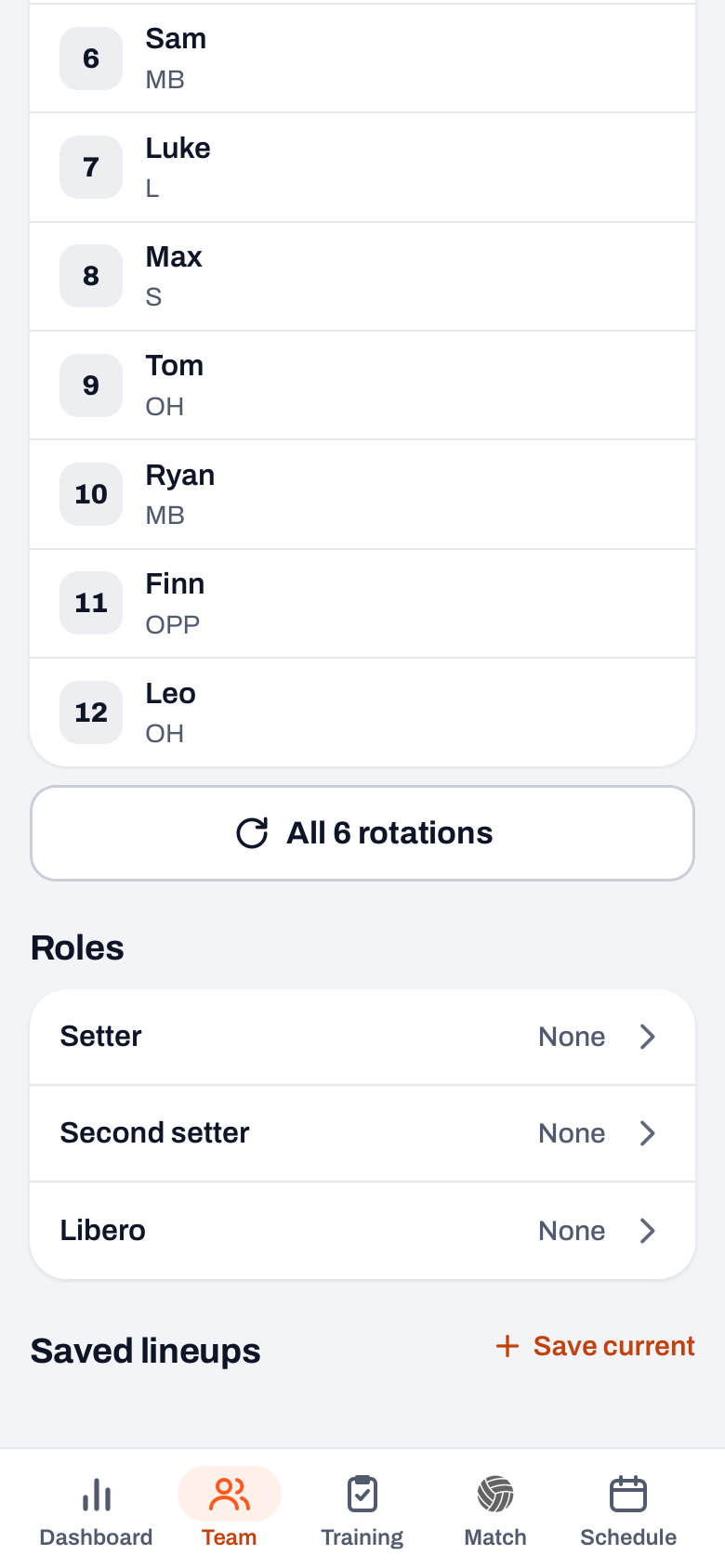
In Koach you give each player a position, such as OH for the outside hitter and OPP for the opposite, and under Roles you assign your setter and libero, for the team and, if needed, per match.
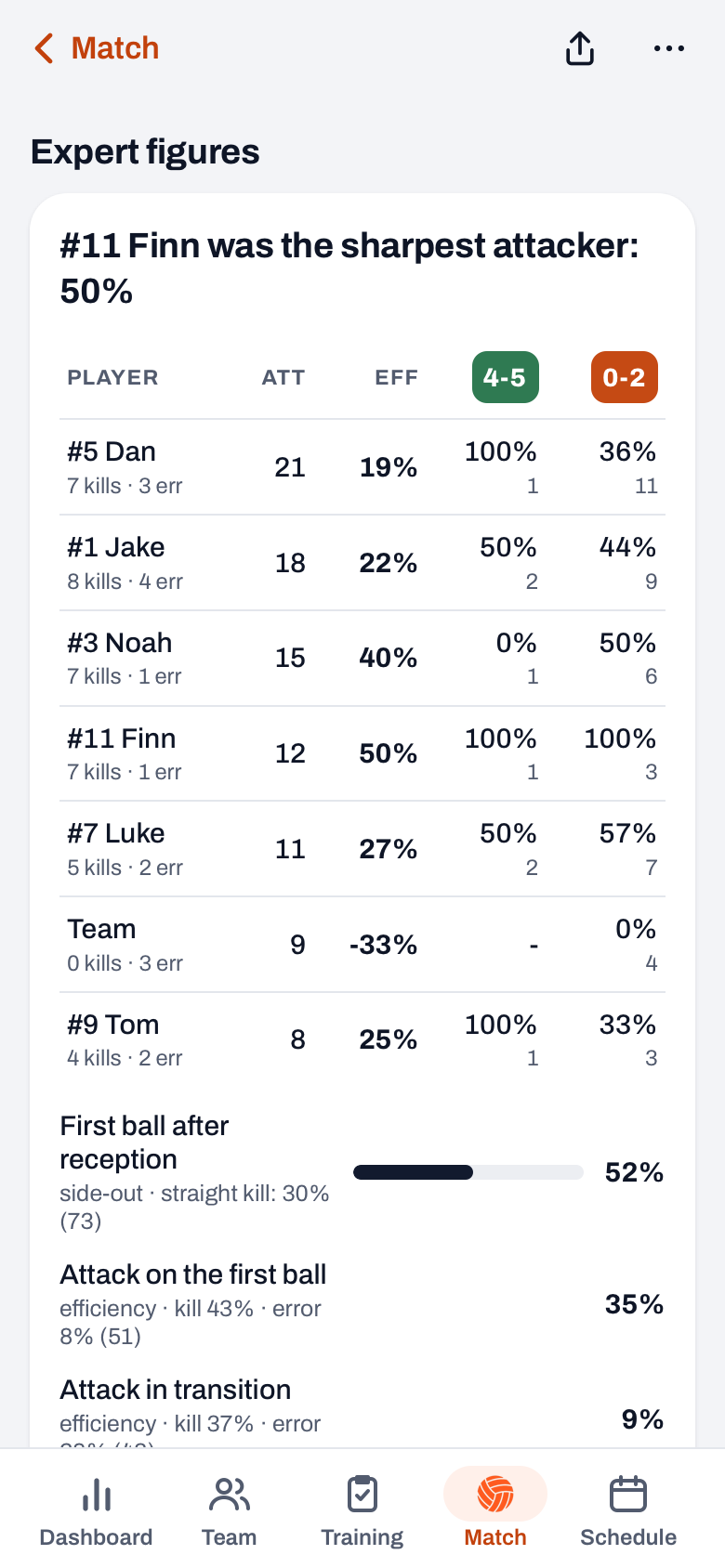
If you track a match in Expert, you give every ball contact a rating from 0 to 5. In that match's Expert figures you see per hitter the number of attempts, the efficiency and how often he scored after a good pass (4-5) and after a poor one (0-2). In the player profile, Ratings 0-5 also shows the serve receive ratings. That way you see whether your outside earns his value in the pass or in the attack, and whether your opposite puts away the hard balls.
What Koach costs after the 14 free days is on the pricing page.
14 days free, no credit card. Track one match in Expert and see whether your outside and your opposite are in the right spot.
Try Koach with your teamFrequently asked questions
Is an opposite the same as a right-side hitter?
Yes. The opposite is also called the right-side hitter, because he lines up opposite the setter in the rotation and attacks from the right. The outside hitter is also called the left-side hitter. On team sheets and in apps you often see the short forms OPP for the opposite and OH for the outside hitter.
Can an outside hitter also play opposite?
Yes, and it happens often when a team is missing an opposite. He then has to get used to an approach from the right, where for a right-hander the ball first has to cross in front of his body to his hitting shoulder, and to blocking against the opposing outside hitter. Let him play it a few times in practice before you ask it of him in a match.
Why does the opposite not pass in serve receive?
Because his approach starts outside the court on the right and every ball he passes costs him that approach. Keeping him free gives you a hitter in every rotation who can approach straight away. On teams that pass with four or five players, the opposite is sometimes in serve receive, especially when he passes better than the weakest outside hitter.
Who scores more points, the outside hitter or the opposite?
That differs by team and by system. On many teams the opposite is the finisher, but on a team with a strong outside hitter, most balls go to him instead. So do not just look at the number of points, but at the efficiency per type of ball, and for the outside hitter also at his serve receive.

Put your wing hitters in the right spot
14 days free, no credit card. After one match you see who scores off which ball.
Get started with KoachOr read first what the volleyball coaching app does.