
How to get better at volleyball: a five-step plan for players
The short answer
How to get better at volleyball: work to a plan. Pick one skill at a time, get extra reps outside practice, ask your coach for specific feedback and play as much as you can. After six weeks, use the same test to check whether it worked, then pick the next point.
How to get better at volleyball is not answered by simply going to practice every week: that mostly makes you better at what you could already do. This is a plan for players, in five steps: pick one thing, get extra reps, ask for specific feedback, play more and measure whether it works.
Why just showing up to practice is not enough
A team practice is made for the team, not for you. In an hour and a half you do drills for everyone, wait for your turn and play a scrimmage in which you mostly do what you are already good at. At your next practice, count how often you play the ball with the skill you find hardest. For most players the number is disappointing.
On top of that, repetition alone is not enough. A player who makes the same mistake a hundred times mostly gets better at that mistake. Players who improve quickly practice with attention: they know on every ball what they are focusing on, they hear whether it worked, and they move to the harder level as soon as the easy one goes well. You can teach yourself that, with a five-step plan.
Step 1: pick one thing to get better at
Work on everything at once and you work on nothing. Pick one skill for the next six weeks, and make it so concrete that you can see whether it works. Not "serve better", but "my serve goes in nine times out of ten, and half of those land in the back half of the court". How to write down a goal like that is in setting a personal goal.
Which skill? Start with what costs your team the most points and what your position asks for most often. For outside hitters, liberos and most beginners that is the pass; for a middle blocker it is more likely the block and the quick attack. Ask your coach too: "What do I need to improve to play more?" gets a more honest answer than "How am I doing?"
| What you want to improve | Extra reps without the team | What to focus on in practice |
|---|---|---|
| Passing and serve receive | Forearm passes against the wall, alternating a ball to the left and to the right | Behind the ball in time, a still platform, the ball at the agreed height |
| Overhand passing | Setting to yourself high, sitting down or against the wall, with the ball in the same spot every time | Hands above your forehead early, playing the ball straight ahead |
| Serve | Ten serves to a fixed target, before or after practice | The same toss every time, and a zone chosen beforehand |
| Attack | Approach and arm swing without a ball, and hitting against the wall | The rhythm of your last two steps, contacting the ball in front of your shoulder |
| Defense | Reaction work with a partner or a ball bouncing off the wall | Being still at the moment the attacker hits, low and with the ball in front of you |
Step 2: get extra reps outside practice
Ten to fifteen minutes, three times a week, is easier to keep up than one long session, and your body sees the movement more often. The advantage of practicing alone: every ball is yours, and you can do the same thing a hundred times without anyone waiting for their turn. A wall is a fine partner for that; series and distances are in volleyball wall drills. If you have no wall, volleyball drills at home shows what you can do in the living room or the backyard.
A second chance lies around practice. Come fifteen minutes early with a teammate and serve twenty balls to each other, or stay five minutes afterwards for a set of passes. Many coaches are fine with that, as long as you ask beforehand.
One rule applies to all extra reps: count them and keep a record. "Twenty passes against the wall without the ball touching the floor" is a goal you can beat next week. "Practicing for a bit" is not.
Step 3: ask for specific feedback
Your coach watches twelve players and may say two sentences to you in an evening. Make those sentences useful. Tell your coach before practice what you are working on, and after a drill ask for one point: "Is my platform too late?" gets an answer you can do something with.
Film yourself with your phone now and then, too, or have a teammate do it: five serves or five attacks, from the side. In a few seconds you see what feels different in your head, such as a toss that keeps drifting left or an arm that is not straight. Show the clip to your coach and ask what they would change first.
One thing per six weeks. Pick one skill, practice it ten extra minutes three times a week and ask your coach for one point of feedback every week. After six weeks, test again. If it works, pick the next point; if it does not, work out why together with your coach.
Step 4: play more, and watch smarter
Matches and scrimmages teach you what no drill can: reading where the ball is going, deciding under pressure, working together. The more you play, the faster that comes. In summer, play beach volleyball or on grass, where with two or three players per team you touch the ball far more often, and join a recreational group or a tournament if you get little playing time on your own team.
Watching counts too, if you do it with a question. For ten rallies, watch only the player in your position: where do they stand when the ball is on the other side, when do they start to move, what are they looking at? You can also practice a movement in your head, for example your serve routine before going to sleep; how that works is in visualization and self-talk for volleyball players.
Step 5: measure whether it works
Without a measurement you do not know after six weeks whether you are better, only whether it feels that way. Do a simple test at the start and repeat it exactly the same way at the end: ten serves to one zone, the number of passes against the wall without an error, or how many overhand balls in a row you keep in the same spot. Same distance, same ball, at the same point in practice.
Also look at what happens in the match, because that is where it has to work in the end. Compare yourself with yourself, not with the best player on the team. How to follow your own line through the season is in tracking your own progress as a volleyball player.
Your own stats in Koach
If your team uses Koach and your coach tracks matches live, your own player profile gives you a starting point for step 1. Under Stats you see your errors by type, such as Bad pass or Service fault. If your coach scores in Expert mode, you also see Ratings 0-5 for each skill, from reception to free ball, and if your weakest skill gets fewer than half good ratings, your overview names it in one sentence. You set your Personal goal on your profile yourself, and whatever your coach gives you as homework is on your dashboard. How your coach uses all those figures is in tracking player development.
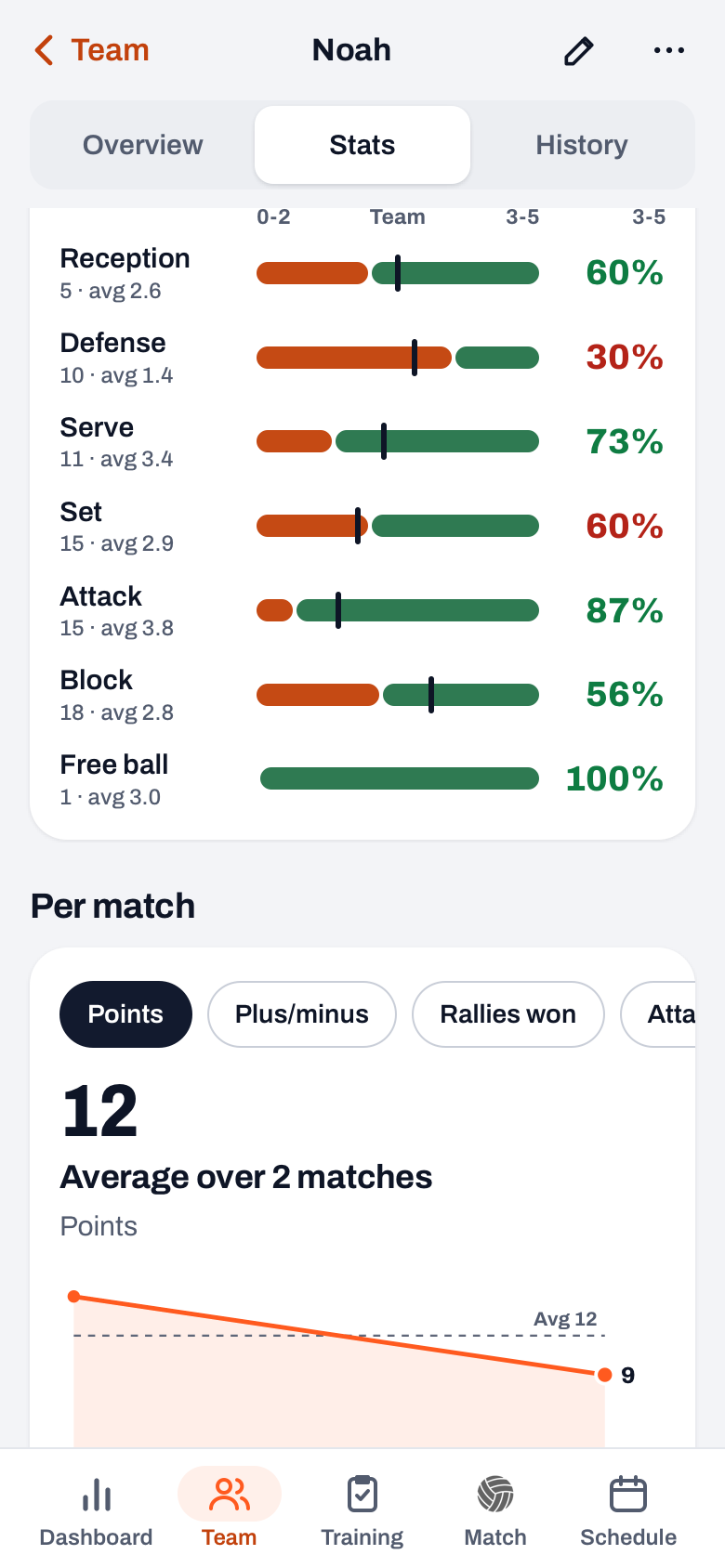
As a player you pay nothing: your account is covered by your team's subscription. Your coach tries Koach free for 14 days; what it costs after that is on the pricing page.
14 days free, no credit card. Score a few matches and give every player their own starting point for their plan.
Try Koach with your teamFrequently asked questions
How fast can you get better at volleyball?
That differs by player and by skill. If you pick one thing and practice it for an extra fifteen minutes three times a week, in most cases you notice a difference in a simple test, such as passes against the wall, within a few weeks. Making it work in the match takes longer, because there you play under pressure and with less time.
Can you get better at volleyball on your own?
Partly. Ball control, your serve, your approach and your fitness can all be trained alone, against a wall or in the backyard. Reading the game, making decisions and working together you only learn in a game with others. So combine extra reps on your own with as much playing time as you can get in scrimmages, matches or on the sand in summer.
How do you get better if you get little playing time?
Ask your coach honestly what you need to improve to play more, and turn that into your plan. Get extra reps outside practice and find playing time elsewhere, for example in a recreational group, at tournaments or with beach volleyball in summer. At practice, be the player who takes every drill seriously: a coach notices that.
What should you improve first in volleyball?
Start with what costs your team the most points and what your position asks for most often. For outside hitters, liberos and most beginners that is the pass, because every rally in which your team receives serve starts with it. Ask your coach which skill will pay off most for you, and work on it in a focused way for six weeks.

Give every player a starting point
14 days free, no credit card. After a few matches every player sees where their plan begins.
Get started with KoachOr read first what the volleyball coaching app does.