How to Coach a Volleyball Team With Different Skill Levels
In an average club team the gap between the best and the weakest player is wide enough that they are effectively playing different sports. Yet they stand in the same gym twice a week, and the same drill has to mean something to both of them.
Splitting the group is almost never the answer
The first reflex with a big skill gap is to divide the group: the advanced players on one court, the rest on the other. It rarely works. You only have one coach, so half your group is permanently unsupervised. And the social price is high: everyone knows within one evening which court is the B court, and the players standing there train with the handbrake on from that moment onwards.
There is one exception: a block of ten to fifteen minutes where a small group does something specific — the two beginners passing at the wall while the rest run a hitting sequence. Short, targeted, and back together afterwards. A permanent split gives you two half teams.
Four ways to differentiate inside one drill
- The requirement. Everyone runs the same passing drill, but the advanced player has to pass into the target and the beginner only has to keep it playable towards the net. Same ball, same movement, different bar.
- The distance or the space. Serving from the end line or from three meters inside it. Defending a nine-meter width or a three-meter lane. Space is the easiest dial and the least conspicuous.
- The role. In a game format not everyone has to do the same thing. The beginner is the fixed passer, the advanced player has to pass and hit. The role scales without anybody standing out.
- The scoring. Give players their own points target: whoever owns the drill plays to 15, whoever is learning it plays to 8. Both teams finish at the same time and the game stays competitive.
What these four have in common: the drill itself does not change. So you explain it once, and the organisation stays simple. That is exactly why differentiating inside a block works better than splitting the group — more on that in practice blocks.
A fifth dial that often gets forgotten: the number of repetitions. Where the advanced player rotates out after ten balls, the beginner may take fifteen or twenty. That costs you nothing organisationally — you simply let one line rotate more slowly — and it is precisely what a player who is behind needs: not easier work, but more work on the same thing.
Three drills with three levels built in
| Drill | Beginner | Intermediate | Strongest players |
|---|---|---|---|
| Serve and pass | Underhand serve from 3 m inside the line; pass playable towards the net | Overhand serve from the line; pass into the front zone | Jump serve to a called zone; pass into a 2-by-2 m target |
| Hitting from position 4 | Swinging off the floor after a toss | Three-step approach, high set, free direction | Blocker added, hitter has to call line or angle |
| Defence | Ball is tossed, defending a 3 m lane | Coach swings, whole half court | Live hitter choosing between hard, tip and the seam |
Challenging your best players without losing the rest
Differentiating is usually about the bottom end, but the top end matters just as much. A strong player who trains at half speed for months goes backwards and eventually leaves for another team. Three changes that cost almost nothing:
- Give them a handicap instead of more volume. Only scoring off an attack from behind the three-meter line, or only tipping with the off hand.
- Make them responsible for a team-mate. A strong player who gets to coach one beginner during the drill starts understanding the game in a different way — and you gain an extra pair of eyes.
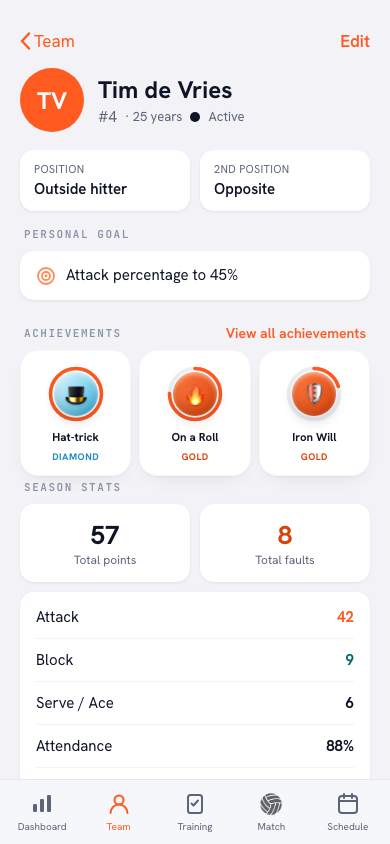
- Give them a goal of their own. Not "train hard", but something measurable for this block: fifty percent of attacks down the line, or three serves per set into zone 1. How to set and follow goals like that is in a personal goal per player.
The conversation with the group
Differentiating only works if it is not a secret. Simply say that you work with different requirements and why: everyone trains at the edge of what they can do, and that edge sits in a different place for everyone. Teams that hear it stated openly handle it surprisingly maturely — and the discussion about playing time gets more honest too, because it becomes about your own development instead of about comparison. That reasoning is worked out further in dividing playing time fairly.
Measure per player, not per team. A team with six levels has no meaningful team average. Judge everyone against their own starting point; otherwise the same player finishes bottom of the same list every year and nothing ever changes about their motivation.
Frequently asked questions
When is splitting the group a good idea after all?
For a short, specific block of ten to fifteen minutes with a second coach present, or when the gap is so wide that a beginner makes no successful contact at all in a game format. Keep it temporary and bring the group back together afterwards.
How do I stop the beginners feeling excluded?
By making the different requirements explicit and normal: everyone has their own bar and it is said out loud. What excludes people is not the adapted requirement, but the feeling that something different is quietly expected of them.
Can strong players go backwards in a weak team?
If they structurally train at half speed, yes. Give them a handicap, a coaching role or a measurable goal of their own; then practice sits at the edge of their ability too.