How to Spike If You Are Short in Volleyball: Angles
Every team has them: hitters with a clean swing who run into a wall the moment a block goes up. Height helps in volleyball, but it decides less than everyone assumes. If you cannot get over the block, you go around it, past it or through it - and all three are learnable skills.
What height does and does not decide
What counts at the net is not your height but your reach in the air: standing height plus arm reach plus jump. Ten centimeters of body height can partly be bought back with ten centimeters of jump, and an efficient approach is worth ten to twenty centimeters that most players are simply leaving on the floor. That is the first place to look before you change anything about how you play.
But even with a maximum jump the gap stays, and that is where the heart of this article kicks in: the ball does not have to go over the block. It only has to hit the floor, and the court is nine by nine meters while a block is not even two meters wide.
Weapon 1: attack earlier than the block expects
A block is only dangerous once it is up. Every tenth of a second you take away from the blocker costs them height: a blocker still moving, or jumping late, does not get their hands over the net. That is exactly what a lower, faster tempo does.
Concretely: ask your setter for a lower, quicker ball - half a meter above the band instead of two meters above it - and leave earlier on your approach. You give up some margin for yourself, but the block loses more. A faster tempo takes rehearsal with your setter, but it costs you nothing in jump. Undersized middle blockers score entire seasons on this principle.
Weapon 2: angles instead of height
If you cannot go over the block, you go around it. Two angles are worth the most:
- The sharp cross-court. From position 4, a short sharp ball toward the opponent's position 4 that lands just behind the three-meter line. You are hitting around the outside of the block, and that ball is barely defendable because it falls so short.
- The line shot past the block. When the block sits inside, the strip along the sideline is often only a meter wide - enough, as long as you close your shoulders toward the sideline in time.
For both: contact is not on the top-middle of the ball but slightly on the side, and your torso turns with it. Anyone trying to steer with the arm alone hits out, over and over.
Weapon 3: using the block instead of avoiding it
The third route runs straight through the opponent. A wipe - deliberately playing the ball off the outside blocking hand and out - is not an emergency move for shorter hitters but a primary weapon, precisely because they are often contacting at the same height as those hands. And when the block is big and closed, there is almost always an empty patch behind it: the territory of the tip and roll shot.
Contact in front of the shoulder, not above it
There is one technical detail that weighs more heavily for shorter hitters than for tall ones. Contact the ball directly above your head and the only shot left is a steep one down - and steep down, from a lower contact point, means into the net. So contact the ball clearly in front of your hitting shoulder and swing flat through it, with plenty of topspin, aimed at the back three meters of the court. A flat ball with rotation landing at six meters is harder to dig than a half-speed ball you tried to place steeply.
Attacking from the back row
The underrated option: from behind the three-meter line, height matters far less. You get a long approach, you contact the ball well away from the net, and the block can barely commit to you because it has to cover the front row first. For a hitter who keeps getting stuffed up front, a solid back-row attack is often the fastest route back to scoring.
Pick three shots and train them
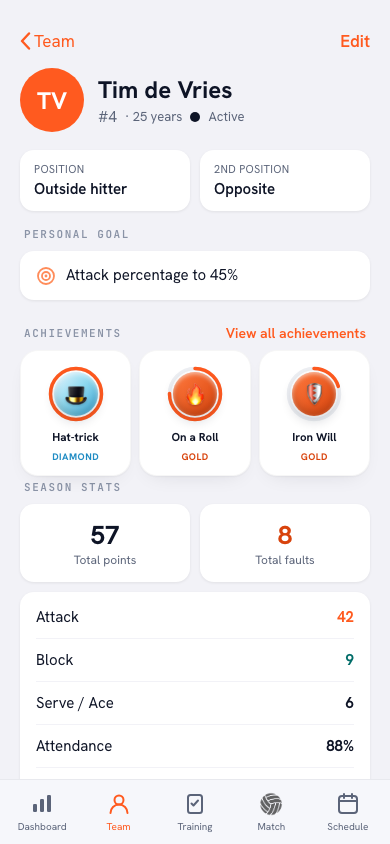
The practical approach: sit down with your hitter and pick three concrete solutions - say the sharp cross-court, the wipe and the deep roll shot - and train only those until they show up in a match without thinking. Three shots you own beat ten you half-know. Koach lets you set a personal season goal per player, and "three shots I can score with" is one of the best ones a shorter hitter can pick - it keeps the choice alive in January instead of dying with the session it was made in.
Then judge the return, not the spectacle. A hitter who reaches a thirty percent hitting percentage on smart shots is worth more than one who hammers away and stalls at ten.
Frequently asked questions
Can you spike well if you are under 1.75 meters tall?
Yes, but with different weapons. Timing, sharp angles, using the block and a proper approach matter more than height. Plenty of shorter hitters score on a faster tempo, simply because the block never gets up in time.
What is the best shot for a shorter hitter?
The sharp cross-court that lands just behind the three-meter line. You hit around the outside of the block instead of over it, and the ball falls so short that the defense is usually not standing there.
Should I just train my jump then?
Jump training helps, but technique first: a correct approach with a double arm swing is worth ten to twenty centimeters for most players. Once the rhythm is in place, additional jump work is worth the time.
How do I stop hitting into the block?
Look at the blocker's hands during your jump instead of only at the ball. If the block is closed, deliberately pick the outside hand or the space behind it, and save the full swing for the balls the block is late on.