
How to tell a player they didn't make the team: what to say
Of all the jobs a coach has, this is the heaviest: telling someone who gave everything that they didn't make it. The conversation takes ten minutes and often decides whether that player is still playing volleyball three years from now. Here is how to run it without falling back on clichés or half-truths.
Prepare this conversation like a match
Most cut conversations don't fail on the message, they fail on the preparation. A player who hears "sorry, you're not in the squad this year" in the car park only remembers that last part. So decide three things in advance and write them down: why this player is being cut (two concrete points at most), what you are offering instead (the second team, training with the top group, a moment when you look again) and when you will come back to it. A conversation you improvise almost always ends in vagueness, and players and parents translate vagueness straight back into favouritism.
Choose the format deliberately too. A phone call or a face-to-face is the standard; a text is at most an announcement ("I'll call you tomorrow evening about the selection"). Never publish the list first and hold the conversations afterwards — then the player hears it from a teammate. And do it fast: every day that half the group knows and the other half doesn't undermines your version of events.
The conversation in four steps
- Say it straight away. No five minutes of small talk about the weather. "I'm calling about the selection and I don't have good news: you're not in the top team this season." Then leave a silence — the player needs a moment to let it land.
- Give two concrete reasons. Not "the level was really high", but "across the four tryout sessions your passing was less consistent under pressure than the other candidates" and "we had one spot left and it had to go to a middle blocker".
- Name what there is. A place in the second team with a clear role, one session a week with the top group, or a specific development point with a date when you look again (the mid-season break is a logical checkpoint).
- Ask what they make of it. Close with an open question and leave room for anger or tears. A player who gets to tell his side doesn't have to tell it later in the locker room or on social media.
Allow ten to fifteen minutes per player. Don't stack them all into one evening — after the fifth call you sound like an answering machine, and the sixth player hears it.
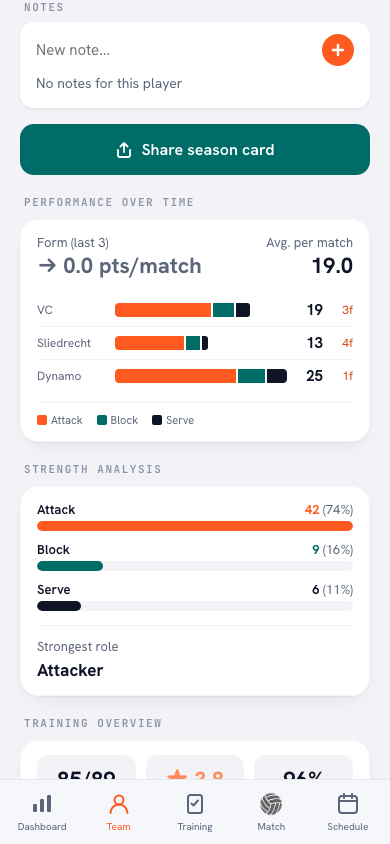
The difference between a conversation that lands and one that escalates is almost always the evidence behind it. If you logged notes and effort scores per player during the tryout sessions in Koach, you can point at something concrete instead of a gut feeling. How to set your criteria beforehand and run the day itself is in organising a tryout day; the way you build that judgement closely resembles what happens with a promotion recommendation.
Four sentences to avoid
- "It was really close." Only say it if it is true. If it isn't, you give the player a false picture of what he has to do to make it next year.
- "I wanted you in, but..." Pushing responsibility onto the selection committee makes you less credible as a coach. Own the decision, even when you didn't take it alone.
- "Next year you'll definitely be in." A promise you can't keep costs you your credibility with an entire age group twelve months later.
- "You're too short." Always translate things nobody can change into skill and behaviour: blocking reach, movement speed, positioning in defence.
With youth players: talk to the child and to the parents
With youth selections you are really holding two conversations. With the child: short, warm, concrete and aimed at the next step ("you're going to play in team 2 and you'll be one of the players it runs through"). With the parents: the same message, but with the factual reasoning and the alternative alongside it. Do it in that order and preferably with both in the room, so there aren't two versions circulating at home. Agree within the club beforehand who answers objections — nothing undermines a selection faster than three assessors each telling a different story. And be honest about what has been decided and what is still open; kids see straight through half a story.
The week after decides whether you lose the player
A cut that is delivered well but then goes quiet still feels like being dumped. So organise the follow-up: have the other team's coach make contact within a few days, turn up yourself at one of that group's practices or matches, and stick to the review moment you agreed. If you're short of players later in the season, call the player you cut in August — that conversation is suddenly a lot easier, precisely because the first one was honest. And run the next development review against the same criteria: that is when you find out whether your development point actually gave them something to hold on to.
Rule of thumb: a cut has been delivered well if the player can retell it to his parents in two sentences, including the why and the next step. If he can't, you weren't clear enough — however pleasant the conversation felt.
Frequently asked questions
Should I explain why another player was picked instead?
Only discuss the player sitting in front of you, never the qualities or shortcomings of teammates. Do explain which role or position the team needed, because that makes the choice traceable without you talking about anyone else.
What do I do if a player or parent reacts angrily?
Let the first reaction come without defending yourself, then calmly repeat your two reasons. If it keeps escalating, close the conversation and offer a follow-up with a third person present, for example someone from the club's technical committee.
How far in advance should I communicate cuts?
Within a week of the last tryout session, and always before the team list is published anywhere. Call later than that and you are talking to a player who already heard it from a teammate.