Is the Line In or Out in Volleyball? The Ball on the Line
The ball lands on the end line, half the gym shouts 'out' and the other half shouts 'in'. The rule is crystal clear, so the argument is pointless — although there is more subtlety in judging it than most players think.
The rule: the line is part of the court
The ball is in as soon as it touches the floor of the playing court, including the boundary lines (rule 8.3). Those lines are 5 centimetres wide and are drawn inside the dimensions of the court: the 18 by 9 metres is measured to the outer edge of the lines. So a ball that touches the line by even a millimetre is in.
The flip side is in rule 8.4.1: the ball is out when the part of the ball that touches the floor is completely outside the boundary lines. So it is not about where the ball appears to land, but about the contact patch on the floor. The court measurements and all the lines are in the dimensions of a volleyball court.
Where the contact patch is
A volleyball is not a point but a sphere that flattens on landing. That flattened patch — easily ten to fifteen centimetres wide on a hard-driven ball — is what counts. A ball dropping at an angle that looks to the eye as if it landed beside the line can still touch the line with its contact patch. That is why a line judge does not watch the ball in the air but the moment it lands, ideally sighting along the line from the side.
Two stubborn misconceptions you can take out of your team:
- "It bounced into the court, so it was in." Nonsense. Where the ball goes after the bounce is determined by spin and says nothing about the point of contact.
- "I saw daylight between the ball and the line." From an angle you never see the contact patch; that observation is physically unreliable.
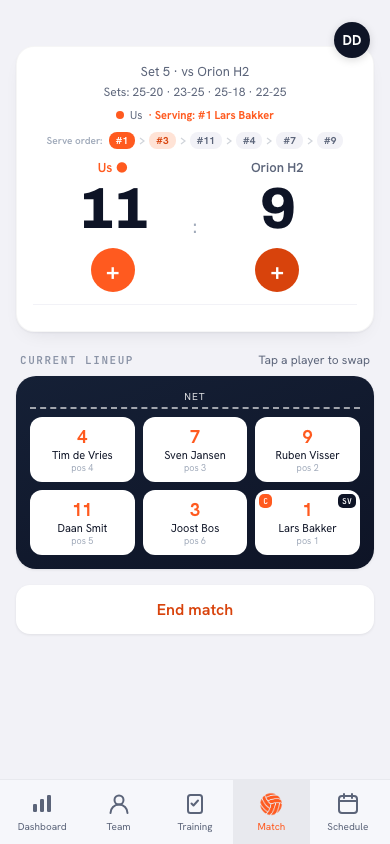
One line call can swing a set — if you score live in Koach you can read back afterwards on exactly which rally it turned.
Who decides what
The first referee decides, always. At higher levels two or four line judges help out: flag down means in, flag up means out, flag up with a tap on the top means 'touched' (the ball is out, but off the block or a defender), and waving along the end line indicates a foot fault by the server. The first referee may overrule a flag signal; that causes outrage in the stands but is entirely correct. All the signals are in the referee hand signals explained.
In regional competition there are no line judges and often only one referee, looking across the court at an angle. That explains why line calls are more debatable there — not because the rule is different, but because there are literally fewer eyes. At the very top there is also a video challenge, where the coach may ask for a review a limited number of times per set.
Different lines, different consequences
Not every line works the same way:
- The boundary lines (sidelines and end line): part of the court — a ball on them is in.
- The attack line (three-metre line): belongs to the front zone. A back-row player who takes off with a heel on the line takes off in the front zone and commits a fault — see the three-metre line rules.
- The end line on the serve: part of the court and therefore forbidden ground for the server — see the foot fault on the serve.
- The centre line: belongs to both halves of the court, which is why both teams may touch it.
How to organise the calling
Most points lost on line balls do not come from bad refereeing decisions but from players letting a ball drop that landed in. Three agreements that solve it:
- The player nearest the line calls it. Not the player nearest the ball — they are watching the ball, not the line.
- When in doubt: play it. A ball you play that was out costs you nothing; a ball you leave that was in costs you a point.
- Only call 'out' once the ball is past. Call too early and you leave a ball based on a read that turned out to be just wrong.
In youth and mini volleyball exactly the same rule applies: lines are part of the court. Mini volleyball is played on reduced courts often marked out with ribbons — in which case the agreement beforehand is that the ribbon itself is part of the court too. The complete rules overview is in all the volleyball rules at a glance.
Frequently asked questions
Is a ball on the line in or out?
In. The boundary lines are 5 centimetres wide and are part of the playing court, so a ball that touches the line at all is in. That applies to the sidelines as well as the end line.
What exactly does the referee look at?
The part of the ball that touches the floor. A ball flattens on landing, and that contact patch decides the call — not where it bounces afterwards or how it looks to be dropping from the side.
Is the three-metre line part of the court too?
The three-metre line is not a boundary line but belongs to the front zone. So for a back-row player wanting to attack above net height, taking off on the line means taking off in the front zone, and that is a fault.
May the referee overrule a line judge?
Yes. The first referee always decides and may set a flag signal aside. That is entirely within the rules, even if it often causes surprise on the sideline.