
Kinesiology tape in volleyball: what it does and doesn't do
The short answer
Kinesiology tape in volleyball does little, according to systematic reviews: for shoulder and knee pain it works no better than a sham tape, and there is no convincing evidence that it adds strength or jump height. It can be part of a treatment, but it does not replace exercise therapy or an adjusted load.
You see kinesiology tape in volleyball in every gym: colored strips on a shoulder, around a knee or along the lower back. But what does that tape really do? Here you read what research shows, why it sits on shoulders and knees in particular and when you are better off leaving it in your bag.
What is kinesiology tape?
Kinesiology tape, often just called kinesio tape, is an elastic, self-adhesive cotton tape with no active substances in it; that is how the Cochrane review discussed further down describes it. It stretches with your skin and lets the joint move freely. That is where it differs from the firm, non-elastic athletic tape you put around a finger or an ankle: that tape is meant to limit a movement. When to use that firm tape is covered in taping fingers in volleyball, and for the ankle in ankle brace, tape or nothing.
The technique was developed in the 1970s. The promises are big: the tape is said to support injured muscles and joints and to relieve pain by lifting the skin slightly, which would let blood and lymph flow better. That is how Williams and colleagues (2012) sum up the claims in their meta-analysis. The question is what is left of them once you measure.
What does the research say about kinesiology tape?
Dozens of studies have been done, and the systematic reviews reach the same conclusion: if there is an effect, it is small.
- No better than sham tape. A systematic review of 12 randomized trials with 495 participants, including people with shoulder and knee pain, found that kinesiology tape worked no better than a placebo tape or other treatments. Where the tape did score better, the difference was small and probably not meaningful (Parreira and colleagues, 2014).
- The shoulder. The Cochrane review on taping for rotator cuff problems, the muscles and tendons around your shoulder joint, pooled 23 studies with 1054 adults. The evidence was of very low certainty and pointed to little or no benefit compared with sham taping or other treatments (Gianola and colleagues, 2021).
- Long-lasting pain. For pain that had lasted more than four weeks, tape gave slightly more pain relief than doing next to nothing, but no more than other treatments (Lim and Tay, 2015).
- Strength and jumping. In healthy adults the tape does not make muscles stronger: a meta-analysis of 19 studies found a negligible effect (Csapo and Alegre, 2015). For jumping, sprinting and other performance in healthy athletes, a review of 15 studies found no convincing evidence (Reneker and colleagues, 2018).
These studies are about people with complaints and about athletes in general, not about volleyball players in particular.
Why do you see kinesiology tape so often on shoulders and knees?
Three reasons, and none of them is that the tape has been shown to work there.
- That is where the load is. An attacker hits with the same shoulder at every practice and every match, and every jump and landing ends up on the knees. That makes shoulder problems and a nagging knee just below the kneecap familiar volleyball complaints. How to recognize them and adjust the load is covered in shoulder problems in volleyball and knee pain in volleyball.
- Visibility. The tape became much better known after it was donated to 58 countries for the 2008 Olympic Games and showed up on well-known athletes (Williams and colleagues, 2012). What you see on TV, you see in your own gym a season later.
- It feels like support. The tape pulls slightly on the skin, and some players say it helps them feel their shoulder or knee better, or makes them feel more confident. That feeling is real, but it is not the same as a joint that is more stable or better protected.
When is kinesiology tape pointless?
- As prevention in a healthy player. Williams and colleagues found little good evidence that kinesiology tape helps prevent sports injuries. Your time is better spent on a warm-up with strength, balance and landing technique.
- To get stronger or jump higher. See the research above: the effect on strength was negligible, and for jumping and speed convincing evidence is missing.
- With a fresh injury. A knee that swells up, a shoulder that seems to have popped out or an arm you can no longer lift: have that assessed first by a family doctor, sports physician or physiotherapist. A player who tapes it and plays on still doesn't know what is damaged.
- Instead of exercise and dosing. With an overloaded shoulder or knee, the approach is about less of the load that hurts and gradually building strength. Tape can at most go alongside that, never in its place.
- If your skin reacts. Itching, redness or blisters under the tape: take it off, and don't stick it on the same spot again.
If a physiotherapist applies tape as part of a treatment with exercises, you don't need to push back as a coach. You do make two agreements: the tape goes alongside the recovery plan, and the player stays honest about pain. If the pain builds during practice, the player stops that drill, tape or no tape. Persistent or severe complaints belong with a family doctor, sports physician or physiotherapist.
Ask about the plan, not the tape. When a player shows up with a strip on their shoulder, ask who applied it and what is happening alongside the tape: which exercises, how many hits or jumps per practice, when the next check-up is. If they have been taping the same complaint themselves for weeks, that is the moment to have it assessed by a physiotherapist or sports physician.
Can you play a match with kinesiology tape?
The international rules don't mention tape by name. They forbid objects that may cause injury or give a player an artificial advantage (rule 4.5.1 of the Official Volleyball Rules 2025-2028). In the FIVB Casebook 2025, tape is in fact named as the solution: a ring that could cause injury must come off or be taped over (case 1.2). A strip of elastic tape on the skin therefore normally does not fall under what the rules forbid, but that is an interpretation, not a rule that names tape. What applies in your competition can differ by country, federation or league. If in doubt, ask the referee before the match.
What you can do as a coach at practice
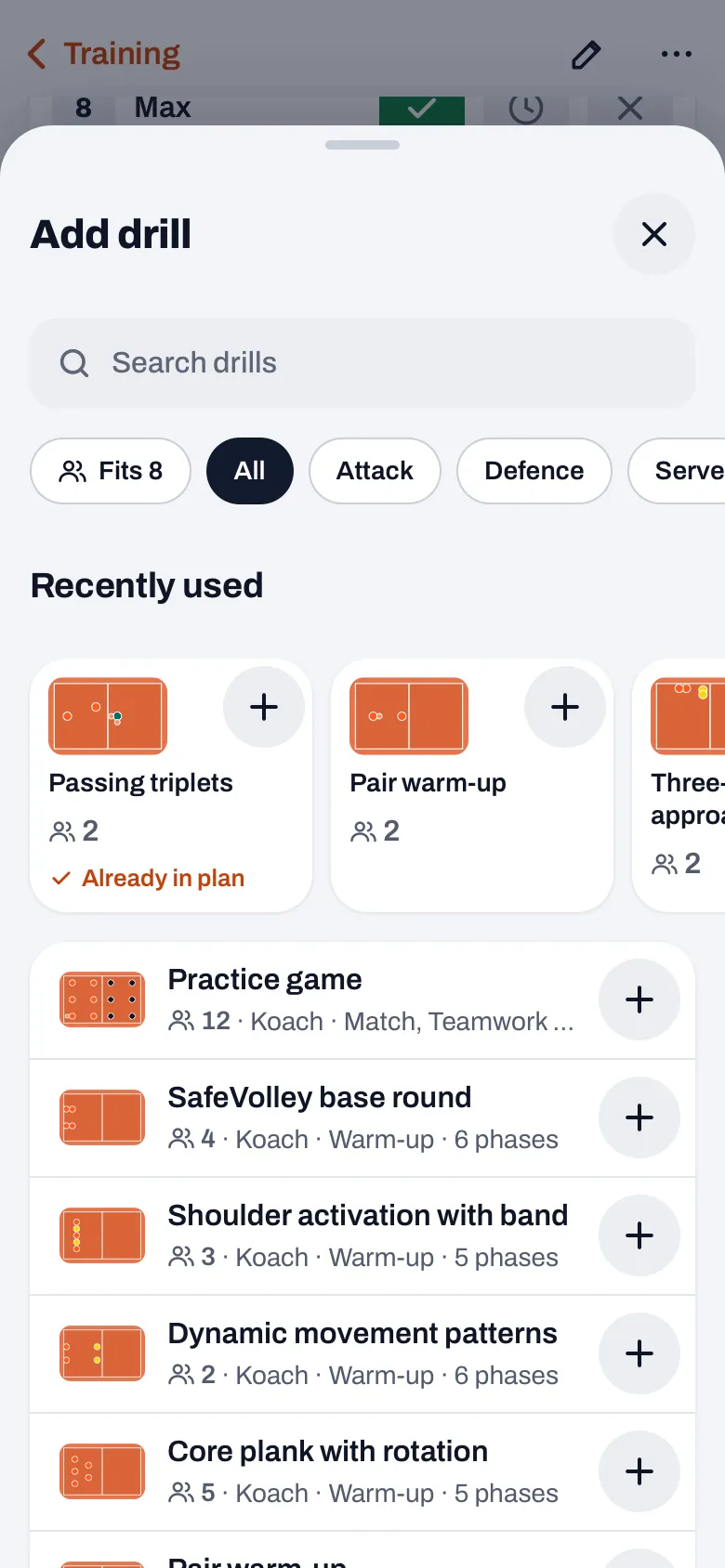
If you want to do something for your attackers' shoulders, a fixed spot for shoulder work in the warm-up is a better use of your attention than a roll of tape. In Koach you add a drill to your practice plan with Add drill. The list includes Shoulder activation with band, a warm-up in 5 phases with a resistance band: pull-aparts, external rotation and raises in a Y, T and W shape. In the gym you walk through it phase by phase, with a diagram on the court for each phase. More band exercises are in resistance band exercises for volleyball.
If you have just started coaching, starting as a volleyball coach covers what to arrange from the first week besides the practices. What Koach costs after the trial is on the pricing page.
14 days free, no credit card. Put a shoulder warm-up in your next practice tonight and see after four weeks what it does for your team.
Try Koach with your teamFrequently asked questions
Is kinesiology tape the same as athletic tape?
No. Kinesiology tape is elastic: it stretches with your skin and lets the joint move freely. Regular athletic tape is firm and doesn't stretch. You use it precisely to limit a movement, for example with a sprained finger or an ankle. If you are looking for support for a joint, kinesiology tape won't give you much.
Does kinesiology tape help with shoulder pain in volleyball?
Systematic reviews find little to no effect. The Cochrane review on rotator cuff problems pooled 23 studies and rated the evidence as very uncertain, with little or no benefit compared with sham tape or other treatments. If you have shoulder pain that doesn't go away or gets worse, have it assessed by a family doctor, sports physician or physiotherapist.
Do you jump higher with kinesiology tape?
There is no convincing evidence for that. A meta-analysis of 19 studies found that the tape doesn't make healthy muscles stronger, and a review of 15 studies in healthy athletes found no convincing evidence for better jumps, sprints or other performance. If you want to jump higher, you get more out of strength training and jump work that is built up gradually.
Can you wear kinesiology tape in a volleyball match?
The international FIVB rules don't mention tape by name. They only forbid objects that may cause injury or give a player an artificial advantage (rule 4.5.1). The FIVB Casebook even names taping over as the solution for a ring. What applies in your competition can differ by country or federation. If in doubt, ask the referee before the match.


Put a shoulder warm-up in your practice
14 days free, no credit card. After a few weeks you know whether it fits your practice.
Get started with KoachOr read first what the volleyball coaching app does.