
Queen of the Court Volleyball Drill: Rules and Variations
Queen of the Court is the game format that works at every level: you need half a gym, a ball and at least six players, and after two minutes of explaining it runs itself. The skill is not in the rules — it is in what you change about them.
What Queen of the Court is
Queen of the Court (also known as King of the Court) is a rotating game in which one side of the net is the queen's side. The team standing there defends its spot; the challengers line up on the other side. If the queen's side wins the rally, that team banks a point and the challengers walk off for the next team waiting. If the challenger wins, they swap sides and become queen themselves — with no point, because points are only scored on the queen's side.
That single rule changes everything. A drill in which you would normally just play on after losing a point becomes a format where every rally has a consequence: you lose your spot, or you earn it. There is no queue worth the name, no team ever stands watching for five minutes, and the tempo is set entirely by the coach feeding the next ball.
The setup: court, numbers and flow
- Court: the full width for 3-on-3, or half a court lengthwise for 2-on-2. Four teams of three on a regular court is plenty.
- Numbers: from six players up (three pairs), ideally nine to fifteen (three to five teams of three).
- Starting the rally: the challengers start. At beginner level with a free ball they toss in themselves, at higher level with a real serve.
- Scoring: every team keeps its own running total, out loud. First team to 10 or 12 wins, or put a fifteen-minute clock on it.
- Rotating: the losing team on the queen's side jogs around and joins the back of the line; the next team steps straight in on the challenger side.
As the coach you stand next to the challenger side with a ball cart. You feed the next ball the moment the new team has both feet inside the court — not sooner, not later. Do that consistently and there are at most five seconds between rallies, which puts a player on sixty contacts in a quarter of an hour without trying. The arithmetic behind that is in more contacts per player.
What you correct in it
The format runs itself, which leaves your hands free to watch. Three things go wrong with practically every team:
- The first ball. Teams play a tossed ball far too flat and far too far off the net. Demand that the first contact goes at least two meters above the band and lands within three meters of the net. Without that demand the whole thing turns into a tipping contest.
- Three contacts. On a small court, batting it straight back is the path of least resistance. Make three contacts compulsory; breaking that is a point for the other side.
- The silence. Whoever takes the second ball calls for it — before the first ball is played, not after. If the calling dries up, stop the drill for thirty seconds and restart it.
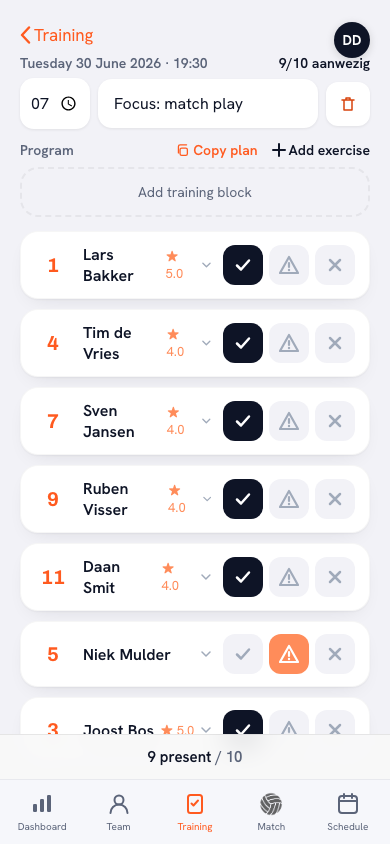
Add Queen of the Court as a block in your Koach practice plan and note afterwards which team held the court; a few weeks in, you can see at a glance whether the same three players always finish on top.
Four variations
1. Serve instead of free ball. The challengers start with a real serve from the end line. Immediately much heavier: the queen's side now has to pass instead of simply receive a toss, and the number of rallies per minute drops. Use this version when you want to put serve receive under pressure.
2. Back-row attacks count double. Every rally won is one point, but a rally finished with an attack from behind the three-meter line counts for two. That steers the whole format towards setting high balls off the net instead of dumping everything on top of it.
3. The winner swaps a player. The team that takes the court trades one player with the team that just got knocked off. The line-ups keep shifting, strong players do not automatically end up together, and nobody can hide behind a good team-mate.
4. Wash scoring. The queen's side has to win two rallies in a row for one point; lose the second and the first is wiped out. This scoring makes the format a great deal heavier mentally — the background is in the wash drill.
You can go the other way just as easily: bigger courts, smaller teams, the coach feeding the ball on the queen's side and the compulsory third contact removed. With a youth group that barely manages a rally yet, let them catch and throw the first ball — at least then there is a game.
When to use it
Queen of the Court is a closer, not a teaching tool for technique. Put it in the last block of the session, after twenty minutes in which you trained the same theme in isolation, and make the variation match your practice focus. Did you train serving pressure? Then run the serve version. Did you train high balls to the pin? Then an attack from position 4 counts double. That way the most enjoyable format of the evening is also the one in which the focus comes back — exactly the build described in practice blocks.
Cut it off at its peak. Twenty minutes of Queen of the Court is nearly always enough. Stop while there is still shouting and laughing; then they ask for it themselves next week.
Frequently asked questions
How many players do you need as a minimum for Queen of the Court?
Six: three teams of two on half a court lengthwise. The format runs best with nine to fifteen players, because then there is always exactly one team ready and the wait stays around ten seconds.
What is the difference between Queen of the Court and King of the Court?
Nothing in substance; they are two names for the same rotating game. Some gyms also call the 2-on-2 version on half a court the winners' court, or simply winner-stays-on.
Is the queen's side allowed to serve?
Not in the standard version: the challengers start every rally, so the queen's side always has to side out to keep its spot. If you want the queens working on serving pressure too, alternate who starts and keep the scoring the same.