
Second positions: using players flexibly
On paper you have a backup for every position. Until the Saturday your opposite is sick, your second setter is off skiing and you suddenly have a puzzle on your hands. Players with a well-trained second position are the cheapest insurance there is.
Why dual roles are worth so much
A roster of twelve covers six court positions twice — in theory. In practice, availability is fickle: injuries, work shifts, exams. Every player who masters two positions doubles your lineup options without growing your roster. It also makes players better: whoever has played opposite understands, back at outside hitter, what their own opposite needs.
Which combinations work?
- Outside hitter ↔ opposite: the classic — similar attacking task, other side of the court.
- Middle blocker → opposite: for the middle with a heavy arm who lacks the blocking tempo.
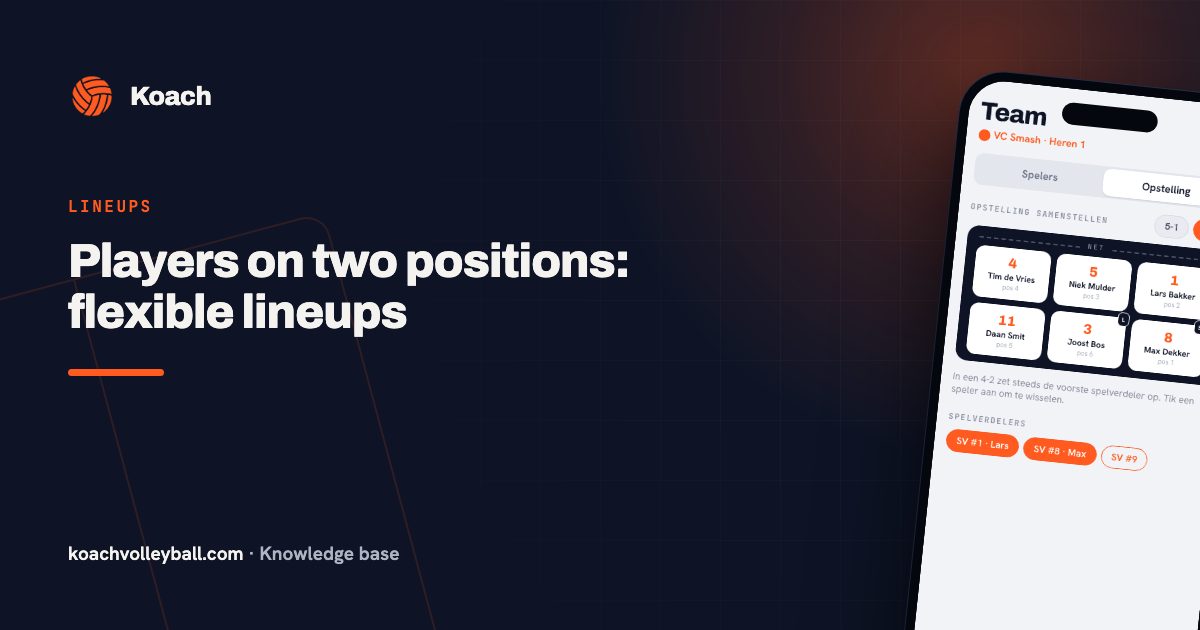
- Setter → outside hitter: rare but gold in a 4-2 that turns into a 5-1 halfway through.
- Outside hitter → libero: your best passer can take over the shirt when the libero is missing.
Recording and training
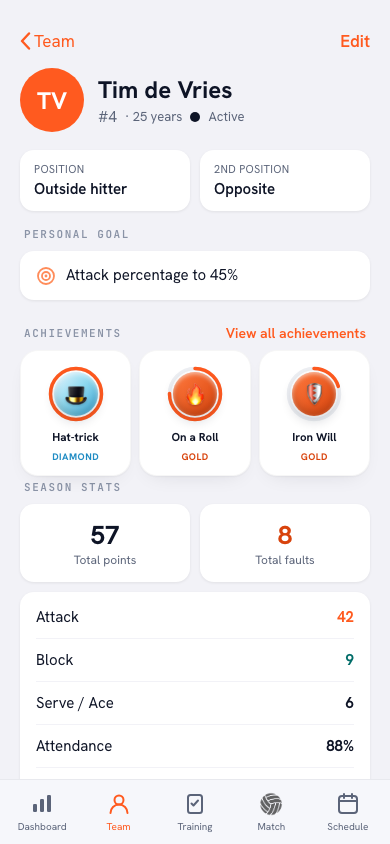
Record the second position in the player profile — then, when building your lineup, you see your alternatives at a glance. And train the dual role before you need it: have the backup opposite run one block of every practice on their second position and give them the occasional set of playing time in that role. A second position that only exists on paper is not a second position.
Be honest in the profile: a second position means 'can play it at match level', not 'has stood there once'. An overly optimistic profile gives false security at the moment you can least afford it.
Frequently asked questions
Should every player have a second position?
No — your setter and libero are specialists; you want to make them deeper in their own role. Focus on the attacking positions, where the overlap in skills is greatest.
How do I keep a player from feeling like 'second choice' on their second position?
Frame it as added value, not demotion: the player who covers two positions is more often indispensable and plays more on average. Discuss the role explicitly in the season talk.
Do a player's statistics on their second position count?
Yes, all points and errors count normally in their profile. When interpreting, do check which role they were in — 12 points as a stand-in opposite is a different achievement than 12 points in their regular spot.
Try it yourself in Koach
Less admin, more coaching — starting at your next practice.
Get started with Koach