Should a 12-Year-Old Specialize in One Volleyball Position?
The tallest kid in the group goes to the middle, the smallest becomes the setter, and within two months it is set in stone. It feels logical and it works in the short term, but it is one of the most expensive choices you can make in youth volleyball. Here is what early specialization costs, and when to make the call for real.
What specializing actually means
Specializing is more than putting someone in the same spot a lot. It is the point at which a player structurally stops training certain skills: the middle who never serves from the corner anymore, the setter who no longer practises hitting, the libero who never touches a block. That leaving-things-out is the problem, not the spot on the court.
Which also means you can assign a position without specializing. A twelve-year-old can happily play a whole match as a middle blocker, as long as they keep doing everything in practice.
What it costs when it happens too early
- You are deciding on the wrong information. Height at twelve is a poor predictor of height at eighteen. The tallest kid in the group is often just early in their growth; classmates catch up over the next three years.
- The ceiling drops. A player who spent four years only at the net arrives in the senior game short of a passing game. And in six-on-six, everybody has to pass and defend.
- The load becomes one-sided. Years of nothing but jumping and swinging loads the same tendons and joints the same way every time — a known risk factor for overuse in growing athletes.
- You lose kids who are not finished yet. A twelve-year-old labelled "sub" or "back row only" loses motivation in precisely the years when they would learn fastest.
The relative age effect in one paragraph
Youth teams are grouped by birth year. So in a team of eleven-year-olds there is nearly a year between the oldest and the youngest child — at that age worth ten centimeters and a serious head start in strength and coordination. A January-born kid therefore looks more talented than a December-born one, gets selected more often, gets on court more often and gets better coaching. By sixteen that difference has vanished, but by then one has had four years more attention than the other. Be aware of that before you fix roles at eleven.
A workable timeline
| Age | What you do about positions |
|---|---|
| Up to 12 | No fixed positions. Everyone serves, everyone takes the second ball, everyone plays front row and back row. |
| 12-14 | Introduce roles as temporary assignments: "today you're the setter." Everyone gets to know all six spots. |
| 14-16 | A primary position plus a seriously trained second position. Skills for all roles stay in practice. |
| 16 and up | Genuine specialization, with a second position as backup for injuries, team selection or a move to another club. |
The one role you may start slightly earlier is the setter, simply because it needs the largest number of repetitions. Even there: train two of them, not one. What the role actually involves is in the role of the setter.
How to rotate roles without chaos
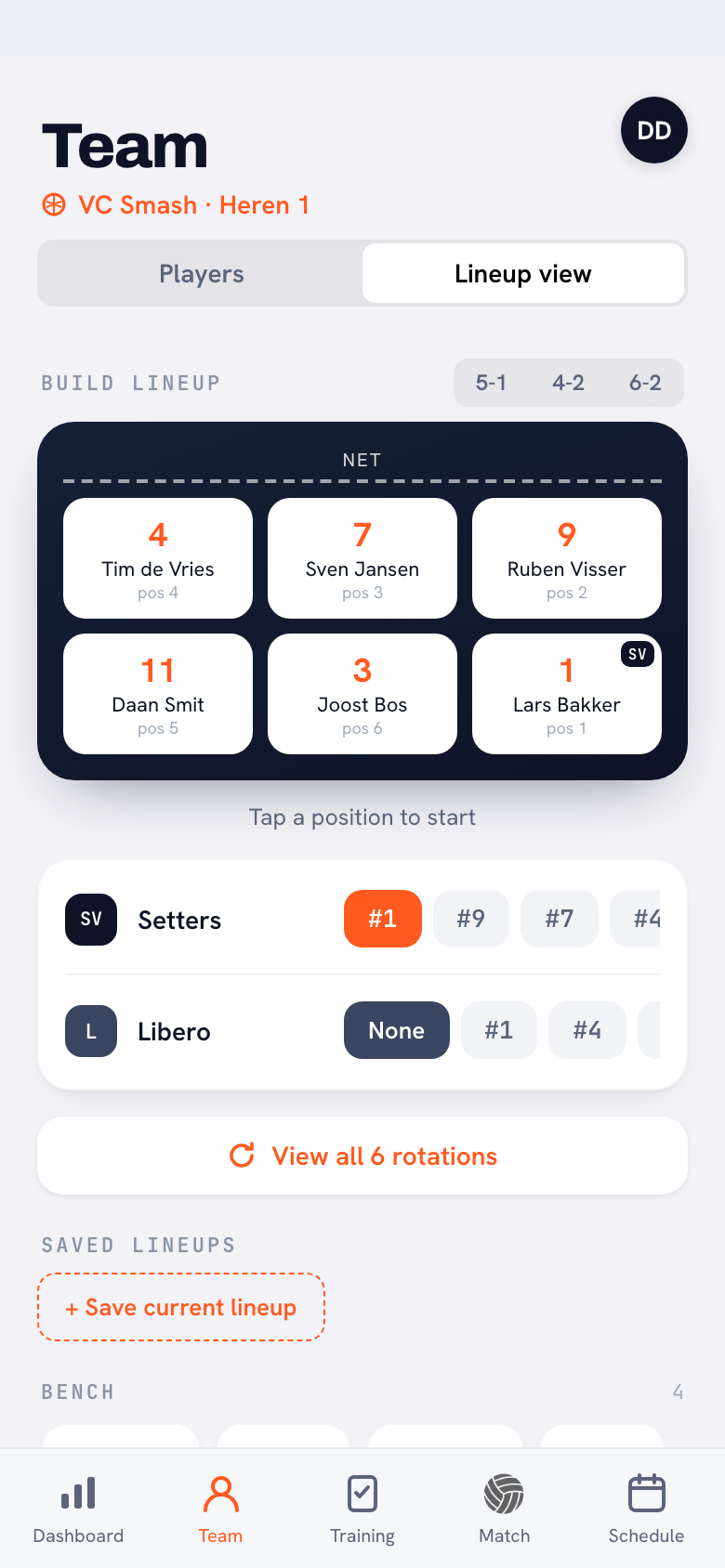
Constant switching produces a team that is not good at anything. What does work is rotating in blocks: give each player a role for four to six weeks, then move everyone on. Within a block a kid builds enough repetitions to learn something, and across a season everyone has done three or four roles. Record who had which role in each block, because without a note the same kids will be back in their familiar spots within a month. In Koach you can give every youngster a second position alongside their primary one, so rotating roles does not mean losing track of who played where — how to use that second role is in working with a second position. Which roles exist and what each one demands is in all volleyball positions explained.
What you say to parents and players
The question is guaranteed to come: "why isn't my daughter fixed in the spot she's good at?" The most honest answer is also the strongest: because we do not know who she will be in four years, and because a player who can do everything can go anywhere later. Make it concrete with an example every club has — the player who grew twenty centimeters at sixteen, or the setter who turned out to be the best passer. For the kids themselves, the practical argument works best: if you can do everything, you always play, even when somebody is sick.
Frequently asked questions
So can I never put a twelve-year-old in a fixed spot?
In a match, yes; in their development, no. Someone can play mostly middle blocker for a season, as long as they keep passing, serving and setting the second ball in practice. It is about what you leave out, not about where someone stands.
What if a kid really wants a fixed position?
Take the wish seriously and give them that role as their primary one, but agree that a second position comes with it. Almost every child goes along with that once you explain it actually increases their court time.
Does this apply to the libero too?
Absolutely, and even more so there. A child who becomes a libero at thirteen spends years not training attacking or blocking. Let a young libero join in those parts of practice, even if they never use them in a match.