
Early sport specialization: only volleyball or more sports?
The short answer
Early sport specialization means that a child up to about twelve trains one sport intensively for most of the year and drops other sports. According to sports medicine consensus statements this brings no advantage in most sports, volleyball included, but it does raise the risk of overuse injuries and dropping out.
Early sport specialization is a choice that parents and coaches face at an ever younger age: should an eleven-year-old quit gymnastics or soccer to put everything into volleyball? Here is what sports medicine organizations and research say about it, why volleyball is no rush and how to combine two sports in a way that works.
What is early specialization?
In its 2016 consensus statement on early sport specialization, the American Orthopaedic Society for Sports Medicine (AOSSM) uses three criteria, all of which apply at the same time:
- Year-round. More than eight months a year of intensive training or competing in organized sport.
- One sport, at the expense of others. Other sports are dropped, and little time is left for free play.
- Before puberty. It concerns children up to about twelve.
So a ten-year-old who plays volleyball twice a week, swims as well and plays outside after school is not specialized. Neither is a fifteen-year-old who chooses volleyball: that is specializing, but not early. It is the combination of young, year-round and exclusive that matters. Specializing in one position within volleyball is a different topic; that is covered in when a youth player should specialize in one position.
What do sports physicians and research say about early specialization?
The major sports medicine organizations agree to a striking degree.
- No advantage in most sports. The AOSSM concludes that there is no evidence that young children gain anything from early specialization in most sports. The statement does link early specialization to overuse injuries, burnout, lower motivation and dropping out of sport. Exceptions are sports in which athletes reach their peak level young, such as gymnastics, figure skating and diving. Volleyball is not one of them.
- Wait until after puberty. The American Academy of Pediatrics (AAP) writes in its clinical report on sports specialization (Brenner, 2016) that for most sports it is best to specialize only after puberty, in late adolescence: around 15 or 16.
- Junior success is not the same as senior success. A meta-analysis by Güllich, Macnamara and Hambrick (2022) of 51 studies found two sides. Among youth athletes, the best were those who started their main sport early and trained a lot in it. Among adults it was the other way round: world-class athletes had played more other sports as children, started their main sport later and progressed more slowly at first than athletes who reached national level.
That last point explains why the debate is so persistent. Specializing early can win a youth title, and you see that right away. What it costs at twenty you only see years later. To be fair, most of the research is observational: it shows a connection, not a proven cause. But whoever has a child specialize early to make them better later does not have the evidence on their side.
Why volleyball is no rush
Three reasons make volleyball a sport in which you can choose late.
- The game builds on general skills. Judging a ball in the air, moving quickly, jumping and landing safely, an overhead hitting motion: you learn those in other sports too, and in a different way. Basketball gives jumping, landing and timing, badminton and tennis an overhead stroke and reading a trajectory, gymnastics body control, soccer footwork. A child brings that baggage into the gym.
- The standout at twelve is not necessarily the player at eighteen. Height and strength develop at very different rates in children. Early developers look like talents for a while; late developers are easily overlooked. So an early choice for one sport is made on information that is still changing.
- Volleyball loads the body one-sidedly. Lots of jumps, lots of landings and always the same hitting arm. Volleyball alone year-round means the same tendons and joints year-round, precisely in the years when the body is growing. Adding another sport spreads that load.
How many hours a week are responsible for a child aged ten to fourteen, how much rest there should be per week and per year and which signs point to overload is in how often youth players should practice. If a child has pain in the knees, heels or shoulders that does not go away after a few days of rest or keeps coming back, have a doctor, sports physician or physiotherapist look at it.
Too many sports for a child? How to combine two sports
Two sports can work fine, as long as someone keeps an eye on the total. Each coach sees their own two practices, and that looks like little. The child sees four, plus two matches at the weekend. Five agreements keep it manageable:
- Add everything up. Practices, matches, PE class and an extra select-team session all count. If the total gets too much, something comes off, nothing goes on.
- Do not put two heavy jumping days back to back. A basketball game on Saturday and a volleyball attacking practice on Sunday is the same thing twice. Alternate heavy and light days.
- Agree per period which sport comes first. If the other sport has a tournament or an important run of games, the volleyball week is lighter, and the other way round. An absence agreed in advance is not a lack of commitment.
- Keep at least one day a week completely free. No organized sport, and without the child feeling guilty for doing nothing.
- Let the child have a say. Ask what they enjoy about each sport and what they find hard. The answer tells you more about the right balance than any schedule.
When does choosing volleyball make sense?
| Age | What fits | Watch out for |
|---|---|---|
| Up to about 12 | Several sports and lots of free play, with volleyball as one of the sports | No year-round program in one sport |
| 12 to 15 | Volleyball can become the main sport, with a second sport or activity alongside | The total load and the growth spurt |
| From 15 or 16 | Choosing volleyball is fine, if the player wants it themselves | A rest period each year and strength that has been built up |
The boundaries follow the AOSSM (up to about twelve) and the AAP (around 15 or 16). They are guidelines, not hard ages. A player is ready when the wish comes from them and not from the parents, when the growth spurt is largely behind them and when there is still room for school and friends beside the gym. Even after the choice, variety stays valuable: another sport in the summer, or strength and conditioning with different movements than in the gym. How that long line runs per age is in long-term athlete development in volleyball and in coaching youth volleyball by age group.
What you can do as a coach or club
- Do not make a spot on a select team depend on quitting another sport. A twelve-year-old who has to choose between the top youth team and their other sport specializes under pressure.
- Ask at the start of the season what else a player does. Which sport, which days, when the games and tournaments are. Then you see clashes coming instead of discovering them on a Saturday morning.
- Call the other coach. One conversation at the start of the season prevents two coaches from both thinking it is not that bad.
- Name what the other sport brings. "You got that footwork at the net from basketball" shows a player that their second sport is not wasted time.
- Do not set the bar at the youth championship. A team of thirteen-year-olds that wins with four early developers says little about who will still be playing at twenty.
Ask about the other sport in the first week. Note for each player which other sport they play, on which days, and when the important games are. Two minutes of work, and you know why someone comes in tired on Thursday or drops out of a tournament.
Two sports in one calendar
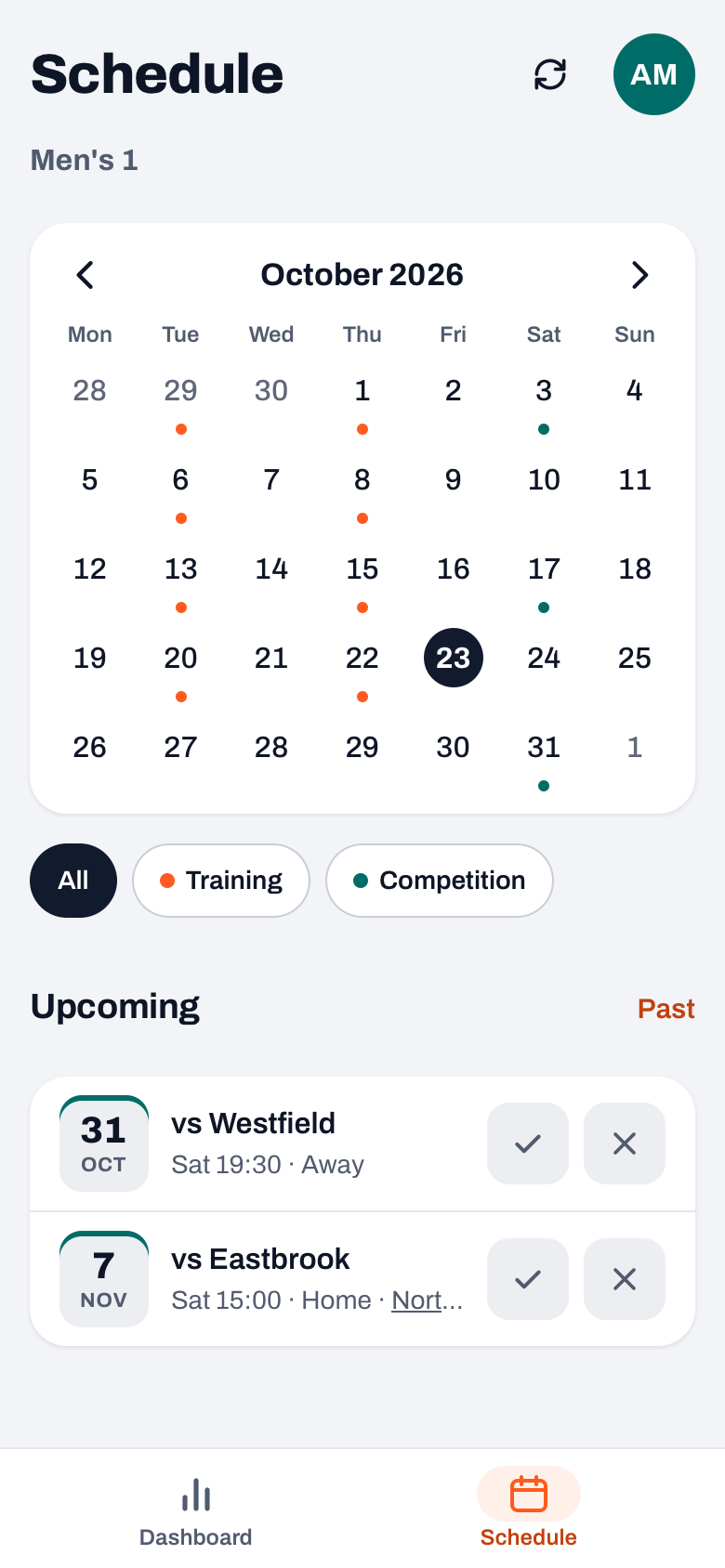
Whoever combines two sports mostly has a planning problem: two schedules, two group chats and two coaches who each only see their own week. In Koach the volleyball team's practices and matches are in one schedule, and parents mark their child as attending or absent for each practice or match, optionally with a reason the coaches can read. So as a coach you see an absence because the other sport has a game in advance. With the sync icon at the top of the schedule a parent adds the team's calendar feed to their own Google, Apple or Outlook calendar, so volleyball sits next to the other sport there and changes come through automatically.
What Koach costs after the 14 free days is on the pricing page.
14 days free, no credit card. Add your practices and matches and show parents how volleyball fits next to the other sport.
Try Koach with your youth teamFrequently asked questions
At what age should a child specialize in one sport?
For most sports the American Academy of Pediatrics (AAP) advises specializing only after puberty, in late adolescence, around 15 or 16. Volleyball is not a sport in which athletes reach their peak level young, so there is no reason to choose earlier. Up to about twelve, several sports and free play are a good base; after that volleyball can gradually become the main sport.
Is it bad if my child only plays volleyball?
Not in itself. The risk lies in the combination of young, year-round and intensive. A child who plays volleyball twice a week and also cycles, plays outside and has PE class moves in a varied enough way. Pay attention above all to the total number of hours, at least one free day a week and a period each year without volleyball.
Which sports go well with volleyball?
Any sport the child enjoys. Sports with different movements complement volleyball well, such as swimming, soccer, track and field, gymnastics or badminton. Basketball and handball are more similar and also involve a lot of jumping; that can work fine, but then keep an extra close eye on how many jumping days there are per week and do not put them back to back.
Will my child be less good if they play two sports?
In the short term a child who plays two sports has fewer volleyball hours, and in youth volleyball that can make a difference in a few matches. In the long term research points the other way: according to a large 2022 meta-analysis, world-class adult athletes played more different sports as children and started their main sport later than athletes who reached national level.


Make volleyball fit next to the other sport
14 days free, no credit card. Parents see the week in their own calendar.
Get started with KoachOr read first what the volleyball coaching app does.