
Long-term athlete development in volleyball: the stages by age
The short answer
Long-term athlete development (LTAD) in volleyball fits practices and matches to a player's stage of development instead of their age. Children first learn broad movement and technique, teenagers build strength and game systems around the growth spurt, and only around 16 to 19 does a player settle on one position.
Long-term athlete development in volleyball is about what a player should learn when, from the first ball around age six to the senior team. Below are the stages of the model, what they mean in the gym, what the research says about them and what a club sets down for each stage.
What is long-term athlete development?
The model is called Long-Term Athlete Development, LTAD for short. It comes from Canada, where Istvan Balyi and colleagues worked it out for Canadian Sport for Life, and since then sport federations in several countries have used it. The core is simple: a child is not a small adult. Practices and matches have to fit a player's physical, mental and social development, and that does not move in step with their date of birth. Volleyball Canada sums it up as the right skills, at the right time, in the right way.
Volleyball Canada has worked the model out for volleyball in Long Term Development in Volleyball. For each stage it sets out which game format, net height, ball, number of practices and degree of specialization fit. The model is not a pyramid in which only the top counts: people who keep playing recreationally, coach or referee have a stage of their own in it as well. The stages below follow that document. The ages are approximate, and in the early stages girls get there about a year earlier than boys.
The stages of long-term athlete development in volleyball
| Stage | Age, roughly | Focus in volleyball |
|---|---|---|
| Active Start | Up to 6 | Moving and playing, no volleyball yet |
| FUNdamentals | Boys 6 to 9, girls 6 to 8 | Running, jumping, throwing and catching; agility, balance, coordination and speed; many sports |
| Learn to Train | From 9 (girls 8) to the growth spurt | Basic technique in small-sided games, all positions, still two or three other sports |
| Train to Train, early | 12 to 14 | Six against six on a full court, simple systems, no fixed position or at least two positions |
| Train to Train, late | 14 to 16 | 5-1 or 6-2, no libero at under 14 and under 15, building fitness and strength |
| Learn to Compete | 16 to 19 | Focus on one position or two related positions, more complex tactics, individual programs |
| Train to Compete, Learn to Win, Train to Win | After the growth spurt, depending on level | Full specialization and performance |
| Active for Life | Any age | Playing recreationally, coaching or becoming a referee |
Two things stand out. Specialization comes late: around 12 to 14 a player in this model has no fixed position or plays at least two, teams at under 14 and under 15 play without a libero, and only from about 16 does the focus move to one position. And the competition side grows slowly. Volleyball Canada works with 70 percent training and 30 percent competition in Learn to Train (competition-specific training included), 60 to 40 in Train to Train, and only from Learn to Compete does it flip to 40 percent training and 60 percent competition. What a practice looks like for each age group is covered in coaching youth volleyball by age group.
Sensitive periods: what holds up and what does not?
The best-known part of the model is the sensitive periods, also called windows of trainability. These are periods in which a child is said to respond especially well to training of one quality, such as skill, speed or strength. Volleyball Canada describes the stage before the growth spurt as the time when brain and body are ready to learn skills, and the growth spurt itself as the big window for endurance and strength.
The evidence for such fixed windows is thin. A review by Ford and colleagues in the Journal of Sports Sciences (2011) concluded that the model has little empirical support and is generic rather than tailored to the individual athlete. The IOC consensus statement on youth athletic development (2015) puts the emphasis on the maturation of the individual child, on broad participation in sport and on preventing overload.
What you take from this as a coach: no window slams shut. A fourteen-year-old who never learned to set properly can still learn it. But the years between roughly 8 and 12 are a good time to offer a lot of technique and coordination, because children can handle many repetitions then and their bodies are not yet in the middle of a growth spurt. Train every quality in every stage; only the emphasis shifts.
Biological age counts for more than birth year
Two thirteen-year-olds can be years apart physically. According to Volleyball Canada's model, the growth spurt falls roughly between 11 and 15 in girls and between 12 and 16 in boys, and within that range it differs per child. That has three consequences for your youth program.
- Measure height. Measuring a few times a season shows who is in the growth spurt. If a player grows fast, keep an eye on the number of jumps and expect a temporary dip in ball control. Ongoing knee or heel pain is something for a doctor, sports physician or physical therapist. What happens in those months is covered in why a player gets worse after a growth spurt.
- Do not select on height at twelve. The tall twelve-year-old is often just early. A late developer who is small now can be your middle three years from now, if they are still playing by then.
- Watch the birth month. Within an age group, a player born just after the cut-off date is almost a year older than a player born just before it. In selections, look at what a player can learn, not only at what they can do now.
What a club sets down for each stage
The model only becomes worth something when a club makes it concrete for each stage. For every stage, write down:
- Game format, court and net. How many players, on which court, with which net height and which ball. Follow your federation's youth rules for this; they differ by country.
- Technical goals. A short list of what a player can do by the end of the stage, such as a serve over the net, a forearm pass to a target and setting to a teammate.
- Positions. Up to what age everyone plays everything, and from when a player focuses on one position.
- Playing time. According to Volleyball Canada's model, every player should preferably get at least 40% of match time over the season around 14 to 16, and at least 30% around 16 to 19. Write down what your club uses.
- Practices, load and other sports. How often per week, how long, and whether another sport alongside volleyball is encouraged. Why that last point matters is covered in early specialization in youth players.
- Who coaches which stage. A coach of ten-year-olds needs different knowledge from a coach of seventeen-year-olds.
All of this belongs in the club's technical plan. A template, and how to see whether it actually happens in the teams, are in a volleyball curriculum for your club.
Start with one page. Write three lines per stage: which game, which technical goals, and from when a fixed position. A one-page plan that every youth coach knows does more than a binder nobody opens.
Tracking long-term development in Koach
You only see development over several seasons, and it helps if the data stays. In Koach the player profile shows, under History, a player's seasons, matches and practices; if the team belongs to a club, also what they did earlier with other teams. Under Stats you use Compare to put a player next to an earlier season of their own, once the team has closed a season. How to read such numbers over the years is covered in from season to season.
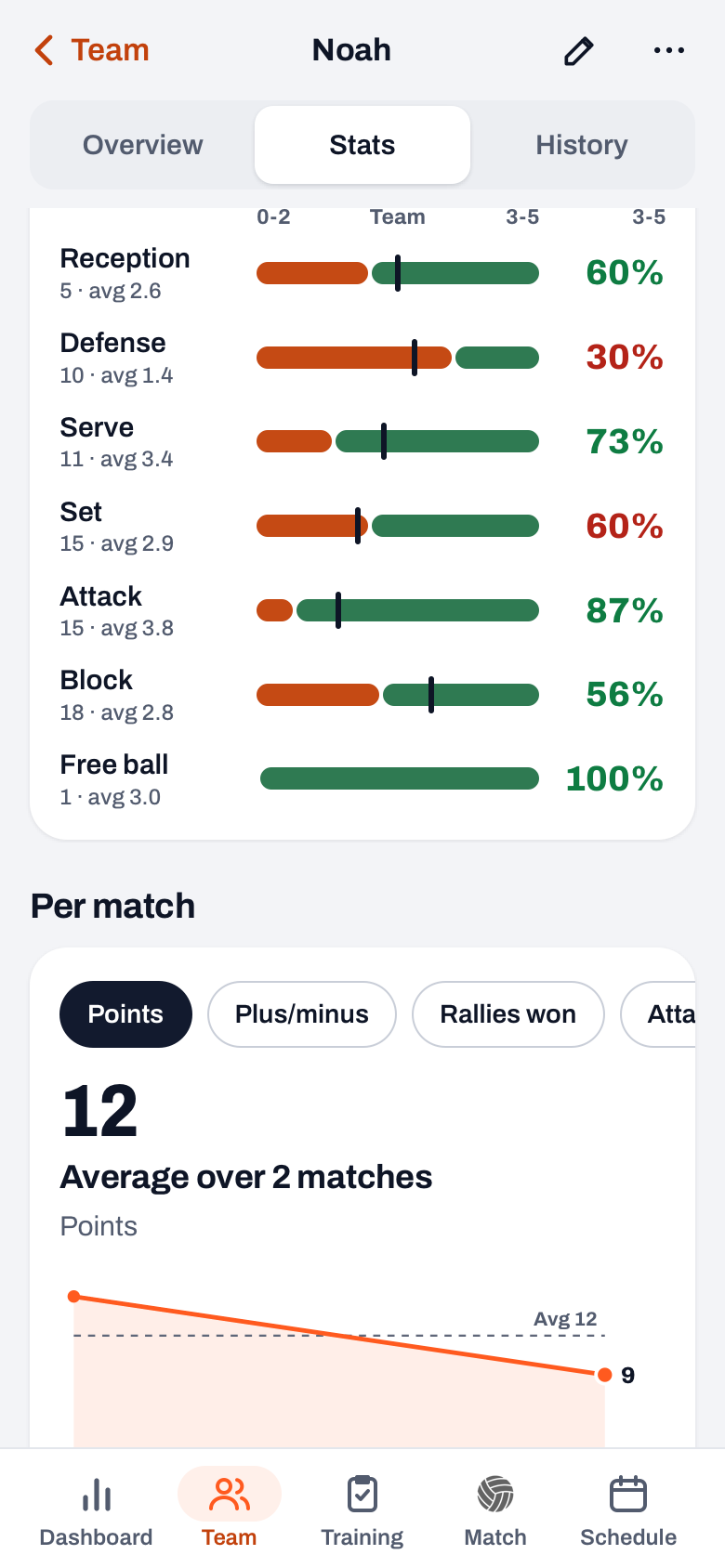
If you score your matches in Expert mode, Ratings 0-5 shows for each skill, from reception to block and free ball, how a player rates compared with the team. That way you see whether a fourteen-year-old keeps developing broadly, which is exactly what the model asks at that stage. What Koach costs after the 14 free days is on the pricing page.
14 days free, no credit card. Add your youth team and start building, this week, the record you want to look back on three seasons from now.
Try Koach with your youth teamFrequently asked questions
What does LTAD mean in volleyball?
LTAD stands for Long-Term Athlete Development. It is a model from Canada that fits practices and matches to a player's stage of development, from moving and playing as a young child to playing recreationally as an adult. Volleyball Canada has worked it out for volleyball, with a game format, training volume and level of specialization for each stage.
At what age should a volleyball player specialize in one position?
In Volleyball Canada's model a player around 12 to 14 has no fixed position or plays at least two, teams at under 14 and under 15 play without a libero, and only around 16 to 19 does the focus move to one position, sometimes with a second one alongside. These are guideline ages: a player who grows late can still switch positions. Your club or federation may use different rules.
Do sensitive periods for training really exist?
The idea that children respond especially well to training of one quality at a certain age has little scientific support. No window slams shut: a teenager can still learn technique. Elementary school age is a good time for plenty of technique and coordination, though. Train every quality in every stage and only shift the emphasis.
Is long-term athlete development only for talented players?
No. The model is meant for everyone who plays volleyball, including players who never make the first team. It has its own stage for playing recreationally, coaching and refereeing at any age. For a club it mainly means that youth players get a broad education for a long time and are not selected on height at twelve.


Follow your youth players over several seasons
14 days free, no credit card. A year from now you see what grew for each player.
Get started with KoachOr read first what the volleyball coaching app does.