Volleyball Drills for Large Groups: One Court, No Queues
Twenty players and one court: on paper a nice problem to have, in practice an evening where half your group stands in a queue. Large groups do not call for different drills, they call for a different layout of the gym.
First count how many active spots you have
Before you pick a drill: count the number of active spots in your gym. A normal court offers twelve spots in a 6-on-6, but the rest of the hall counts too. A wall is a spot. A three-meter strip along the side is a spot for a pair. A second net, even one strung across the width, doubles your capacity in one go.
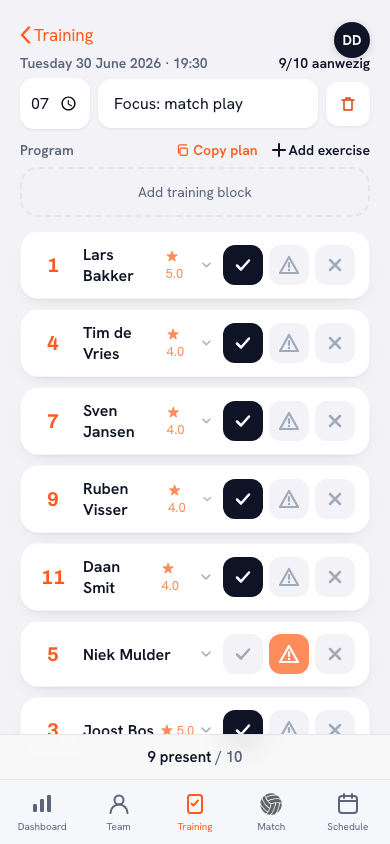
The rule of thumb: you need at least one active spot per two players. With twenty players that means ten parallel actions — which you will never get out of one drill on one court, so you have to think in stations. Koach shows you who has confirmed for tonight, so you pick the right group sizes before you drive to the gym instead of after.
The three layouts that work
- Stations. Three or four spots in the gym, each with its own drill and its own ball. Rotate every seven minutes on one whistle. It costs you explanation time up front, but after that the hour runs itself.
- Rotating formats. One drill in which players automatically move to the next role after their action — passer becomes hitter becomes server. No lines, because everyone is on their way somewhere.
- Half-court games. Two or three small games side by side across the width of the hall. Twelve to eighteen players in play at once, and the intensity regulates itself.
Five formats for 16 to 24 players
1. Four stations of five (28 min). Station 1: serve and pass over the net. Station 2: hitting off a toss from a box. Station 3: defence in threes along the sideline. Station 4: setting at the wall or in pairs. Seven minutes per station, one whistle to rotate. Twenty players, twenty active spots.
2. Two courts across the width (25 min). String a second net across the width of the hall (or use a rope) and play two 4-on-4 games at once. Sixteen players in play, the remaining four referee and feed balls and rotate in every five minutes. For the setup of small-sided games, training with a small squad is a useful source: the same formats, just several of them side by side.
3. Serve-pass-hit carousel (20 min). A player serves, runs under the net and joins the passing line; the passer becomes the hitter; the hitter shags their ball and joins the serving line. Everyone is constantly on the move and there is no queue whatsoever. Works from twelve players and scales up to twenty-four.
4. Winners' court with five teams (25 min). 3-on-3 on half a court, winner stays on. With five teams of four (one substitute per team) a team waits two rallies at most. The rules are in Queen of the Court.
5. Rally relay (12 min). Four groups of five, each with their own strip. Every group tries to make as many consecutive contacts as it can without the ball dropping; the group total counts. Simple, loud and with zero waiting — a fine closer or warm-up.
Switching without chaos
With a large group every unclear transition costs you two minutes, and with six transitions that is a quarter of an hour gone. Three agreements solve it:
- One signal. The whistle always means the same thing: hold the ball, rotate clockwise. No explanation each time.
- A visible clock. Put a timer where everyone can see it. Players then anticipate the switch themselves.
- A second pair of hands. With twenty players an assistant is not a luxury. If you work with several coaches, divide the stations in advance — see working with multiple coaches.
When it is structurally too crowded
Twenty players five weeks running is not a planning problem but an organisational question. The honest conclusion is usually that a second training slot or a second group has to be created. Take that to the club with numbers rather than feelings: the average attendance per evening over eight weeks is a far more convincing argument than "it is always so busy". How to build those numbers up is in tracking attendance.
More players, less explaining. With a large group every minute of explanation costs twenty playing minutes. Explain stations with one demonstration each and let an experienced player run the first round at every spot.
Frequently asked questions
How many players fit sensibly on one court?
For game formats about twelve to fourteen; beyond that queues appear. From sixteen players upwards you switch to stations or to two small courts across the width of the hall.
Does a station setup work with youth teams too?
Especially with youth teams. Short blocks of five to seven minutes suit their attention span, and the rotating itself gives structure. Do keep the number of stations to three and use fixed signals.
What do I do if I am alone with twenty players?
Choose formats that run themselves: rotating carousels and half-court games need almost no supervision. Save your own attention for one station and change which station that is every session.