What does a volleyball team manager do? The task list
Someone asked whether you would like to be team manager, and you said yes before you knew what it involved. Don't worry: it is manageable, as long as you know which jobs are yours and which belong to the coach. This is the complete list, ordered by phase of the season.
The role in one sentence
The team manager arranges everything around the volleyball, so that the coach can deal with the volleyball. That is the whole dividing line — and it is sharper than it looks. Anything about who plays, what gets trained and how the team is coached is coaching work. Anything about when, where, who rides with whom and who arranges it is team-manager work. When in doubt the rule of thumb is simple: if you need a sporting opinion for it, it isn't yours.
How much time it takes depends on level and age. Reckon on about an hour a week for a senior team and closer to two for a youth team — there you add communication with parents, and that is the bulk of the work.
Before the season: the start-up list
- Collect contact details for players and, with youth, for parents — including at least one emergency number per player.
- Set up one communication channel: one place where announcements appear and one way to report an absence. Two group chats side by side is the most common source of chaos.
- Copy the match schedule into the team calendar, including venue, start time and meeting time (those are not the same thing).
- Set up the driving rota for away matches — with youth teams the most appreciated job of the whole season.
- Schedule the fixed duties: bar duty, hall duty, scorekeeping and refereeing at other matches.
- Kit and equipment: a complete set of shirts, balls, first-aid kit, and who looks after what.
- Membership fees and player registrations: check that everyone is eligible to play before the first match.
Weekly: the team manager's rhythm
The weekly rhythm is predictable and that is exactly its strength. Start of the week: ask for availability for the match and verify the venue and start time (changes happen more often than you would think). Midweek: send round the driving rota and pass the number of absences to the coach, so he can build his lineup. Just before the match: a reminder with the meeting point and time, who is driving and who is on the scoresheet. After the match: pass the result to whoever tracks it at the club, plus anything notable — an injury, a card, a problem with the venue.
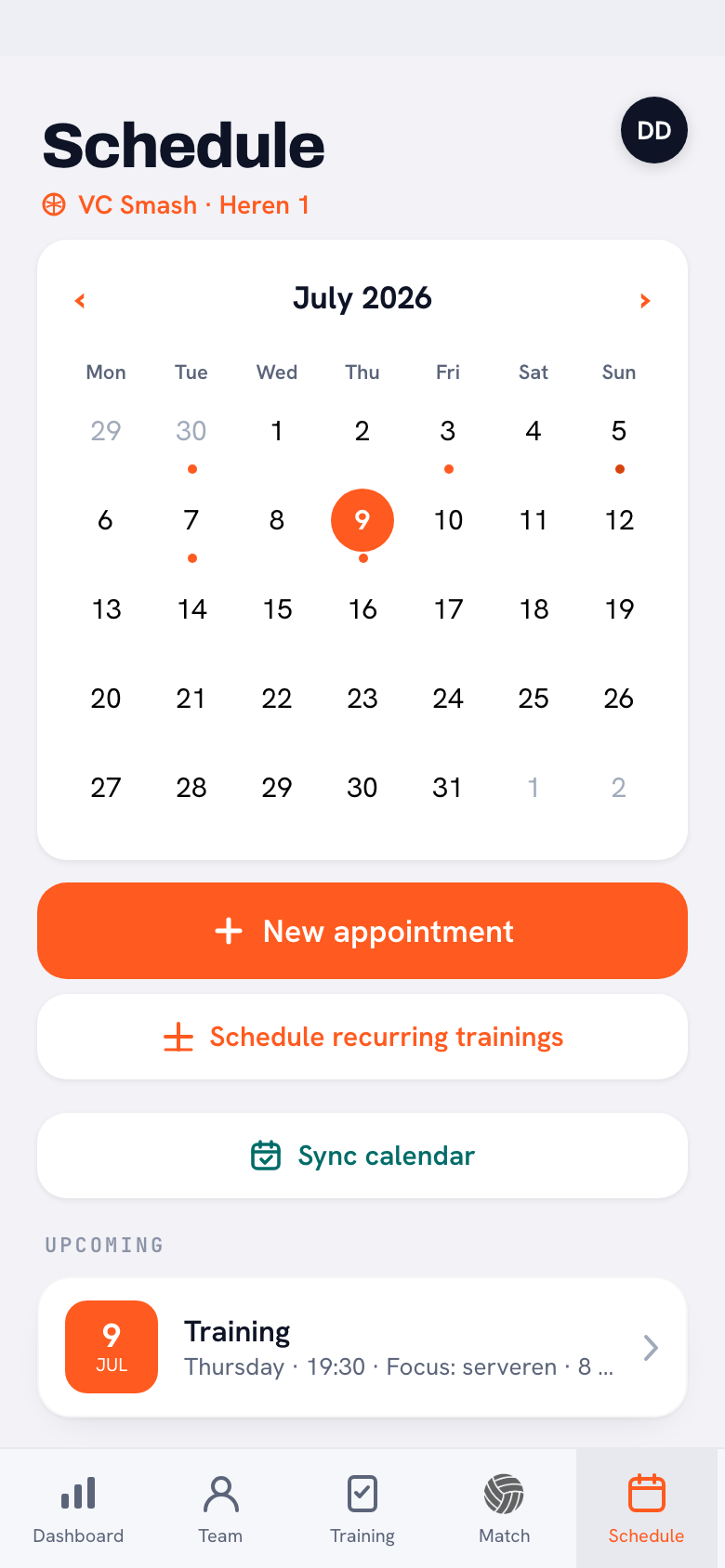
Most of that list — calendar, availability, driving rota, bar duty — lives in one place in Koach instead of in one person's head and spreadsheet. That pays off above all at handover: whoever stops halfway through the season hands over a system rather than a pile of chat messages. How such a handover works is in handing a team over, and the driving rota itself we cover in who drives to the away match.
Around match day
On the day itself there are four fixed jobs: getting into the hall on time (for away matches at least 45 minutes before the start), filling in the scoresheet and getting it signed afterwards, arranging the scorer and possibly the referee when you play at home, and making sure the changing room is left as it was found. Small but important: the team manager is the one who calls when the team is stuck in traffic, and the one who knows where the first-aid kit is. Tournaments add a day of food, drink and a timetable; that is a project of its own, see planning a volleyball tournament.
What stays with the coach
These jobs you hand back, even when the coach would love to be rid of them: the lineup and who plays, conversations about playing time or level, the content of practices, disciplinary matters and conflicts between players, and assessments for next year's selection. A team manager who joins in on those becomes, within two months, the address for discontent that isn't his. What you may do: flag things. "Three parents asked about their child's playing time" is useful information for a coach — the solution isn't yours.
At the end of the season
Wrap up with four things: collect and count the kit, close and account for the team kitty, organise a closing activity, and — the most underrated — hand over your notes. Who never drives, which hall has awkward parking, which opponent always starts late? That kind of knowledge is worth half a season to your successor and otherwise disappears completely. Finally, go through how it went with the coach; most team-manager tasks can only be improved once someone has done them for a year. The framework for that is in organising a volleyball season.
Tip for new team managers: agree one thing with the coach in the first week — who communicates what to the team. Nine out of ten misunderstandings in a season come from a message being sent twice or not at all.
Frequently asked questions
How much time does being a team manager take per week?
About an hour a week for a senior team, closer to two for a youth team. Most of the work is communication and the driving rota; with a fixed calendar and a clear channel for absences it drops sharply after a few weeks.
Does a team manager need to know about volleyball?
No. The role is organisational: calendar, communication, transport, paperwork and equipment. Sporting decisions belong with the coach, and that separation is exactly what makes the role doable for a parent or a player.
Can a player be their own team's manager?
In senior teams that happens often and works fine, as long as the tasks don't get mixed up with sporting decisions. If needed, split it between two players: one for calendar and communication, one for transport and duties.