
Everything Lands on the Coach: Handing Over Team Tasks
The evening before the match, quarter to eight: you are still messaging to find out who is coming tomorrow, who is driving and who is keeping score. None of those three is coaching. Handing over team tasks starts with exactly that insight, because the work that wears out a volunteer coach is often not in the gym but around it. This piece lays out the five piles of work that build up around a volleyball team, and asks the same question of each pile: whose job is this really? It does not promise that you will feel better. It promises that less will land on you.
It is rarely the coaching itself: the five piles around your team
Ask a coach who is unsure whether to carry on next season what costs them the most, and chances are the answer is not the practice. What costs them is everything that comes on top between two practices, usually via their phone and usually in the evening.
That work usually falls into five piles:
- Sign-ups. Who is coming to practice, who is available for the match, and who hasn't said anything yet.
- Driving. Who takes whom to the away match, and what happens if that lift falls through at the last minute.
- Scoring. Who keeps track of the score and the numbers during the match while you are coaching.
- The practice. Planning it, setting it up, running it — and finding cover when you can't make it.
- The match you take home with you. The defeat, the parent, the player who stopped turning up. The work that is in no calendar.
The first three are not coaching work. They have to happen, but not by you. The fourth is partly yours and partly transferable. The fifth you cannot give away, but you don't have to carry it alone either.
Handing over tasks starts with writing down what is on your plate now
Before you give anything away, you need to see what you have — and that is easy to underestimate, because every individual message seems too small to count. So for one ordinary week, keep a note open on your phone and write down every action that has to do with the team and does not happen in the gym: every message, every call, every time you check or arrange something. No times and no judgement, just one line per action.
At the end of the week, put one of three letters after each line:
- C — coach. This really needs the coach: the lineup, the conversation with a player, the choice of who plays.
- S — someone. This has to happen, but any reliable adult or older player can do it.
- D — drop. You did this because you always did, not because anyone asked for it.
Then count the letters. The aim is not to empty the C column, but to be able to think of a name for every S and to dare to let every D go. Take the list to a team meeting; how to structure an evening like that and come away with agreements that stick is in the first team meeting with agreements.
One rule when handing things over: never ask the group "who wants to help?". Ask one person for one pile, with a clear start and a clear end — "would you run the driving rota for the rest of this half of the season?" is a question someone can say yes to.
Hand over a pile, not a chore. Someone who arranges the driving for one match will call you again for the next one. Someone who owns the driving for half a season sorts out a cancelled lift themselves. The difference is not in the amount of work but in who owns it.
Piles 1 and 2: sign-ups and driving are not yours
Signing up belongs to the player. Letting you know whether they are coming is their job — with young players, the parent's. What you do is one thing: agree a fixed moment by which everyone has responded, and set that moment early enough that you can still act on it. Anyone who still hasn't said anything by then gets one reminder — not from you personally, and not five times. Anyone who still says nothing after that does not count in your planning. That is not a punishment, it is an agreement.
The hard part is not the rule but letting go. As soon as the team notices that you chase it up in the end anyway, the agreement is gone.
Driving belongs to the parents — or, in an adult team, to the players themselves. Don't make the driving rota week by week, but once for a block of matches, and give it to one person who manages it. The rule that makes it sustainable: anyone who can't drive arranges a swap themselves and only reports the result. That way a cancelled lift never lands on you the evening before a match again. Where players and parents see their lift once the rota is set is in who is driving to the away match.
Duties for the club — running the bar, setting up the hall, refereeing another team's match — are not team work but club work, and should be divided at club level; see dividing club work among members. Don't add them to your pile just because they happen to come through your team.
Pile 3: the match score doesn't have to come from your hands
Coaching and scoring at the same time is possible, but you then do two things halfway. While you enter a point, you don't see why it happened; while you watch the court, you miss the point on your scoresheet.
The score is exactly the kind of thing someone else can do. Usually that is a player who is not playing that day or is sitting out for a while: an injured player, or someone on the bench for a set. The person doing it doesn't need to be a volleyball expert — just someone who can keep their attention for a whole set, and preferably someone who wants to do it more often.
What you tell that person beforehand, how to explain it in one minute and what you get back from it yourself is in handing over live scoring to a scorekeeper.
Pile 4: an assistant coach — what they take over and what they don't
Of the five piles, this is the only one where you really need someone who knows something about the game. It often feels like admitting you can't do it alone, but it isn't: a team with two coaches keeps going when one of them is out for a week, and a team with one coach doesn't.
What an assistant coach can take over well:
- A fixed part of every practice, for example the warm-up or one group at the stations.
- One whole practice a week, if you run two.
- The match when you are not there, with a lineup the two of you prepared together in advance.
- One of the piles above, if no parent can be found for it.
What you are better off not handing over are the things for which the team needs one voice: the final choice of who plays, and the conversation with a parent about playing time. Not because an assistant coach can't do it, but because otherwise players and parents start choosing whom to bring their question to. How two coaches arrange permissions, notes and coordination is in working with several coaches on one team.
Pile 5: the match you take home with you
This pile is in no schedule and yet often weighs the most. A run of defeats, an angry parent, a player who quit without explanation: the work is in the going over it afterwards.
You can't give this away. But you can do three things that make it smaller:
- Close the match at a fixed moment. That same evening, write down in a few lines what happened and what you want to do about it. After that it is written down and you no longer have to hold on to it.
- Don't reply to messages about the match that evening. A reply to an irritated question late in the evening is rarely better than the same reply the next day.
- Have one person to talk it through with. Your assistant coach, another coach at the club, or someone who doesn't know your team. Not to solve it, but so you are not going round in circles on your own.
How one coach tackled this in practice — what he gave away first, and what he let slide in a week when it really wasn't working — he tells in the interview about quitting as a volleyball coach and how to keep going. That story is about whether you carry on; this article is only about what you give away.
When there is nobody to hand anything to
A small team, few parents who are able to help, no assistant coach to be found: then there is one route left, and that is making it smaller.
- Really drop the D column. The weekly report, the extra friendly match, the detailed lineup in the group chat: if nobody asked for it, let it go.
- Bundle your messages. One fixed moment per week when you share everything for the coming week in one go, instead of separate messages spread over the days.
- Lower the bar where it doesn't matter. A driving rota with one swap that didn't go completely smoothly is good enough.
And go to the club, but don't arrive with "it's too much". Arrive with the list: these are the piles, these three I can't hand off, for this one I need someone. A concrete question gets a concrete answer. What a club can do to find and keep coaches is in recruiting and keeping coaches as a club. If you are facing your first season and want to prevent it getting this far, start with starting out as a volleyball coach.
Try it yourself in Koach
An app doesn't take these piles away, but it can put them with the right person without you sitting in between. In Koach that comes down to four things:
- Inviting an assistant coach with a link. With a Coach plan you add one alongside yourself, two in total; with a Club plan the number of coaches is unlimited.
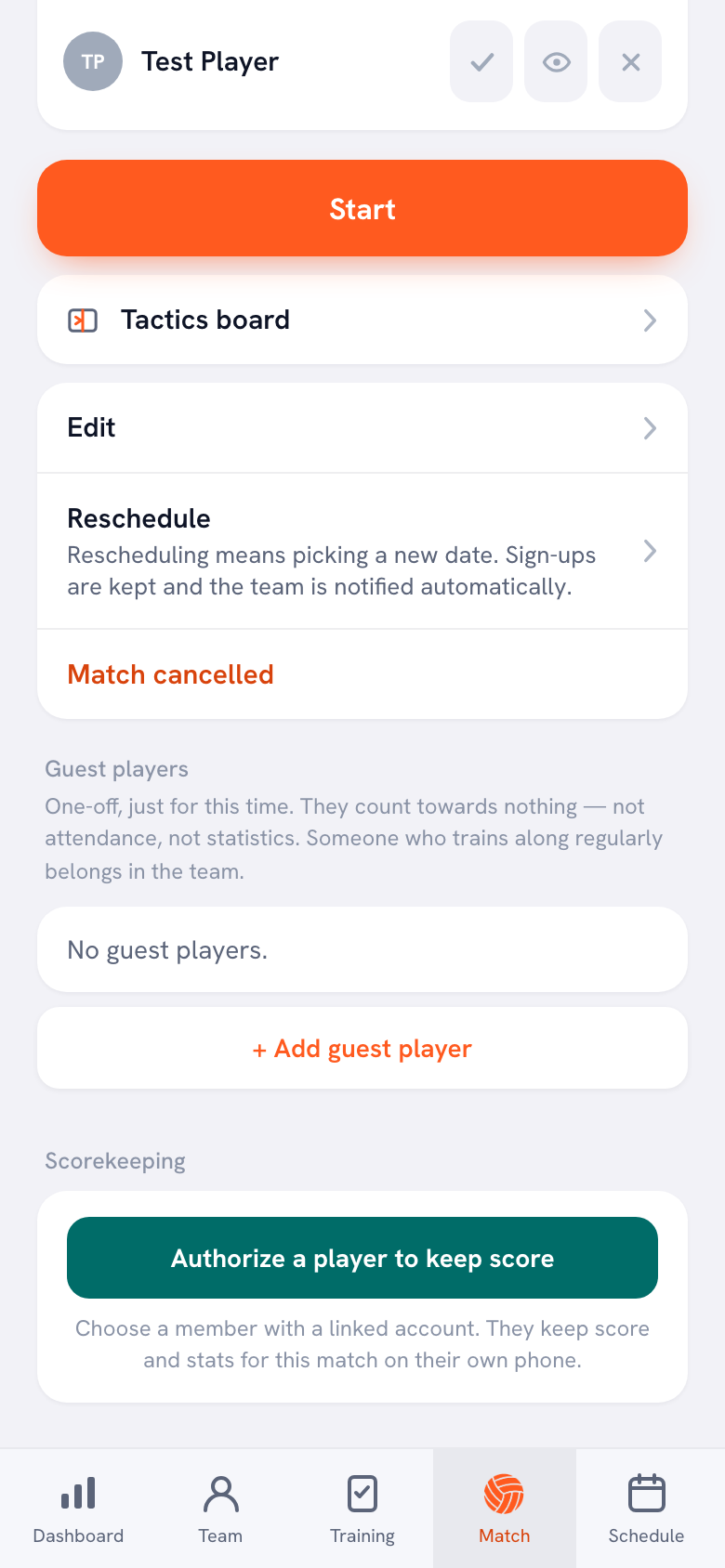
- Authorising someone to score. At the bottom of the match screen you authorise a member with a linked account to keep track of the match. That has to be a player on the team — a parent can't do this. In practice it is usually an injured or substituted player.
- Leaving sign-ups with the players. Players sign themselves up or out, and anyone who hasn't said anything 48 hours beforehand gets one nudge; how that works is in the reminder two days beforehand.
- Driving as a task. Put a task on the team board; it says 'Nobody signed up yet' until someone taps 'I'll do it'. How announcements, polls and tasks work is in team messages, polls and tasks.
The app doesn't plan your practice, doesn't talk to your players and doesn't take the match you bring home off your hands. It makes sure you do less alone, not that you do less. Put your team in, invite an assistant coach and leave sign-ups with your players: you can try Koach free for 14 days.
Frequently asked questions
How many coaches can I add alongside myself on one team?
That depends on your club and, if you use an app, on your plan. In Koach a Coach plan lets you add one extra coach, two in total; with a Club plan the number of coaches per team is unlimited. Apart from that, one regular assistant coach usually works better in practice than three who take turns, because players then know who to go to.
Can a parent score the match live instead of me?
On paper anyone can keep score, including a parent. In Koach, authorising someone to score live only works for a player on the team with a linked account; a parent account cannot be authorised. That is why in practice it is often an injured player or someone sitting on the bench for that set.
What do I do if nobody on the team wants to take over a task?
Make the question smaller and more personal. Don't ask the group, but one person, for one pile and with a clear end, such as the driving rota for the rest of the half-season. If that still doesn't work, check whether the task really needs to exist or can be done at a lower standard. And go to the club with a concrete list: which pile you can't hand off and what you need for it.
I'm thinking about quitting as a coach — what do I tell the club?
Say it early, and say it concretely. Not just that it is too much, but which pile is too much: sign-ups, driving, scoring, the practice or what you take home with you. Ask for help with that one pile before you make a decision, so the club can do something. How another coach weighed that decision is in the interview about quitting as a volleyball coach and how to keep going.
Isn't it easier to just do it myself?
For one week, yes; for a season, no. The first handover takes time: explaining, letting go and accepting that it will be done differently from how you would do it. But you spend that time once, while the task comes back every week. So choose a quiet period for handing over, not the week of an important match.

Try it yourself in Koach
Less admin, more coaching.
Get started with KoachOr read first what the volleyball coaching app does.