
“I did not start doing less. I started doing less of it on my own”
About the other half of coaching: not how many hours it costs, but how you keep going when you do it alongside a full-time job.
Every season a fresh batch of volunteers takes charge of a team, and every season a chunk of them quietly disappears again. Volleyball coach burnout rarely starts with the hours. It starts with the pile nobody takes off your hands, with the losing run you carry home, and with the feeling that you are the only one holding it together. Dennis Boekhout, 28, knows that point well.
A conversation about what he handed over so he would not lose his team — a second coach, the scorekeeping, the driving — and about what he deliberately lets slide in the weeks when it simply is not happening.
You say coaching rarely breaks down over the hours. What does it break down over?
“I knew about the hours in advance. Two sessions, a match on Saturday, the drive there — that is what I said yes to. What I did not know is that the work does not stop when the hall closes. Who is coming on Tuesday? Who is driving on Saturday? Who do I put on court at 12-12 in the fifth? That keeps running in your head, including on a Monday morning.
“And it all sits with one person. That is the real problem. Not that there is a lot of it, but that nobody is standing next to you when it goes badly.”
Do you see it happen — coaches dropping out after one season?
“I know a few, yes. Somebody says yes for one season because otherwise there is no team. In November it is still fun, in February it is an obligation, and in May they say: I am not doing another year. And if you ask why, it is almost never that volleyball stopped being fun. It is that they were on their own with it.”
What does a losing run do to you, rather than to your team?
“It gets under your skin. After three defeats in a row you are coaching yourself instead of your team. I would still be lying awake on Sunday morning going over a substitution in the third set. That is not healthy, and it makes you a worse coach too: you start pulling at everything at once.
“What helped me is reviewing the match in numbers instead of in my head. The momentum graph and the side-out per rotation tell a much calmer story than my memory does. Usually it turns out to be one rotation leaking, not a team that has forgotten how to play. You can do something with that on Tuesday. You cannot do anything with a bad feeling.”
Is a coach allowed to say, in the hall, that he does not know?
“Yes. And it took me far too long to dare to. I thought I had to have an answer to every question or I would lose them. The opposite is true. Once I said, ‘lads, I am not seeing it right now, what are you seeing?’ and somebody on the bench made a point about their block that had never occurred to me.
“Players are not scared of you not knowing for a moment. They are scared of you pretending.”
Your headline is: doing less of it alone. What did you hand over first?
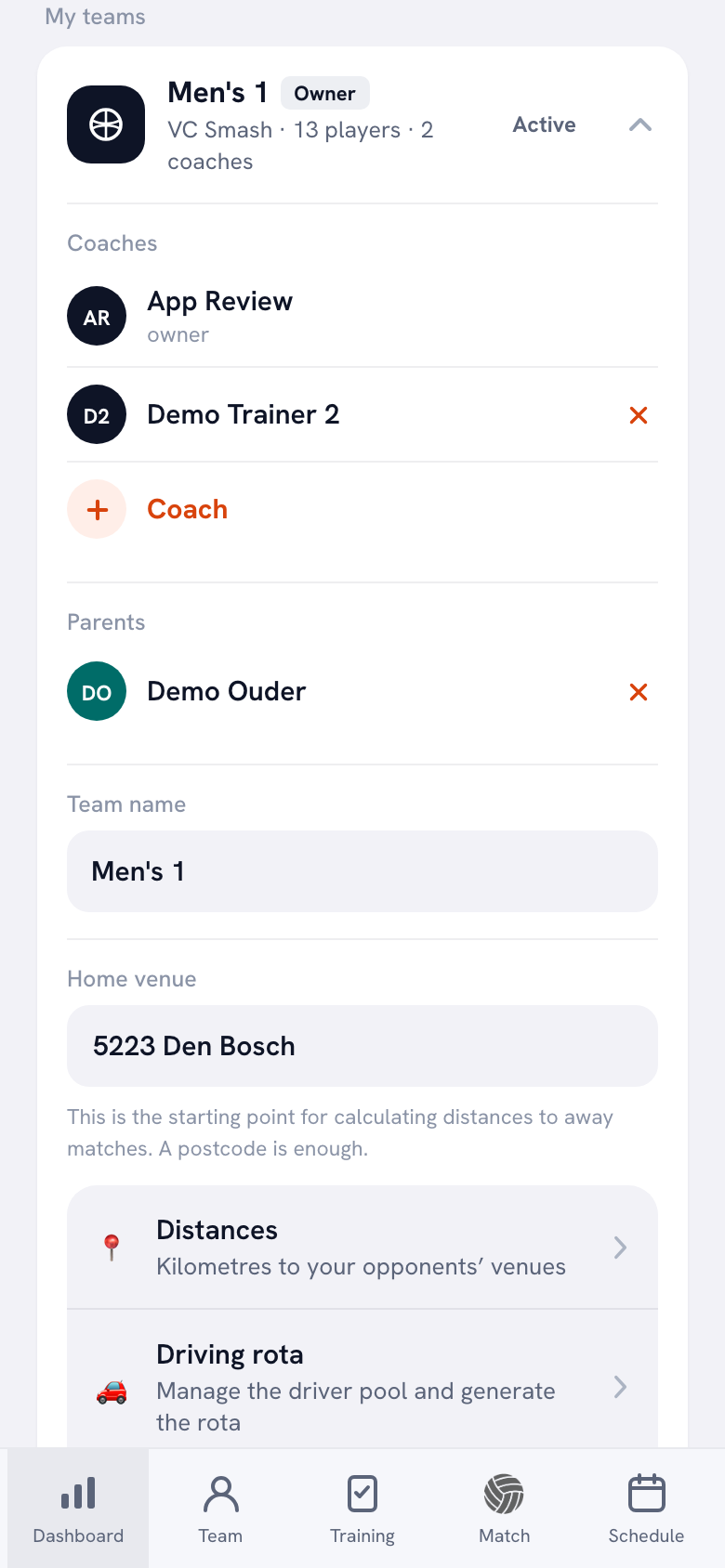
“A second coach. I forward a link, and whoever opens it becomes a coach of this team — even if they do not have an account yet. After that they see exactly what I see: the same players, the same sessions, the same matches. No more messages saying ‘could you pass on that…’.
“On the Coach plan you can add one alongside yourself, two in total; a club has unlimited. Two was enough for me. One evening a week where it does not depend on me changes more than you would think.”
Did letting go come naturally?
“No. The first time he set up a lineup differently from how I would have done it, I had to sit on my hands. I could see exactly where it would go wrong.
“It did not go wrong. We won in four sets. I learned more from that than from ten matches where I was right.”
And on match day — surely you keep score yourself?
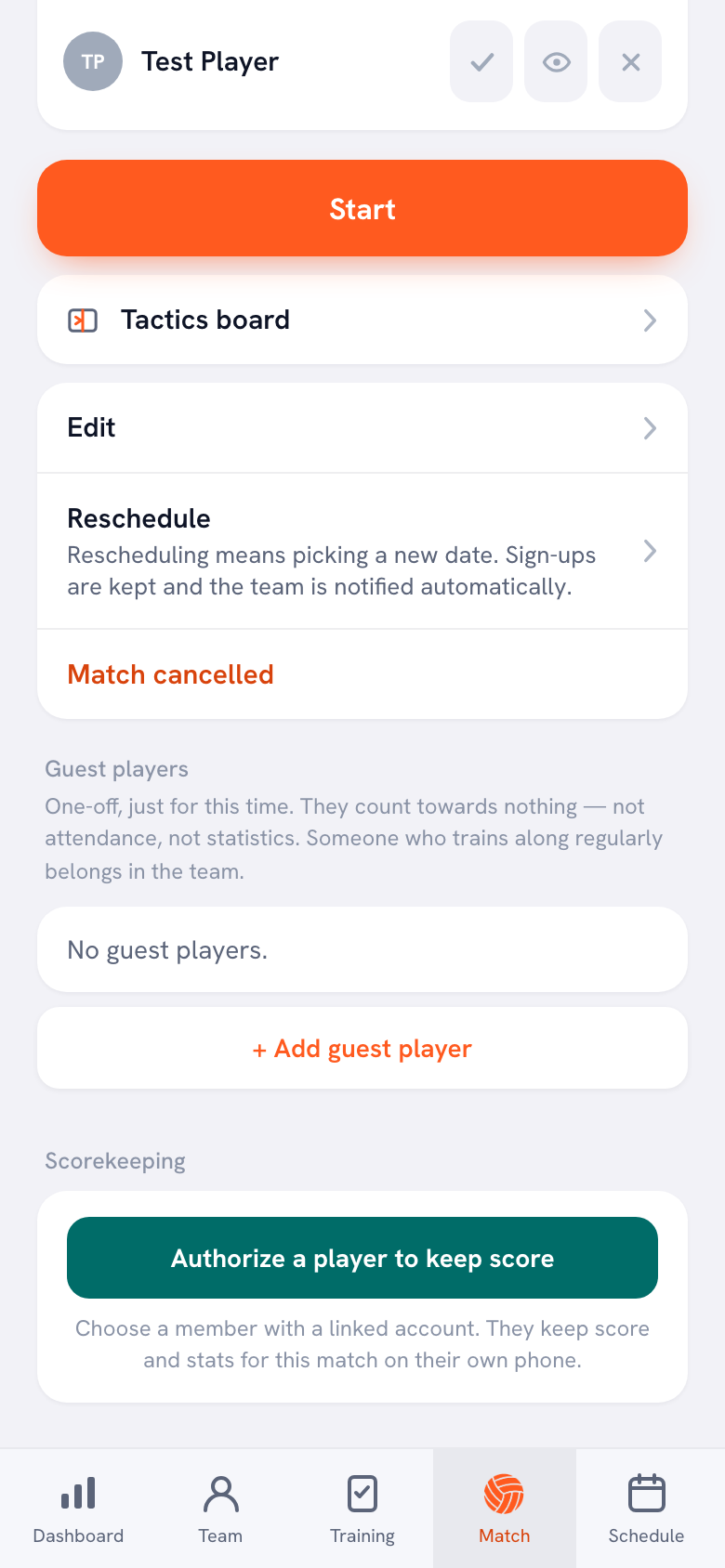
“Not always any more. At the bottom of the match screen there is a Scorekeeping block with a button to authorise a player to keep score. You pick a member with a linked account, and they keep the score and the stats for that match on their own phone.
“Usually that is an injured player who is sitting on the bench anyway. He likes being part of it, and I get to watch the court for a whole match instead of my phone. Afterwards the result is simply there in the app. Honestly: the first time I looked over his shoulder twice. After that, never again.”
What did you hand to the players themselves?
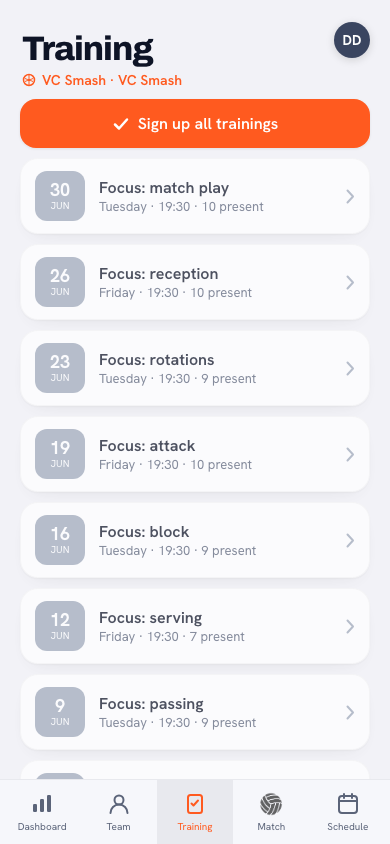
“Signing up. I used to ask in the group chat who was coming on Tuesday, count the thumbs up and always forget one. Now a player signs up or off themselves, and anyone who cancels can add a message. I do not have to chase anybody, I just look at who is down.
“At the top of their own screen there is a button to sign up for all sessions at once. That costs them ten seconds at the start of the season. It saved me half an hour a week of chasing people.”
And the driving to away matches? For a lot of teams that is the sore point.
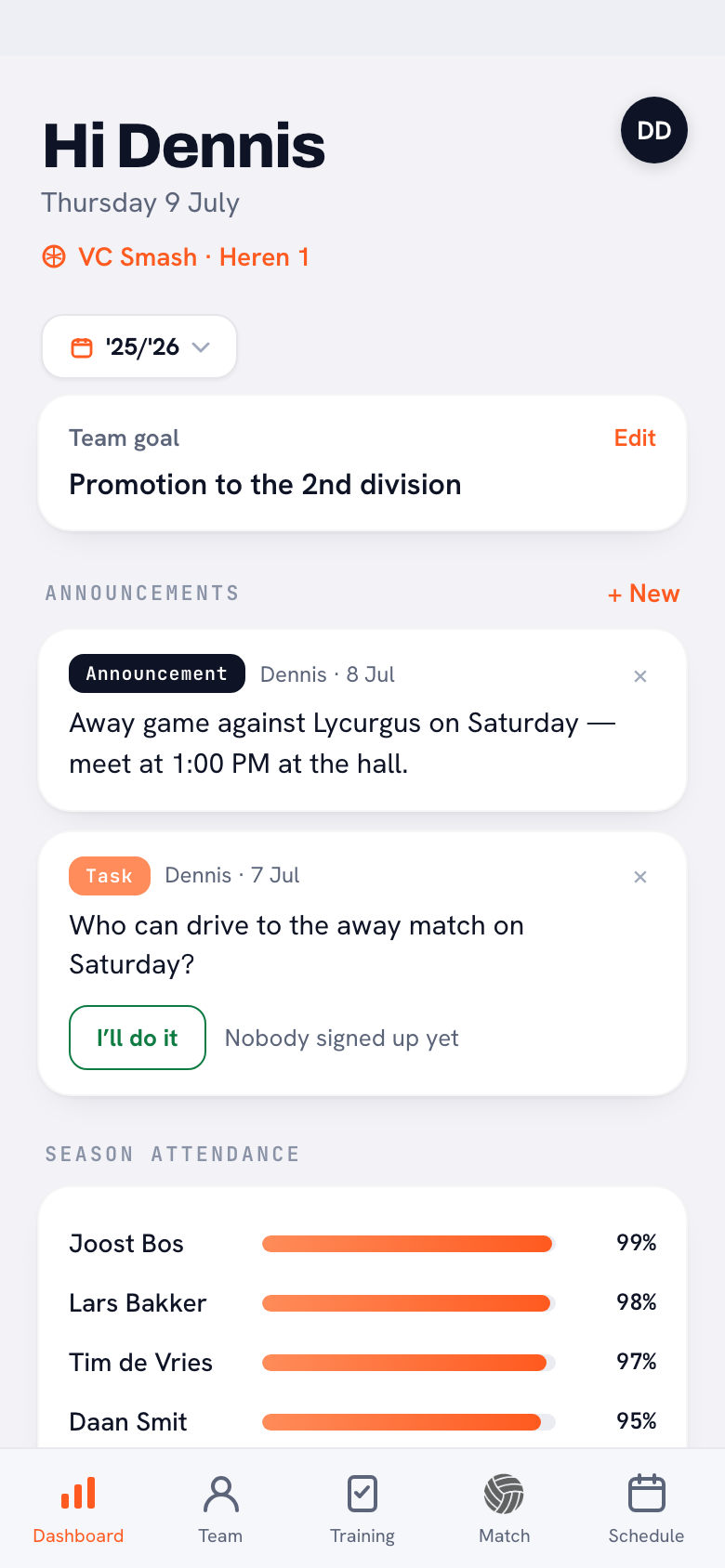
“That sits with the parents. On the home screen I post a task — who can drive to Saturday’s away match? — with an ‘I’ll do it’ button underneath. As long as nobody has stepped up, it literally says ‘Nobody signed up yet’. That is slightly uncomfortable, and that is exactly why it works.
“Parents have their own place in the team as well. They see the schedule and they cancel for their own child when they are ill. And there is a driving rota that tracks how many kilometres somebody has already driven; whoever is lowest goes first. That saves me the same argument every week.”
And in a week when it really is not happening — what do you let slide?
“Live scoring. I do not track it point by point, I just fill in the set scores afterwards, two days later if need be. I lose the playing time and the error breakdown for that match. A shame, but not a disaster.
“I think that matters more than it sounds. An app that only works if you keep it perfectly up to date is an app you throw away in February. Koach has to be usable at half power too. And it does not do everything: it does not design your sessions for you and it does not talk to your players. That stays your job, and rightly so.”
Finally: what would you say to the coach wondering whether to carry on after this season?
“Do not do less — do less of it alone. Ask one person to join you. Put the signing up with the players and the driving with the parents. That is not weakness. That is the difference between one season and five.
“And remember why you started. I did not start in order to keep attendance lists. I started because I saw a team that could get better. Anything that does not contribute to that can go, or can go to somebody else.”
Coach your team, not on your own
Put your team into Koach, invite a second coach and leave the signing up to your players. Free to start, and your squad is in there within ten minutes.
Try Koach free