
Club volunteers: do the job or buy it off?
The same conversation runs at club after club: the same small group does everything, and now something really has to change. The reflex is a compulsory duty with a buy-off fee next to it. Before you introduce that, it is worth working out how many hours your club genuinely asks for — that number usually comes out lower than anyone expects. And then it often turns out you do not have a contribution problem at all, but something else entirely.
First count how many hours your club really asks for
Most clubs have no idea how many hours sit in a season's rota. So the discussion runs on feeling: one member thinks two bar shifts is a lot, the next thinks nothing is being asked at all. Count it once and you have a number everybody can agree on.
An example with round figures. A club with fourteen teams and 180 members, 140 of them old enough to work a shift themselves. Per home playing day the rota looks like this:
- Bar: 2 people times 4 hours = 8 hours.
- Hall duty: 1 person times 4 hours = 4 hours.
- Scorer's table: 5 matches times 1.5 hours = 7.5 hours.
That is 19.5 hours per playing day. Across fifteen home playing days it comes to 292.5 hours. Add two tournament days (around 80 hours together) and the maintenance and cleaning sessions (40 hours) and you are at a good 410 hours per season. Divided by 140 members that is under three hours per member per year — one bar shift, and you still have time to spare.
That number is the heart of this whole subject. Under three hours a year is not heavy; it feels heavy because a small group works the overwhelming majority of those hours. So you do not have a workload problem, you have a distribution problem, and that calls for something other than one more appeal in the newsletter. Work it out for your own club before you read on. Travel to away matches is deliberately left out here — a team sorts that among itself, along with the other jobs on the team manager's task list.
Four ways to share out the club work
In practice there are four models, and what mainly separates them is what they demand of the board. They can also be combined: plenty of clubs put the bar shifts on a rota and leave everything else voluntary.
- Voluntary, but asked in person. No obligation, no money. Someone asks members one by one, with a name, a task, a date and a duration attached. It costs the asker a lot of time and it works surprisingly well — as long as that asker exists. Lose them and the model stops dead.
- Compulsory duty without money. Every member is put on the rota a fixed number of times a year; swapping is allowed, buying your way out is not. The ask is a number and the rota is finished before the season starts. You do need somebody to plug the gaps when a person fails to turn up.
- Compulsory duty with a buy-off fee. Anyone who does not work their shifts pays an amount. This form — the volunteer levy — is normal in countries such as the Netherlands and Germany, but far from everywhere; in Spain, Italy and Poland club members do plenty of jobs too, just not as a charge on top of the membership fee. Whether it is permitted in your country and how you have to set it down differs per federation and per legal form: check before you announce it.
- Built into the membership fee, with a discount for doing the work. The same amount, the other way round: the contribution sits in the fee by default and anyone who works their shifts gets it back. Arithmetically identical to option 3, psychologically not — you are rewarding instead of punishing. The drawback: you collect from everyone up front, including the people who always show up.
Pick one and write down why. The worst model is the half-built one: an obligation nobody enforces teaches members that agreements here are optional — and that carries over into everything you ask afterwards.
The buy-off fee: which amount does what
A buy-off fee is not a fine but a price, and that price decides whether your rota fills up. Convert it into an hourly rate. Say the duty is two shifts of four hours, eight hours together, and the buy-off fee is 40 euros. Then you have valued an hour of your members' time at five euros. Anyone with a job and a busy Saturday does that sum in two seconds and buys their way out. That is not unwillingness; that is exactly what you offered them.
There is only one lower limit that makes sense: the amount for which you could buy those hours in yourself. If hired help in your country costs fifteen to twenty euros an hour including employer's costs, then buying off eight hours is worth 120 to 160 euros. Those rates differ enormously per country, so fill in your own figure. If your buy-off fee sits below it, the club is subsidising the buy-out and the share of people buying out grows every year — until you have a healthy bank balance and an empty bar.
From that follows the sharpest rule in the whole scheme: buying off is only allowed for jobs you can genuinely replace. A bar shift you can buy in. A scorer at a youth match on a Saturday morning you cannot, and hall duty usually not either. Make those buyable anyway and you are selling something you cannot deliver: the money is in the account and the scorer's table is empty. So split your task list into replaceable and non-replaceable, and only let the first column be bought off.
Finally, agree where the money goes and make that visible in the budget. If the buy-off fee disappears into the general pot it is a disguised fee increase, and everybody feels that inside a season.
A fine is a price, not a punishment
Plenty of clubs add a fine on top for people who sign up and then fail to appear. It looks logical and it rarely turns out well. Gneezy and Rustichini (2000) studied day-care centres in Israel that introduced a fine for parents who collected their child late. The number of late collections did not fall, it rose — and it stayed high after the fine was scrapped again. The researchers' explanation: the fine turned a social obligation into a service with a price tag. Once you have paid, you have nothing left to explain.
The same thing happens at a volleyball club. As long as not turning up means "you are leaving your team in the lurch", the social brake is strong. The moment there are 25 euros attached, it has become a transaction, and transactions are negotiable. That same trade-off comes up when you enforce agreements about practice, where a fine system fails for the same reason; improving practice attendance covers what does work instead.
What does hold up: not a fine, but a consequence paid in the same currency. Anyone who misses their shift goes back on the rota — and on the very next date with a gap, not in three months' time. That is not a punishment, that is keeping the agreement.
The consequence nobody plans for: the hours admin
The moment money hangs on a shift, every unrecorded shift is a conflict. That is the first predictable side effect of any levy scheme, and it is routinely underestimated. In the example above that means 140 members with one shift each: a hundred and forty lines a year that have to be right, and double that as soon as you ask for two shifts — including swaps, injuries and people quitting halfway through.
Sort these four things out before you start, not afterwards:
- Does signing up count, or turning up? Choose turning up, and have somebody tick off the completed shift on the spot in the per-member tally — the bar manager on the night itself, not someone reconstructing it from memory a week later.
- Who owns the admin? One name, one fixed moment a month. Two people who both fit it in around everything else means nobody does it.
- How long can somebody object? Put a deadline on it, two weeks after the shift for instance. Without one you will be arguing in June about a Saturday in October.
- Who collects, and what if somebody doesn't pay? This is the unpleasant part and that is precisely why it has to be on paper beforehand. What you are allowed to do about non-payment differs per country and belongs in your own constitution or club rules.
Reckon on about two hours a month, so around twenty hours across a ten-month season. Hold that up against your total of a good 410 hours: administering the scheme costs more hours than six members contribute between them. That is no reason not to do it, but it is a reason to keep it simple and to record it in one place — together with the rest of your agreements in your club handbook. You can also let that record run inside the app: the duty count per member sits in the club side of Koach for volleyball clubs.
An hour behind the bar is not an hour of team selection
The second side effect rarely keeps you waiting: the argument about which hours count. A coach is in the hall forty evenings a year, a team manager adds about an hour a week, and a member of the technical committee spends three weekends in May on the team selection. If those people are handed a bar shift on top, the row that follows is fair enough.
The answer is not to weigh hours against each other, but to make two categories and keep them apart:
- Rota-able shifts: bar, scorer's table, hall duty, maintenance day, tournament day. Short, interchangeable, anyone can do them.
- Roles: coach, team manager, board member, match secretary, referee, committee member. Long, tied to one person, not interchangeable.
Rule of thumb: anyone in a role that costs more than forty hours a year is exempt from rota-able shifts. Put that threshold on a number and publish the list of roles, otherwise every exemption becomes its own conversation. And do not start a points system in which all hours are set off against one another: the treasurer will claim ninety hours, a bar shift four, and you will be weighing hours instead of sharing out work.
Two edge cases you had better decide straight away. Per member or per household? A family with three playing children gets the obligation three times over and has one Saturday. From what age? Working behind a bar carries a legal minimum age in most countries because of alcohol sales; check what applies to you and set down that for younger members the obligation sits with the parent. Which means those parents do have to be in your membership records — at a youth club that is where a large slice of your volunteer potential is, see adding parents to your team.
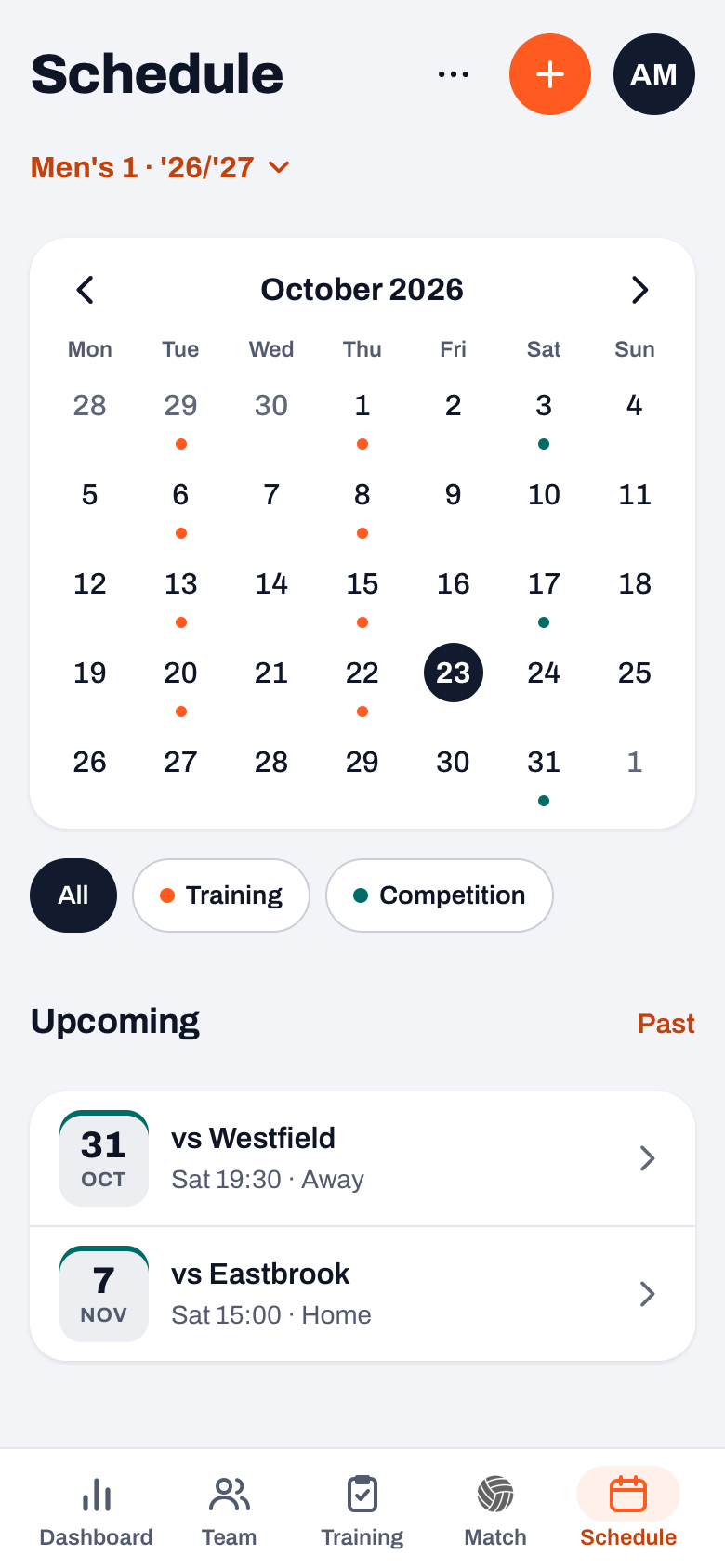
A contribution problem or a visibility problem?
Before you bring in a levy, run this test. Ask five random members two things: what does the club expect from you this season? and what have you done so far? If they cannot name a number for the first and a date for the second, you do not have unwilling members. You have simply never asked clearly — and that is a far cheaper problem to solve.
A distribution of work that does not end up with the same ten people meets three conditions:
- The ask is a number. "Two shifts of four hours per season" is an ask. "We are counting on your help" is a mood, and nobody can act on a mood.
- Everybody can see their own tally. A member who cannot see on their own screen how many shifts they still owe believes they are doing too much when they do a lot, and never thinks about it when they do nothing.
- It is visible that other people are doing it too. People join in with what they see happening around them. A rota with names in it therefore works better than an appeal to everyone — an appeal to everyone is an appeal to nobody.
The same goes for the way you ask. "Who wants to do the bar on Saturday?" in the club group chat produces silence. "Can you do the bar on Saturday 14 March from 12 to 4? You are on with Erik" is a different question: it has a name, a date, a finishing time and a colleague in it. Save the broad club announcement for the things where you genuinely cannot point at anybody.
Practically: put the rota where members are already looking. In Koach a scheduled bar shift appears in the member's own calendar, next to their practices and matches, and in the club dashboard, under ⋯ Bar duties in Match day, you see per shift how many spots are filled; the rules by which that rota gets filled are in planning bar shifts for the whole club. At team level you do the same with smaller jobs through announcements, polls and tasks.
Attach a new member to a job straight away
The moment somebody joins is the only moment at which the ask is not a reproach. A member who has been around four years and suddenly has to work a shift hears a change. Somebody who signs up today hears how it works here.
Three things to set up for that. One: put the duty on the registration form, as the same number as above, with a list of six to eight jobs from which the new member ticks two. Asking about preference costs nothing and raises the chance that somebody actually turns up. Two: schedule the first shift within eight weeks of joining and put somebody experienced alongside them. The first time is the expensive one: a person who does not know how the till works or where the key hangs will call in sick. Three: for youth members the parent signs, not the child — and ask at registration, not in March when the rota will not close.
For existing members the same principle applies at a different moment: the start of the season. Build the distribution of work into the planning of your club year, at the same time as the team selection and the hall hours, so the rota stands before the first match is played — see organising a volleyball season.
The six agreements you record before you introduce anything
Whatever you choose, these are the six points you will fall back on later. Exactly where such a decision has to be recorded — constitution, club rules or simply a board decision — differs per country and per federation, so check that in advance.
- Who is liable for duty: from what age, per member or per household, and whether non-playing members count.
- How much per year, expressed as a number: how many shifts, and how many hours sit behind them.
- What earns an exemption: the list of roles and the hours threshold, in black and white and in public.
- Whether buying off is allowed, for which jobs (only the replaceable ones) and at what price, with the cost of buying the hours in as the floor.
- Where the buy-off money goes, recognisable as its own line in the budget.
- Who does the admin, at what moment, and within what period a member can object.
Six answers, one side of A4. Anyone who cannot write them down is not introducing a scheme yet, they are formalising a frustration — and that costs a season you do not get back.
Key point: work out your total first and divide it by your number of members. If that comes out at a few hours per member per year, a levy is rarely the answer: you are not asking too much, you are asking too few people and asking it too vaguely. Fix that first — and keep the buy-off fee in reserve for the jobs you can genuinely buy in.
Frequently asked questions
Can a sports club make volunteering compulsory?
That depends on your legal form, your constitution and the law in your country. In the Netherlands and Germany a compulsory volunteer levy with a buy-off option is common; in many other countries it is not. Have the decision taken by whichever body your constitution puts in charge of the membership fee — at many clubs that is the general meeting of members — record it in writing, and ask your own federation what is permitted in your situation.
How high should the buy-off fee for a bar shift be?
At least the amount for which you could buy those hours in yourself. Convert it into an hourly rate: if the buy-off fee sits below what hired help costs per hour, you are subsidising the buy-out and your rota empties a little further every year. And only allow jobs to be bought off that you can genuinely replace — you do not hire in a scorer for a youth match.
Does a fine for a missed shift work?
Usually not. Gneezy and Rustichini (2000) showed at day-care centres that a fine for late collection did not reduce the behaviour but increased it, because a social obligation turned into a service with a price tag. The same mechanism operates at a club: rather than charging money, put the missed shift back on the rota at the very next date with a gap.
How many volunteer hours can you ask of a member?
Work it out rather than guessing: add up all the rota-able hours in a season and divide them by the number of members who can work a shift. That number often comes out lower than members expect; a few hours per member per year is not unusual. If it still feels like a lot, the problem is in the distribution and not in the size.
Do parents of youth members have to work shifts too?
Yes, and you agree that explicitly, because working behind a bar carries a legal minimum age in most countries. Set down that for members under that age the obligation sits with the parent or carer, and decide whether you count per child or per household — a family with three playing children still only has one Saturday.
How do you stop the same ten people doing everything?
Replace appeals with a rota that has names on it, make the ask a number, and make sure every member can see their own tally. Ask in person rather than in the group chat as well: with a name, a date, a finishing time and a colleague attached, it is a different question. And attach new members to their first job the moment they register.




Try it yourself in Koach
Less admin, more coaching.
Get started with KoachOr read first what the volleyball coaching app does.