What Does an Outside Hitter Do in Volleyball? Four Jobs
Ask any coach who their most important player is and the answer is usually the setter or the top scorer. Ask who they could least afford to lose, and it is almost always their outside hitter. That is no coincidence.
Why the outside does the most
The outside hitter — left side, wing spiker — is the only player with a job in every phase of every rally. She passes the serve, attacks from the left, blocks on the left, defends in the back row and serves. Where the opposite is an attacking specialist and the middle a blocking specialist, the outside is a generalist who has to be at least decent in four areas.
Most teams play with two outside hitters standing opposite each other, so there is always one in the front row. Between them they account for the majority of the attacks and the majority of the serve-receive balls — and it is precisely that combination that makes the position so heavy.
Job 1: passing, and why it weighs heaviest
In a three-person serve receive the passing line is the libero plus the two outside hitters. That means your hitter covers a third of the court against the opponent's sharpest serve — and has to run her approach immediately afterwards. Servers know it: 'serve their best hitter' is not a classic serving tactic by accident. An outside who has to pass a deep ball first starts her approach later, shorter and flatter.
The consequence for the coach: for this player, passing practice is attacking practice. Every tenth of a second she wins in the pass, she also wins in her approach.
Job 2: the ball nobody else wants
The outside hitter gets the high ball. Off a perfect pass she can pick from every tempo, but off a mediocre pass — and at club level that is the majority — the ball goes high to the left, with a closed double block on the other side. That is the out-of-system emergency button of virtually every team, and it sits under her name.
So you read her attack percentage differently than a middle's: a middle gets almost only good balls, an outside almost only hard ones. An outside hitter at 25 percent who swings twelve times a set is worth more than a middle at 45 percent with four swings.
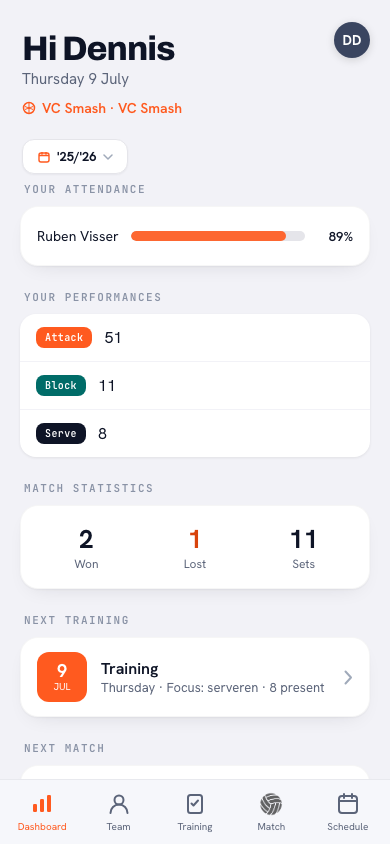
Outside hitters carry both reception and attack, so it helps to see both their pass ratings and attack percentage side by side in Koach, on the same player screen.
Job 3: blocking their opposite
At P4 she stands across from the opponent's P2 — their opposite. That is usually their hardest hitter, and often their back-row attacker as well. So your outside has to do more than block: she has to learn to deal with a hitter who swings steeply from close range. The angle she shuts determines where your floor defense stands; without that agreement, you defend on hope every rally.
Job 4: defending and the pipe
When she rotates back, she becomes a defender at P5 or P6 — the zones where most hard cross-court attacks land. And in the rotations where she is in the back row she is often the designated player for the attack out of the middle back, the pipe. At a lot of teams that is the only way to threaten with four attackers instead of three.
The load: two roles at once
Do the maths and you understand why this player breaks down first. Per set she passes ten to fifteen balls, swings ten to fifteen times, blocks dozens of times and defends in the back row. That is nearly double what an opposite does. Two practical consequences: watch her load when there are three matches in a week, and never train her on attacking alone — a tired outside loses her pass before she loses her swing.
What to look for and what to train
- Consistency in the pass. Above everything else. A hitter who cannot pass cannot be an outside, however hard she swings.
- Being able to attack a high ball. Against a double block: use the block, roll it over, find the line.
- Being able to adapt the approach. From outside the court, from close in, after a pass — different every time.
- Blocking a hard hitter. Hands over the net, angle shut, not jumping into the ball.
The best drill is a combination: pass a serve, turn straight out and attack the ball that gets set from that pass. Ten series, with the second half deliberately off mediocre passes. That is exactly what the match asks of her, and exactly what is missing from most training sessions.
Never judge an outside hitter on her attack percentage alone. Put her pass rating next to it. A player who passes the hardest serves and swings at the hardest balls should not sit at the bottom of a list that measures only one of the two.
Frequently asked questions
What is the difference between an outside hitter and an opposite?
The outside hitter passes and attacks from the left; the opposite stays out of serve receive and attacks from the right. That makes the outside the most complete player on the team and the opposite the attacking specialist.
Why do outside hitters pass and middles do not?
Because the outside can simply turn out for her approach after passing, whereas a middle would never make her fast attack if she had to pass first. Outside hitters are also generally the better passers.
How many balls does an outside hitter swing at per set?
At club level usually ten to fifteen, often more than any other player — and that is on top of ten to fifteen serve-receive balls. That double load is exactly what makes the position so heavy.
What do you train first with a young outside hitter?
The pass. A hitter who cannot handle the serve never gets to attack in matches, however good her swing is. After that, combine passing and attacking in the same drill.