What Happens If a Volleyball Player Gets Injured Mid-Match?
A player lands badly after a block and stays down. What happens next is largely written into the rules: when the referee has to stop, how much time you get, and which substitution you still have in hand when formally you have none left.
Stopping immediately for a serious accident
If something serious happens while the ball is in play, the first referee must stop play immediately and allow medical assistance onto the court (rule 17.1.1). The rally is then replayed — so no point is scored, even if the ball was practically on the floor. That is deliberate: nobody should have to weigh up playing on while a team-mate is down.
In lighter cases — a rolled ankle, a ball in the face — the referee stops play as soon as the rally is over. What follows depends on whether you can still substitute.
First, an ordinary substitution
The main rule is simple: a player who cannot continue is substituted normally within the six substitutions each team has per set (rule 15.6). All the conditions — who may come on for whom, and how often — are in the substitution rules. As long as you still have that room, an injury is nothing special in rule terms.
The three-minute recovery time
If the player cannot be substituted either normally or exceptionally, they get three minutes of recovery time (rule 17.1.2). Two hard limits apply: it may happen only once per player per match, and the referee keeps the time. If the player has not recovered after three minutes, their team is declared incomplete for that set — what that means for the result is in fewer than six players.
Note the order: recovery time is the last option, not the first. A team that still has substitutions left does not get three minutes to let a player catch their breath. Those three minutes are not an extra time-out either: coaching is allowed, but the team stays with the injured player rather than huddling by the bench.
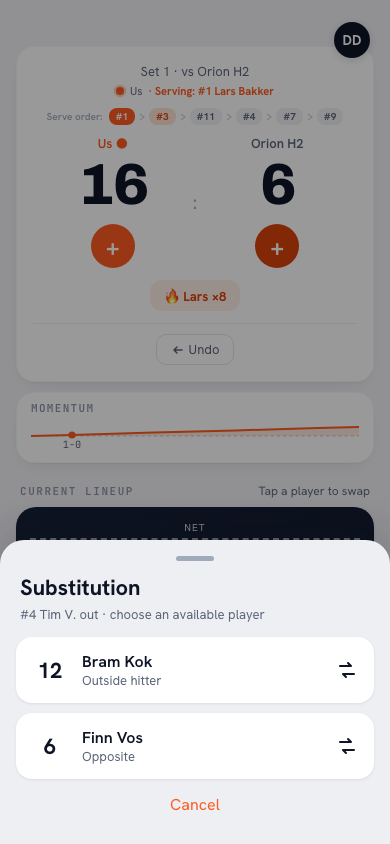
Every substitution you enter in Koach ends up in the match report, including the one you had to make after an injury.
The exceptional substitution
This is the rule that gets forgotten most often. If an injured player cannot be substituted normally — because you have used your six substitutions, or because the only eligible player has already been substituted — the team is entitled to an exceptional substitution, over and above the normal limit (rule 15.7).
The conditions are exact:
- Any player who is not on court at the moment of the injury may come on, except the libero, the second libero and the player being replaced by the libero.
- The exceptional substitution does not count towards the six regular substitutions for that set.
- The injured player may not return for the rest of the match — not in that set and not in a later one.
That last point makes it a heavy call in borderline cases. A player who will probably be fine in ten minutes is better substituted normally; only somebody who is genuinely done goes off through the exceptional substitution.
If the libero goes off
The libero has their own route. If they are injured, the coach may — with the first referee's permission — designate a new libero from the players not on court at that moment (excluding the player the libero is currently replacing). The injured libero may not take part again for the rest of the match. How libero replacements normally work is in the libero replacement rules.
What to arrange as a coach beforehand
- Know who your exceptional substitution would be. If your six substitutions are gone and somebody goes down, you do not want to start puzzling. Decide it in advance, per rotation.
- Make sure there is a first-aid kit and somebody responsible for it. In regional competition there is no medical staff; the referee allows help onto the court but does not provide it.
- Never let a player with a head injury continue. That is not in the rules of the game, but it is in every sports-medical protocol.
- Write down what happened. For the return to training, the nature of the injury matters more than the result — see also injury prevention in volleyball.
Youth and recreational competitions use the same rules: there is no separate youth version of the recovery time or the exceptional substitution. What does differ is the practice — at youth matches the referee is often a junior player themselves, and then it is up to the coaches of both teams to work calmly through the protocol.
Frequently asked questions
How much recovery time does an injured player get?
Three minutes, and at most once per player per match. That recovery time only applies if the player cannot be substituted either normally or exceptionally. If they have not recovered afterwards, the team is declared incomplete for that set.
What is an exceptional substitution?
An extra substitution on top of the six regular ones per set, for a player who cannot continue because of injury. Any player not on court at that moment may come on, except the liberos and the player the libero is replacing.
Can the injured player come back later?
Not after an exceptional substitution: that player may not take part again for the rest of the match. After a regular substitution they may return, under the normal substitution rules.
What happens to the rally in which the injury occurred?
In a serious accident the referee stops play immediately and the rally is replayed — so no point is scored. In lighter cases the rally is played out first.