
Dislocated shoulder in volleyball: what to do and the way back
The short answer
A dislocated shoulder in volleyball is an emergency: the player stops, you support the arm in the position they are holding it, and they go to a doctor right away. Never put the shoulder back in yourself. According to the NHS, recovery usually takes 6 to 12 weeks; when they hit and block again is decided by the person treating them.
A dislocated shoulder in volleyball happens in a fraction of a second: a fall on an outstretched arm, a dive that goes wrong, a collision at the net. What you do in the minutes after counts. Here you read what you do and leave alone in the gym, why it comes back more often and what the way back looks like.
What happens when a shoulder dislocates
The shoulder joint is a ball in a shallow socket: the head of the upper arm bone rests against a flat little socket on the shoulder blade. That gives the arm its huge freedom of movement, and it makes the shoulder vulnerable. In a dislocated shoulder, a dislocation, the head of the upper arm bone pops out of that socket. If it only comes partly out and pops back in by itself, it is called a subluxation. According to the American Academy of Orthopaedic Surgeons (AAOS), the shoulder usually dislocates forward, and that happens while the arm is raised away from the body.
That is exactly the position volleyball players often have their arms in. The cause is usually a blow, a fall or a collision (source: MedlinePlus). In volleyball you can think, for example, of a player who catches a dive on an outstretched arm, two players diving for the same ball at the same time, or a blocker who falls against a teammate or the net with raised arms. So it is a different injury from the creeping pain in the hitting arm from too much attacking; that is covered in shoulder problems in volleyball.
Recognizing it: what a dislocated shoulder looks like
According to the AAOS, a shoulder that is fully dislocated is usually very painful and clearly visible. The UK's National Health Service (NHS) lists these signs after a blow to the shoulder:
- the player cannot move their arm;
- the shoulder looks different or is out of place;
- pain, swelling or bruising.
The arm may also feel numb or weak, or tingle (AAOS, MedlinePlus). A subluxation is trickier: the bones can pop back in by themselves and the joint may then look fairly normal, the AAOS writes. The player then says the shoulder "slipped out for a second". Have that checked as well, because according to the AAOS a shoulder that has been partly out of its socket can keep doing so if the ligaments do not heal properly.
In the gym: what you do and what you never do
The general order after an injury, from stopping play to who makes the call, is in volleyball first aid. For a dislocated shoulder it comes down to this:
- The player stops right away. No "let's see if it works", no playing on, no moving the arm.
- Support the arm in the position the player is holding it. MedlinePlus puts it like this: splint the arm in the position you find it in and do not move the joint. The NHS mentions a sling or a towel to support the arm, and briefly cooling with a cold pack wrapped in a cloth.
- Straight to a doctor. A dislocated shoulder belongs in the emergency department. The player does not drive themselves; if they cannot get there safely, call the emergency number (NHS): 112 in the European Union, elsewhere your own country's number. Also call the emergency number right away if the arm or hand below the shoulder is pale, cold, clammy or blue (MedlinePlus).
- Never put it back in yourself. Not even if a teammate, parent or coach says they have done it before. Both the NHS and MedlinePlus say it without reservation: do not try to put the joint back yourself. In hospital an X-ray is taken first; then a doctor puts the shoulder back, with an anesthetic or a sedative (NHS).
- With young players: call the parents and have a parent or another adult go along.
If it happens during a match, the referee stops play in the case of a serious accident; how it continues afterward with substitutions is in an injury during the match.
Say it out loud at the start of the season. Agree with your team that nobody puts back or pulls straight a shoulder, finger or knee, not even someone who once saw it done. Then you don't have to argue about it in the moment.
Why a shoulder that has been out comes back more often
The chance of it happening again is real. According to MedlinePlus, a joint that has been dislocated once dislocates more easily again, and the AAOS names people who have already had a dislocation as a high-risk group. People with naturally loose ligaments also run a higher risk, according to the AAOS.
How big that chance is was examined in a review by Olds and colleagues in the British Journal of Sports Medicine (2015). In ten studies with a combined 1324 adults, 39 percent had renewed trouble with an unstable shoulder after a first traumatic forward dislocation. Those who were 40 or younger the first time ran a clearly higher risk, as did men and people with loose ligaments. The risk became smaller the more time had passed since the first time.
That is also why treatment after a first dislocation varies. The NHS writes that surgery is sometimes needed to reduce the chance of another dislocation, and the AAOS mentions young athletes in particular as a group that may already choose it after a first time. Whether it will be exercise therapy or surgery, the doctor and the player decide together. You don't need to have an opinion on that; it is good to know, though, that it is not a minor injury.
The way back to hitting and blocking
According to the NHS, recovery from a dislocated shoulder usually takes 6 to 12 weeks, with a sling in the first weeks. A full return to some sports can take up to 16 weeks, and for some people longer. A physiotherapist can give exercises for pain and stiffness, and to regain mobility and strength (NHS, AAOS). When the player can play sport again is something they discuss with their doctor or physiotherapist.
That return runs on criteria, not on the calendar. In a review of non-surgical treatment in the Journal of Athletic Training (2024), Olds and Uhl describe rehab in phases, in which an athlete only moves on once they pass the previous step, with tests of strength and stability at the end and also the question of whether they are mentally ready. For you as a coach that means three things:
- Ask at each step what is allowed. Passing, footwork, setting, hitting without a jump, hitting with a jump: the person treating the player says which step is possible now. You adapt the drills to that.
- Ask explicitly about blocking, diving and falling. In those the arm goes above or beside the head and you catch yourself, the position in which, according to the AAOS, a shoulder most often dislocates forward. How to learn to fall without catching yourself on one arm is in defending and diving.
- Expect hesitation. A player also has to be mentally ready, Olds and Uhl write. If they do not yet dare to block or dive fully, build up their match minutes calmly and discuss it with the player and the physiotherapist.
Shoulder exercises with a band, as in resistance band exercises for volleyball, are meant for a healthy shoulder. After a dislocation, the player follows their physiotherapist's program. If symptoms persist, the shoulder feels loose or it pops out again, go back to the family doctor, sports physician or physiotherapist.
What you do as a coach until they are back
A player with their arm in a sling can often still do a lot: be at practice, keep stats, listen in during the timeout, help run a drill with the youth players. Someone who sits at home for weeks easily drifts away, and a player who stays involved also tells you sooner how things are going. If you are new to coaching, starting as a volleyball coach covers what to arrange from the start besides the practices.
Keeping track in Koach of who is injured and what was agreed
Koach does not make a rehab plan; the physiotherapist does that. What you do in the app is keep track of who is not taking part, or only partly. On the player profile, tap the pencil (Edit player) and under Status set the player to Injured. When you prepare a match, they then appear grayed out with that label at the end of the bench, and they get no nudge or reminder to sign up. Teammates see Absent for them instead of Injured.
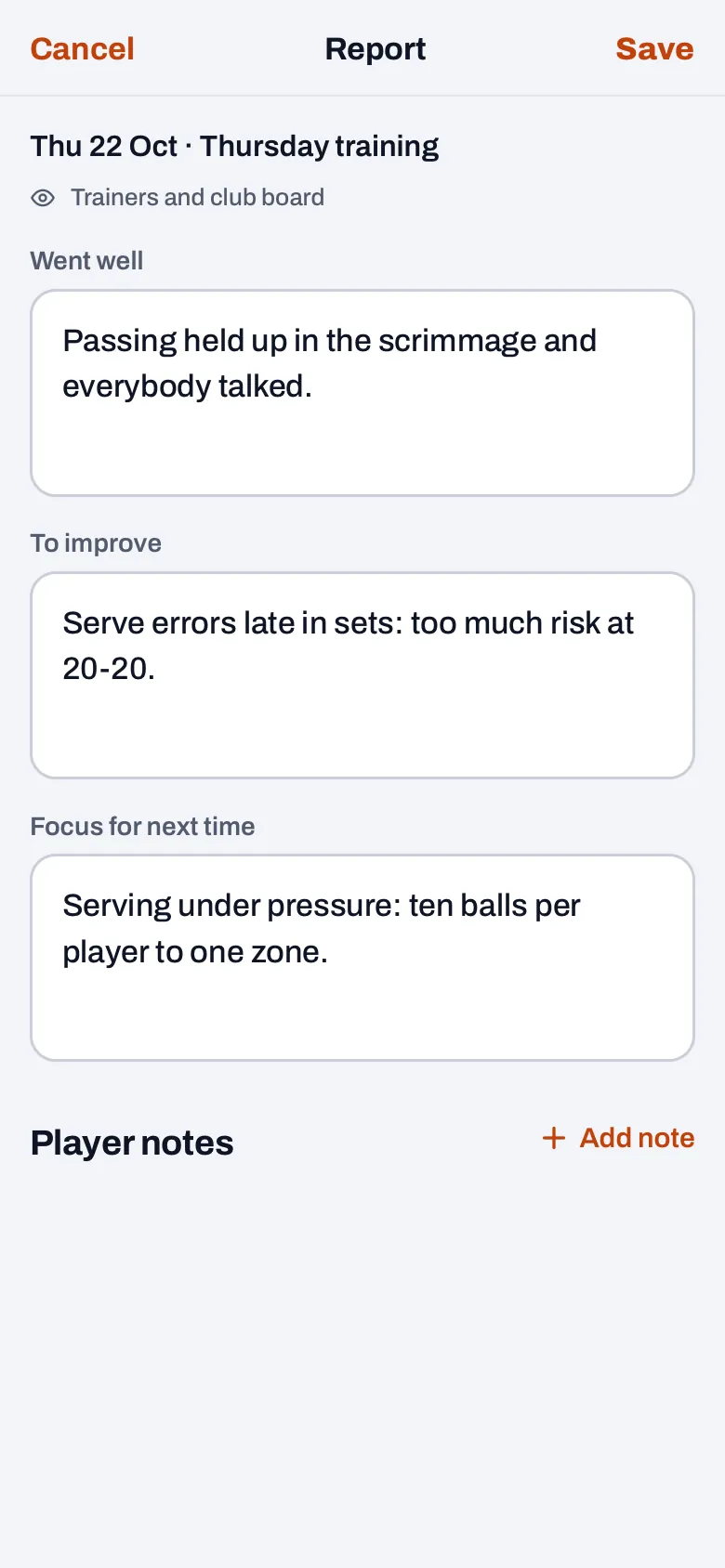
After a practice, under Report in Player notes, you write which step the physiotherapist has cleared and what the player skipped. Those notes are seen by the coaches, and for a team in a club also by the club board; players and parents don't see them. That way your assistant knows too, and weeks later you can still see when they were allowed to block again. The status has no end date: when they are fully back, you set them back to Active yourself.
14 days free, no credit card. Add your team tonight and keep track of who is injured and what was agreed with the physiotherapist.
Try Koach with your teamWhat Koach costs after the trial is on the pricing page.
Frequently asked questions
Can you put a dislocated shoulder back in yourself?
No. The NHS and MedlinePlus both say you should not put the arm back yourself. In hospital, an X-ray usually first confirms that the shoulder is dislocated, and then a doctor puts it back with an anesthetic or a sedative. Support the arm in the position the player is holding it and go straight to the emergency department.
How long does it take to recover from a dislocated shoulder?
According to the NHS, usually 6 to 12 weeks, with a sling in the first weeks. A full return to some sports can take up to 16 weeks, and for some people longer. When a volleyball player hits, blocks and dives again is decided by the doctor or physiotherapist based on strength and stability, not by the match schedule.
Can a shoulder dislocate again?
Yes. According to a review by Olds and colleagues (2015), 39 percent of adults had renewed trouble with an unstable shoulder after a first traumatic forward dislocation. Those who were 40 or younger the first time ran a higher risk, as did men and people with loose ligaments. That is why, with young athletes, a doctor sometimes discusses surgery after the first time.
What if the shoulder pops back in by itself?
Then it may have been a partial dislocation, a subluxation. According to the AAOS, the bones can pop back in by themselves and the joint may then look fairly normal. Still have it checked by a family doctor or sports physician: a shoulder that has been partly out of its socket can keep doing so if the ligaments do not heal properly.


Keep track of who is injured
14 days free, no credit card. Your players' status and agreements in one place.
Get started with KoachOr read first what the volleyball coaching app does.