
Volleyball first aid: the kit and the first minutes of an injury
The short answer
Volleyball first aid comes down to three things: a stocked first aid kit with gloves, dressings and cold packs, a calm first few minutes (stop play, keep the injury still, never put anything back in place yourself) and knowing when to call the emergency number. If you suspect a concussion, the player does not play again that day.
Volleyball first aid does not start with the injury, but with the kit you bring. An ankle rolled under the net, a finger pointing the wrong way, a ball full in the face: in the first minutes you are often the only adult on the sideline. This is what you do then, and what you leave alone.
What goes in a volleyball team's first aid kit?
In its 2025 first aid guidelines, the European Resuscitation Council (ERC) gives a basic content list for every first aid kit, and adds straight away that you supplement it for the risks of your own situation. In volleyball those are mainly ankles, fingers and balls to the face. This is a kit that always comes along:
| In the kit | What it is for in volleyball |
|---|---|
| Disposable gloves and hand sanitizer | For every wound and every nosebleed, for you and the player |
| Adhesive bandages, medium and large wound dressings | Scrapes after a dive, an open spot on a finger |
| Roller bandage, triangular bandages, safety pins and tape | Supporting an ankle or wrist, an arm in a sling |
| Cold packs or ice in a cooler bag, plus a thin cloth | Briefly cooling a sprained ankle or a bruised finger |
| Scissors and tweezers | Cutting tape and bandage to size |
| Pocket mask or face shield | Resuscitation, if you have learned it |
| The emergency plan on paper and a pen | Emergency numbers, the address of the gym, noting the time |
Painkillers are not on that list, and handing them out is not a coach's job either. The ERC says it in one line: always call for help, and only use equipment and products you have been trained to use. The guidelines also ask you to check the kit regularly; do it at least at the start of the season and after every use, because you only notice an empty cold pack when you need it. Also know where the AED and the gym's own first aid box are. Put them on the emergency plan for your team, together with your players' emergency numbers. The rest of your preparation as a new coach is in starting as a volleyball coach.
The first minute: stop play and look
If a serious accident happens in a match while the ball is in play, the referee stops play immediately and allows medical assistance onto the court; the rally is then replayed (rule 17.1.1 of the FIVB rules). At practice you are the referee: blow the whistle, even if the rest are still playing. Then follow the order from the ERC guidelines:
- Is it safe? Balls away from the player, the rest of the team stops and keeps its distance.
- Does the player respond? Talk to them. No response? Read below what to do when a player collapses.
- Are they breathing normally, and are they bleeding heavily? You stop severe bleeding with direct pressure on the wound.
- Only then the injury itself. Let the player lie or sit and ask where it hurts, before anyone touches an ankle or a finger.
Send one person to get the kit and one to call the emergency number if needed. In the whole European Union that is 112, free of charge and from any phone, and the same number also works in a number of countries outside the EU (source: European Commission). Elsewhere you call your own country's emergency number; if you play a tournament abroad, look it up beforehand.
Sprained ankle or finger: the first minutes
You do not need to know what is broken. The international first aid guidelines of the Red Cross and Red Crescent Movement (IFRC, 2020) keep it simple: if in doubt, assume it is broken. Only an X-ray confirms a fracture, and you do not take one on the sideline.
- Still and supported. Keep the ankle or hand still and support it in the position that hurts least, raised if possible. Do not pull on anything or straighten anything.
- Cool it for the pain. The Netherlands Red Cross (page in Dutch) advises cooling for 10 to 20 minutes when there is pain, with the ice or cold pack in a thin cloth so the skin does not freeze, and stopping if the pain increases. See it as pain relief for the first minutes, not as treatment: for the days after, the advice is no longer rest and ice, but protect, elevate and start moving again as soon as the pain allows (Dubois and Esculier, British Journal of Sports Medicine, 2020).
- Ankle: watch the four steps. If the player cannot walk four steps without help, if the swelling has not gone down after 4 to 5 days or if the pain only gets worse, they should see a doctor, according to the Netherlands Red Cross.
- Finger. A finger that is crooked or has been out of its joint is something you never put back yourself: according to the IFRC, a dislocation always needs to be seen by a doctor. Take off any ring before the finger swells. When taping is fine is covered in taping fingers in volleyball.
How a player comes back safely after a sprain is covered in returning after an ankle injury.
Ball to the face: nose, eye and tooth
- Nosebleed. Have the player lean forward, so they do not swallow blood, and pinch their nose for 10 minutes; after that, take it easy for at least 30 minutes, says the Netherlands Red Cross. So they do not go straight back on court. If the nosebleed comes from a blow, such as a ball or an elbow, the Netherlands Red Cross advises contacting a doctor urgently.
- Eye. No rubbing and no pressing. If the player's vision has changed after the blow, they have severe pain, there is blood coming from the eye, they get a headache, feel sick or cannot keep the eye open, they go to the emergency department (source: NHS).
- Tooth. Hold a knocked-out tooth by the crown, not by the root, do not clean it and do not put it back yourself. Keep it in cling film with a little saliva, or otherwise in milk, and have the player see a dentist as soon as possible (IFRC). For a baby tooth of a young child, seeing a dentist is the advice too.
Blow to the head: out, and with these signs call the emergency number
A ball to the head often looks harmless; that is exactly why the rule is strict. The ERC guidelines list the signs of a concussion: trouble thinking or remembering, headache, changes in vision, dizziness, nausea or vomiting, sensitivity to light or noise, and a player who behaves differently than usual. If you suspect a concussion, take the player out of the practice or match, and according to the ERC have them assessed by a doctor right away, so that same day. They do not play again that day, even if they feel fine again a little later; that is also how the US public health agency CDC puts it.
Call the emergency number right away for a head injury with any of these signs, listed in the IFRC guidelines:
- has been unconscious, even if only for a few seconds;
- confused, aggressive or slurring their words, or a seizure with jerking movements;
- tingling in an arm or leg, or problems with balance;
- blurred or double vision;
- a severe headache that has not eased after two hours;
- blood or clear fluid from the nose, ear or mouth;
- vomiting more than once;
- not responding and not breathing normally.
After a fall, also think of the neck. If the player has neck pain or tingling, call the emergency number, do not move them and ask them to keep their head as still as possible until the emergency services arrive (IFRC). Recognizing a concussion, informing the parents and the return to play are covered in ball to the head and concussion.
A player collapses: think of cardiac arrest
The 2025 ERC guidelines are clear: if someone does not respond and is not breathing normally, assume cardiac arrest. Slow, labored or gasping breathing counts as not normal. At the start there may briefly be something that looks like a seizure; as soon as that stops, check the breathing again.
- Call the emergency number with the phone on speaker; the dispatcher guides you through the next steps.
- Start chest compressions right away, in the middle of the chest.
- Have someone fetch the AED, switch it on and follow the spoken instructions. Anyone may use an AED.
- If you have learned rescue breaths, alternate 30 compressions with 2 breaths; if you have not, continue with compressions only (ERC).
Afterwards: who you call and what you write down
Once the player has been looked after, you take care of three things. You call their emergency contact; with youth players a parent picks the child up, and after a blow to the head a child never goes home alone. You inform the club, and the facility manager if you used the gym's AED or first aid box. And that same evening you write down what happened: the time, what you saw and what you did. According to the IFRC, that time helps a doctor. Tell the team briefly what happened, without medical details.
If symptoms persist or are severe, the player should see their doctor, a sports physician or a physiotherapist. That person also decides when the player plays again, not the match schedule. How to reduce the chance of these injuries is in injury prevention in volleyball.
Pack the kit together with your assistant before the first practice. Then you both know where the cold packs and gloves are, and you have agreed in advance who makes the call while the other stays with the player.
Keeping track of injuries in Koach
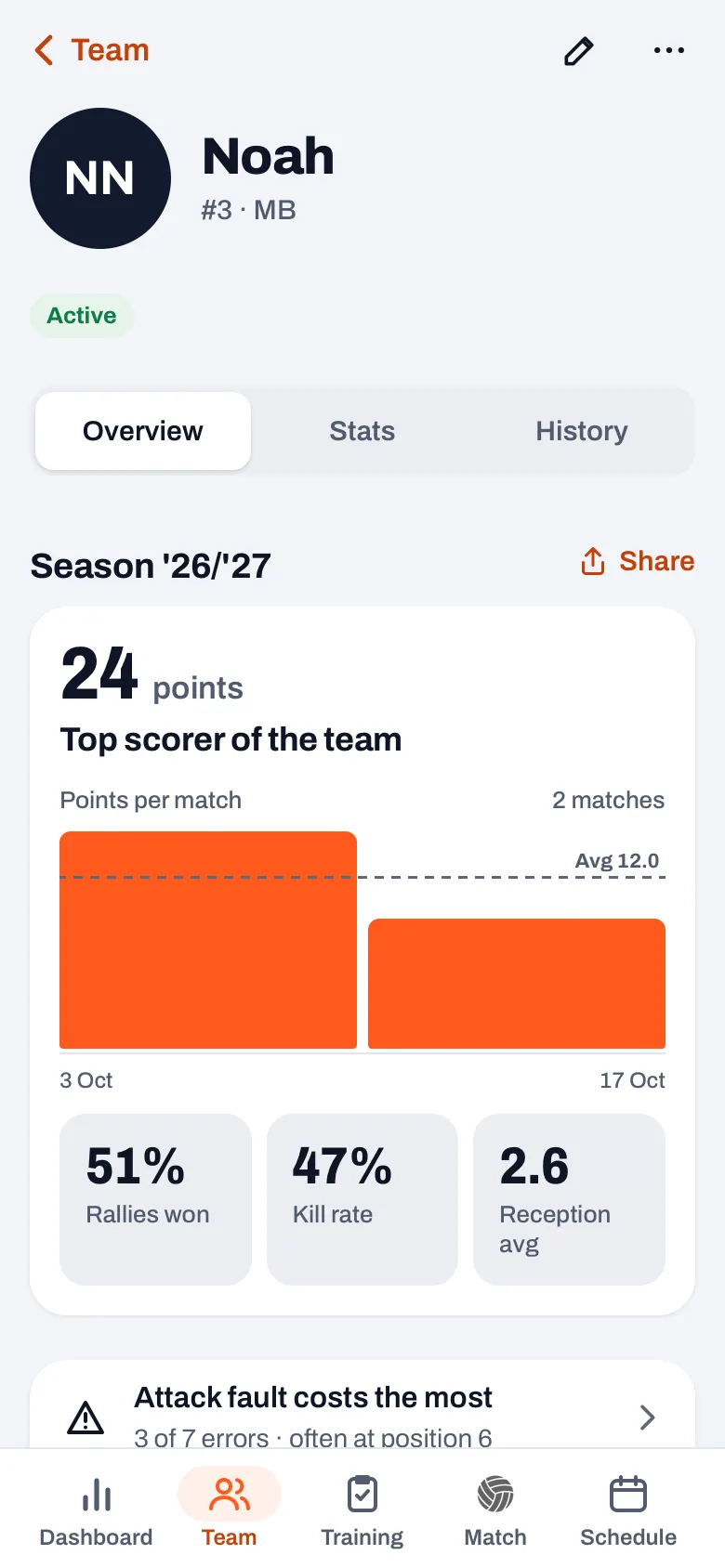
On the player profile in Koach, tap the pencil (Edit player) and under Status set the player to Injured. When you prepare a match, they then appear grayed out with that label at the end of the bench, and they do not get a nudge or reminder for a practice or match. Teammates see Absent for them instead of Injured. If the player has their own account, their profile shows further down, under Contact, the emergency contact they filled in themselves, and you call it with one tap. For players without their own account, often the youngest players, nothing is shown there: put their parents' numbers on your emergency plan. What happened at practice you write down with that practice under Report, as a player note.
14 days free, no credit card. Add your team tonight and see right away for each player whether they are fit for Saturday.
Try Koach with your teamWhat Koach costs after the trial is on the pricing page.
Frequently asked questions
What should be in a first aid kit for a volleyball team?
According to the 2025 first aid guidelines of the European Resuscitation Council, at least adhesive bandages, wound dressings, a roller bandage, triangular bandages, safety pins, tape, disposable gloves, hand sanitizer and a pocket mask, in a waterproof and clearly marked bag. For volleyball you add cold packs or ice, a thin cloth and sports tape for fingers. Also put the emergency plan with emergency numbers and the address of the gym in it.
Can you put ice on a sprained ankle?
Yes, briefly and for the pain. The Netherlands Red Cross advises cooling for 10 to 20 minutes, with the ice or cold pack in a thin cloth so the skin does not freeze, and stopping if the pain increases. Support the ankle and keep it raised. If the player cannot walk four steps without help, they see a doctor. For the days after, the advice is no longer rest and ice, but protecting the ankle and moving again as soon as the pain allows.
When do you call the emergency number for an injury at practice?
Call the emergency number (112 in the EU, elsewhere your own country's number) for a player who does not respond or is not breathing normally, for neck pain or tingling after a fall, and after a blow to the head with loss of consciousness, confusion, repeated vomiting, double vision, or blood or clear fluid from the nose or ear. According to the IFRC guidelines, an arm or leg in an odd position, or with a lot of pain and swelling, is also a reason. If in doubt, call: the dispatcher helps you decide.
Does a volleyball coach need a first aid certificate?
That differs by country, federation and club. A course in first aid, CPR and AED use is a good idea though: what you have practiced, you also do under pressure. The European Resuscitation Council also says you should only use equipment you have been trained to use. Ask your club whether it organizes a course, and agree within your team who gives first aid.
Know on Saturday who is fit
14 days free, no credit card. See for each player whether they are injured, and record what happened.
Get started with KoachOr read first what the volleyball coaching app does.