
Emergency action plan for volleyball: free template for your team
The short answer
Your club or venue has an emergency plan for the building. Your team also needs its own short emergency action plan: the emergency number, the venue address, where the AED is, who does what and every player's emergency contact. The template below is free, and in Koach each player with an account fills in their own emergency contact.
Your club or venue has an emergency plan for the building, but who makes the call when your middle blocker lands badly at practice? Here is a free emergency action plan for volleyball teams that you can fill in and print, plus where your players' emergency contacts live in Koach.
Free emergency action plan template for your team (PDF and Word)
First, what you came for: an emergency action plan for your volleyball team, free, and without leaving your email address anywhere.
- Printable emergency action plan for your volleyball team (PDF): two A4 pages with the emergency number, the venue, who does what, emergency contacts for 18 players and what to sort out afterwards. On US Letter paper, choose "fit to page" when you print.
- The same template in Word (.docx): fill it in on your computer and adapt it to your own team and your own venue.
You are free to use, copy and adapt the template. Fill in the team, the season and the date at the top. Do it before the first practice, together with your assistant coach, and print two copies: one goes in the ball bag, your assistant keeps the other. Paper has one advantage no app has: it still works when your phone is dead.
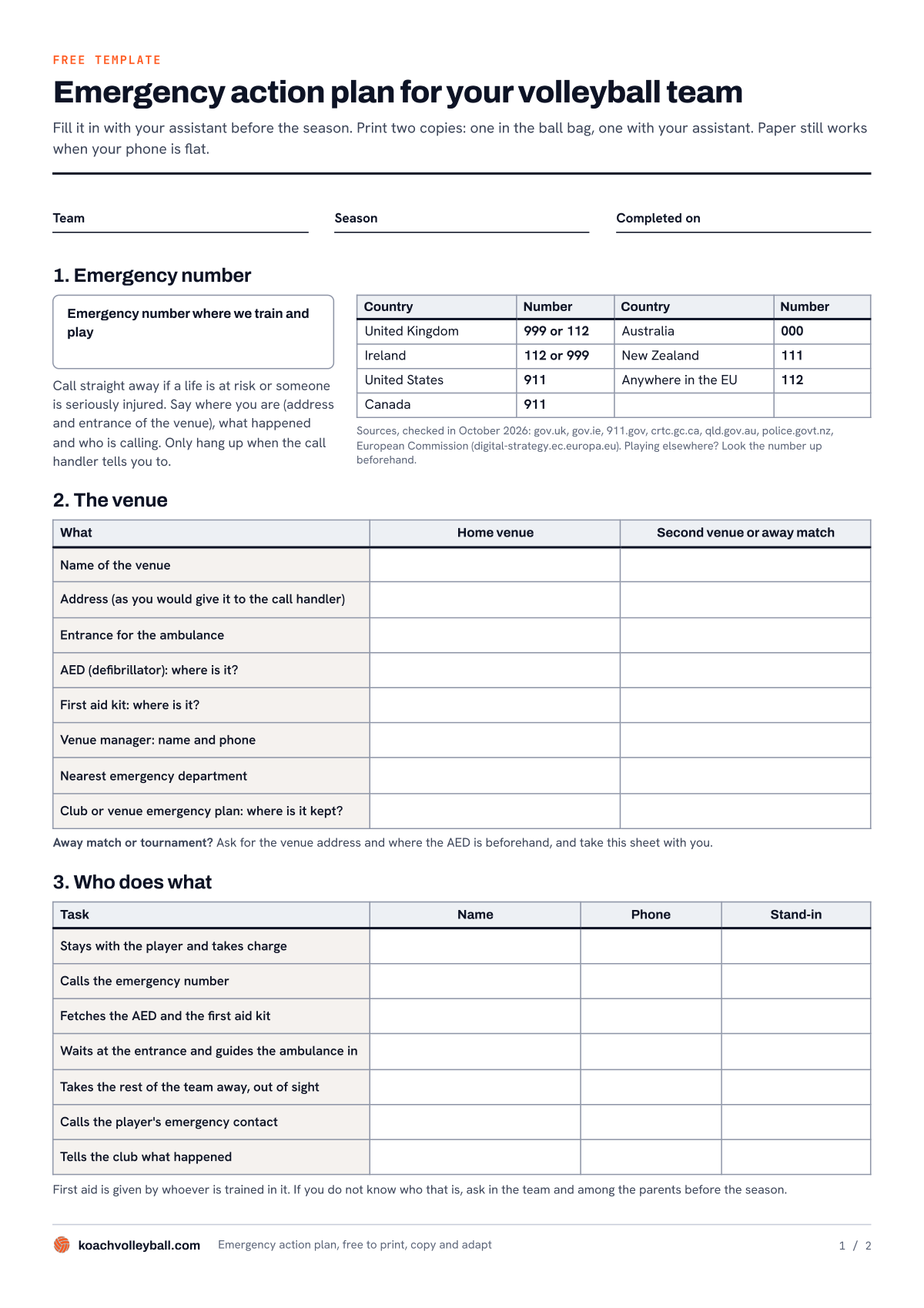
Page 1 of 2: the emergency number, the venue and who does what. Page 2 has the players' emergency contacts and a checklist for after an emergency.
The club's emergency plan or a plan for your own team?
Search for an emergency action plan for sports and most of what you find is written for a building or a whole athletics program: how to evacuate the gym in a fire, where the exits are, who meets the ambulance crew and who locks up. That kind of plan is made by the club, the school or whoever runs the venue, and it covers everyone inside.
As a coach, your question is smaller. A player comes down from a block on a teammate's foot, or collapses during the warm-up. In that moment you don't want to be working out who calls, where the AED is and how to reach the parents. You settle that in an emergency action plan for your own team: two pages that go with you to every practice and every match. It doesn't replace the plan of the club or the venue. Ask where that plan is kept and note it on your own sheet, so you know where to look.
What goes in an emergency action plan for volleyball?
A team plan doesn't need to be thick. It answers five questions, and the template has a section for each one.
- Which number do you call, and what do you say? In the United States and Canada you call 911, in the United Kingdom 999 or 112, and anywhere in the EU 112 (source for 112: European Commission, checked in October 2026). The template lists more countries, each with its official source. Playing a tournament somewhere else? Look the number up beforehand. The sheet also says what the call handler needs to hear: where you are, with the address and the entrance of the venue, what happened and who is calling. Only hang up when the call handler tells you to.
- Where exactly are you? The name of a gym is not an address. Write the address down the way you would give it to the call handler, plus the entrance where an ambulance can stop, where the AED is, where the first aid kit is, who the venue manager is and where the nearest emergency department is. Do that for your home venue and for a second venue or an away match. Why a venue name alone can send people the wrong way is explained in adding the address of the venue.
- Who does what? Seven tasks, each with a name, a phone number and a stand-in: staying with the player and taking charge, calling the emergency number, fetching the AED and the first aid kit, meeting the ambulance at the entrance, taking the rest of the team away and out of sight, calling the emergency contact and telling the club. First aid is given by whoever is trained in it. If you don't know who that is on your team, ask your players and the parents before the season.
- Who do you need to call? For each player, an emergency contact with the relationship (a parent, a partner, a roommate) and a phone number that isn't the player's own. Only fill in the column on what responders need to know if the player or a parent provides it. Which details you really need for this, and which you don't, is covered in which player details a coach really needs.
- What do you sort out afterwards? A short checklist: the emergency contact has been called, the club knows, the team and the parents have been briefly told without medical details, and the venue manager knows the AED or the first aid kit was used. Below it you write down what happened: the date and time, who helped and who was called.
The second page holds personal data, sometimes about minors. It's for you and your assistant only. Replace it every season and destroy the old sheet. If your club is in the UK or the EU, how it should handle data like this is covered in GDPR for sports clubs.
Paper, phone or app: where do you keep emergency contacts?
Most coaches already have the numbers somewhere: in a list on their phone, in the group chat with the parents or on a printed sheet. Each of those places has a weak spot.
| What you want | Printed sheet | Phone or group chat | Koach |
|---|---|---|---|
| Works with a dead phone | Yes | No | No |
| Tasks and AED location on it | Yes | If you type them in yourself | No |
| Emergency contact stays current | If you renew the sheet | If someone tells you | The player updates it |
| Your assistant has it too | If you print a second copy | If you forward it | Yes, the second coach sees it |
| Cost | Free | Free | 14 days free, then Coach €2.99 per month |
We make Koach, so read this as the maker's view. Even so, the honest conclusion is that you need both. The printed sheet is your backup: it works without battery or signal, and it holds the tasks and the AED location, which Koach doesn't keep track of. The app is your source: a player with a new phone number updates their emergency contact themselves, and then it's right on your side too. At the start of the season, copy the details from the app onto the sheet, and renew the sheet whenever something changes.
A list on your own phone is quick to make, but your assistant doesn't have it. And an emergency number in the parents' group chat is visible to everyone in that group.
Where are the emergency details in Koach?
Koach has no separate emergency action plan. But the details you need for one are always in the same places, so you don't have to dig them out of three different chats.
Players fill in their own emergency contact
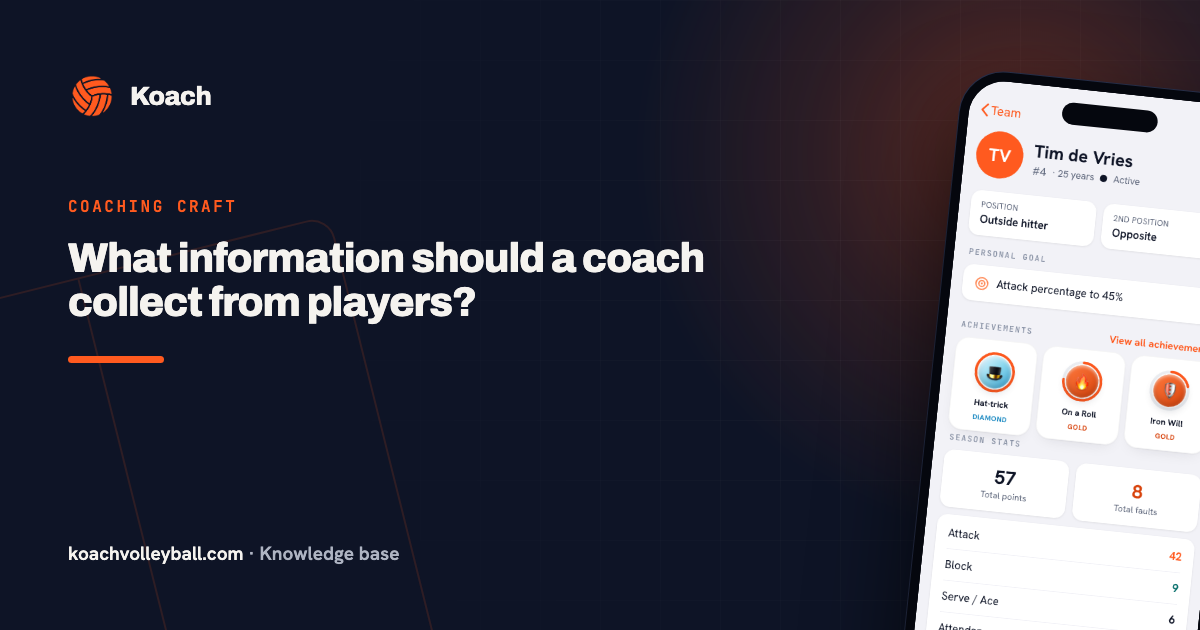
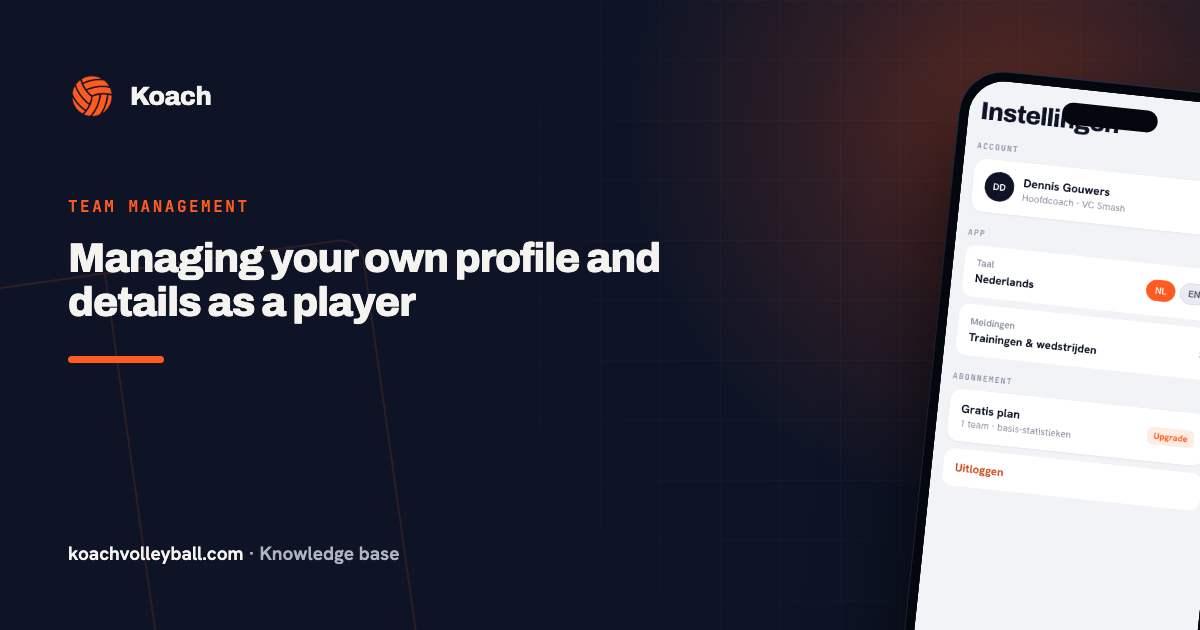
Every player with their own account opens their profile and, under Edit profile, fills in their phone number, an Emergency contact and an Emergency phone. What that looks like for the player is shown in managing your own details as a player. You see it in the player list: tap the player and scroll to the Contact & emergency section. Tap a number to call it.
If a player has an account but hasn't filled anything in yet, it says: "No contact details yet. The player adds them via Edit profile." Without an account, the section isn't there at all. With Invite players you send everyone their own link in one message, and the account is free for players and parents. Youth players without their own account have no emergency contact in Koach, so put their parents' numbers on the printed sheet.
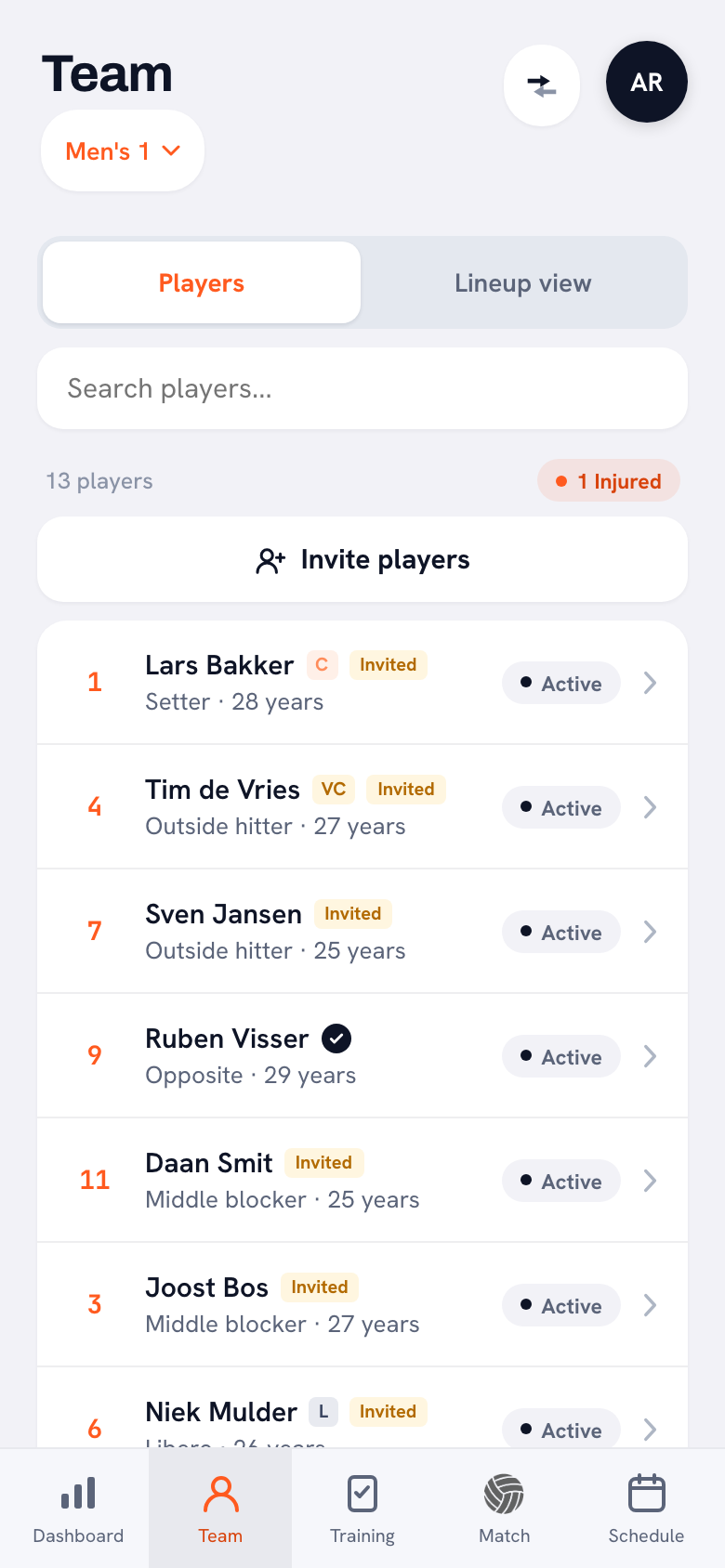
14 days free, no credit card. Invite your players tonight; after that you can see for every player whether their emergency contact is filled in.
Try Koach with your teamYour assistant sees the same
With the Coach plan, two coaches work in the same team. Your assistant sees the same players and the same emergency contacts, on their own phone. That fits the plan: while you stay with the player, they can make the call.
The venue address
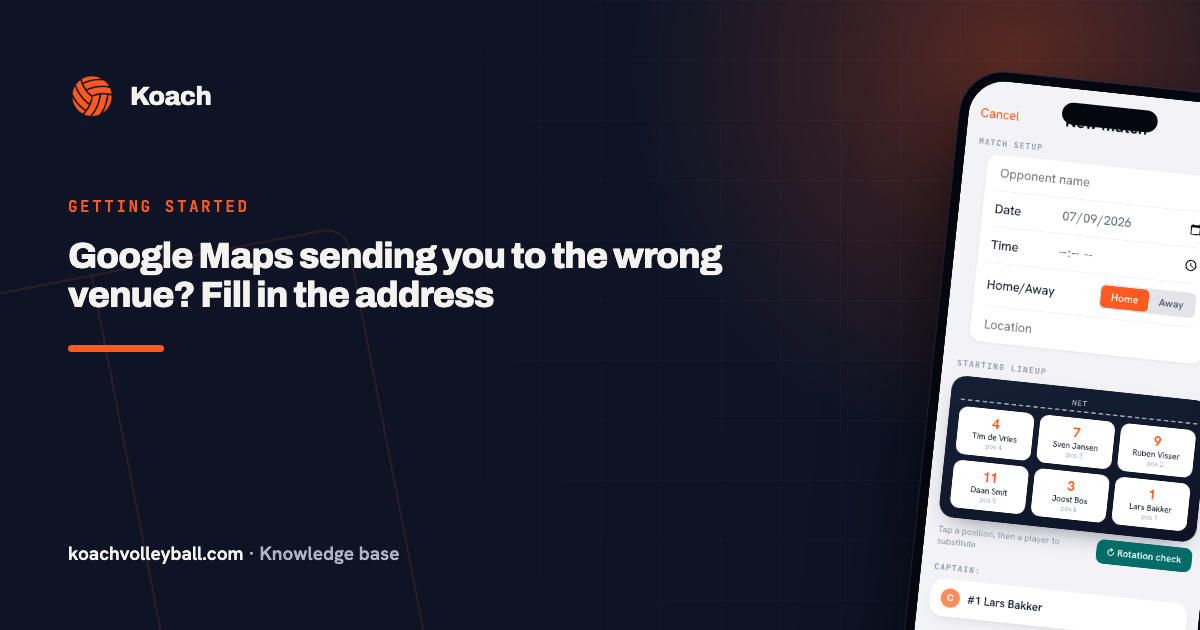
When you schedule a match, fill in the Venue address (optional) field under the location. The match details then show the address below the venue name, and it is used for every later match at that venue. At an away match you then have the address to give the call handler. Under My teams your team also has a Home venue, but that field is only the starting point for travel distances to away matches, so it doesn't need the full address. The full address and the entrance for the ambulance go on the sheet.
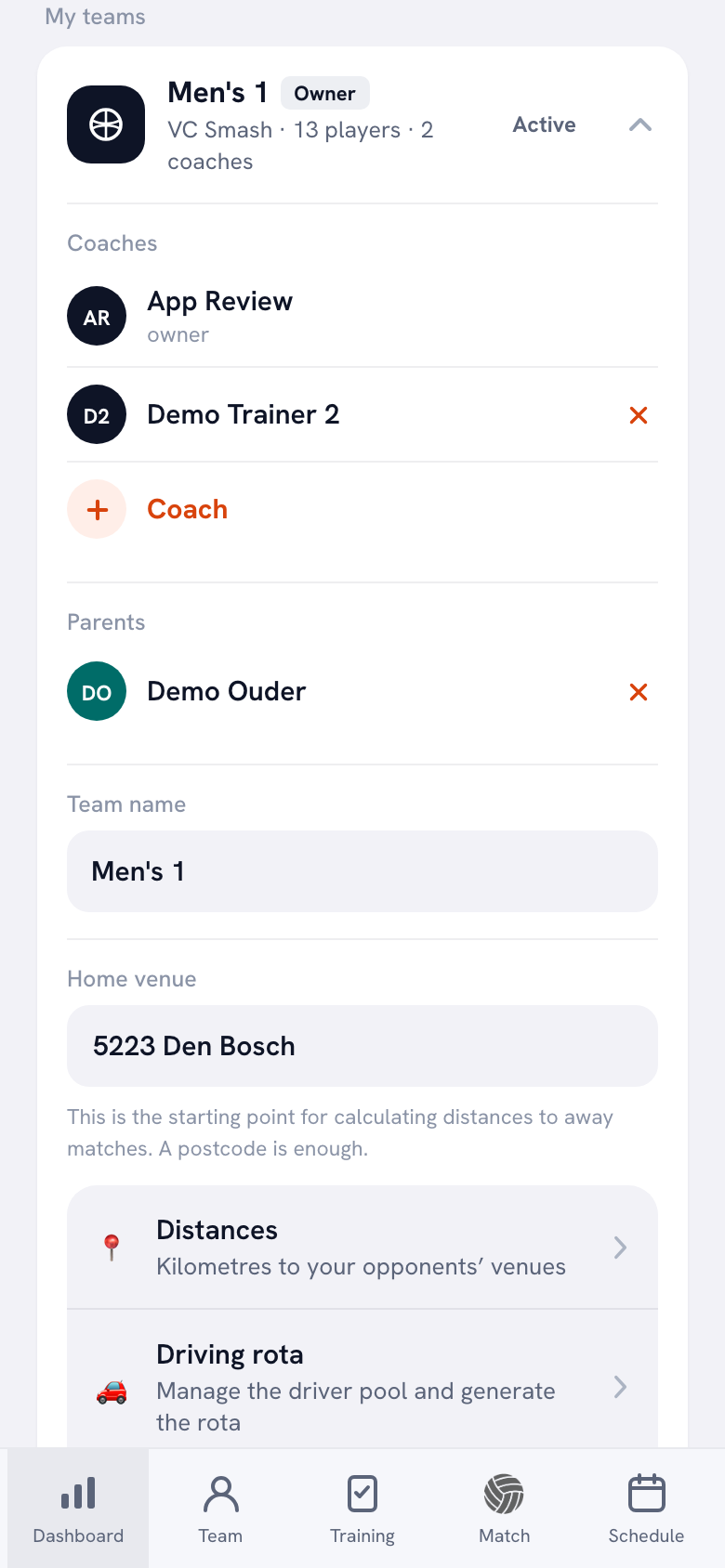
After an injury: status and a short announcement
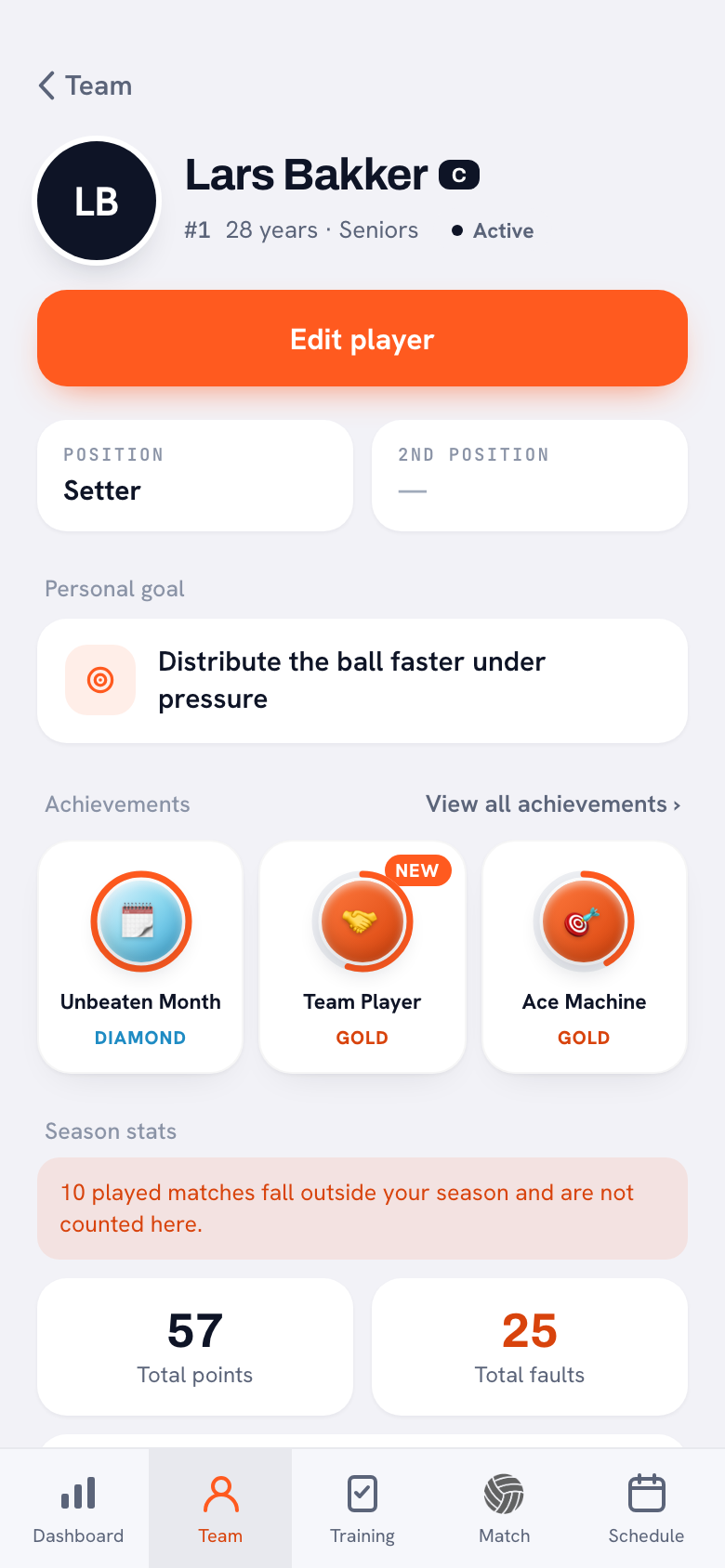
If a player can't take part for a while after an injury, use Edit player to set their status to Injured. The player list then shows at the top how many players are injured. The coach sets that status, not the player. If you want to tell the team and the parents what happened, post a short message under Announcements and leave out medical details. How to set up a player profile further is explained in creating player profiles.
Who this is for, and what Koach doesn't do
The template is for every coach, with or without an app. Koach fits if you're looking for a team app anyway: emergency contacts stay current because players keep them up to date themselves, and your assistant has them too. For an emergency plan alone you don't need an app; the sheet is enough. How the plan fits into the rest of running your team is covered in the overview managing a volleyball team as a coach.
What Koach doesn't do:
- There is no emergency plan in the app. The tasks, the AED location and the entrance for the ambulance are only on the sheet.
- Koach doesn't log incidents or keep medical records. You write down what happened on the sheet and report it to the club.
- It doesn't replace the emergency plan of the club, the school or the venue.
- Don't count on opening the details without signal or with a dead battery. That's why the sheet goes in the ball bag.
How much does Koach cost?
The template is free. You can try Koach free for 14 days with one team, no credit card. After that you choose Coach for €2.99 per month (one team, two coaches) or Club for €9.99 per month (unlimited teams and coaches). With a yearly plan you pay €2.49 or €8.33 per month. In the App Store and on Google Play you pay the store price in your own currency. Players and parents pay nothing: their account is free, so filling in an emergency contact costs nobody anything. The prices are on the pricing page.
Walk the route once at the first practice. From the court to the AED, and from the ambulance entrance back to the court. Anyone who has walked it once won't have to look for it when it matters. Write it on the sheet straight away.
Frequently asked questions
What is an emergency action plan in sports?
An emergency action plan sets out what happens in an emergency: who calls for help, how the ambulance crew gets in and where the AED is. Clubs, schools and venues usually have one for the building. For your own team you also need a short plan with the emergency number, the venue, the tasks and your players' emergency contacts. The free template in this article is that team plan.
What number do you call in an emergency at an away match or a tournament abroad?
In the US and Canada you call 911, in the UK 999 or 112, and in every country of the European Union 112, free, from a landline or a mobile phone (source for 112: European Commission, checked in October 2026). Playing somewhere else? Look the number up before you travel and write it in the box at the top of the template. Add the venue address too, because that is the first thing the call handler wants to know.
How should a coach handle players' emergency contacts?
An emergency contact is exactly the kind of detail a coach needs, but it is still personal data, and for youth players it belongs to a minor. Keep the sheet with you and your assistant, don't post the numbers in a group chat and destroy the old sheet at the end of the season. What a club may keep beyond that is covered in GDPR for sports clubs.
How do you keep your team's emergency contacts up to date?
Let players keep their own emergency contact current instead of typing it over yourself. In Koach every player with an account fills in their emergency contact and emergency phone via Edit profile, and you see it on the player under Contact & emergency. Copy it onto the printed sheet at the start of each season, and ask right then whether the numbers are still correct.
Is Koach free for players and parents?
Yes. Players and parents have a free account, in the app or in the browser. The coach tries Koach free for 14 days with one team, no credit card. After that Coach costs €2.99 per month for one team with two coaches, or Club €9.99 per month for unlimited teams. The emergency action plan template is free, with or without Koach.
Let your players fill in their own emergency contact
14 days free, no credit card. For every player you see whether their emergency contact is already there.
Get started with KoachOr read first what the volleyball coaching app does.