What Is a Joust in Volleyball? The Ball Above the Net
Hitter and blocker arrive at the ball together, push against each other, the ball hangs still above the tape for half a second — and the referee does not whistle. To anybody who does not know the rule, that looks like two held balls at once. It is precisely the opposite.
What a joust is
A joust is the situation in which two opponents contact the ball simultaneously above the net and push against each other for a moment. Commentators also call it a net battle or simply a fight at the net. The rulebook does not use the word, but it does govern the situation — in two articles.
First: prolonged contact with the ball by two or more opponents at the net is allowed. What would instantly be a held ball for one player is not a fault when two opponents are involved. Second (rule 9.1.2.2): if two opponents contact the ball simultaneously above the net and the ball remains in play, the team receiving the ball is entitled to three new touches.
Why it is not a double contact or a held ball
The rules on double contact and held balls are about how one player handles the ball within their own team. In a joust, two players from opposing teams press against the same ball from two sides: neither can play it cleanly, because the counter-force holds it there. Whistling here would mean arbitrarily penalising one of the two for something the other caused. Hence the exception.
Important: every other rule still applies. Anyone who touches the net during the joust commits a net fault. Anyone who makes contact while blocking above the tape as a back-row player commits a blocking fault. The joust suspends the ball-handling rule and nothing else.
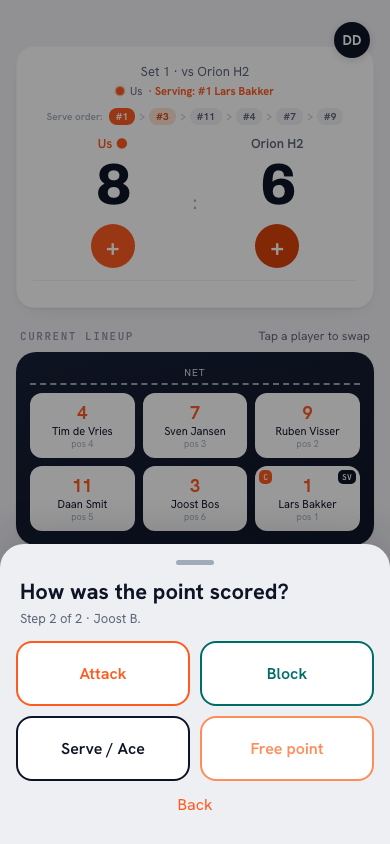
A won joust gives your side three fresh contacts, and the point that follows still gets logged by type in Koach — attack, block or serve.
Who plays the ball next?
After the joust the ball comes down on one side. The team on that side has three full touches. The joust contact does not count as a team touch, and the player who was in the joust may play the ball again straight away — just as after a block. In practice that is exactly what happens: the blocker who loses the joust drops back and digs their own ball.
If the ball lands outside the court after the joust, that is the fault of the team on the other side of the net (rule 9.1.2.2). So if the ball went out past your end line, the point goes to you: the opponent pushed it out. From the sideline that often feels unfair, but it is the logical inversion of the same idea — the last force came from the other side.
Joust, or simultaneous contact within your own team?
Do not confuse the joust with the other simultaneity rule. If two team-mates touch the ball at the same time, that counts as two touches (except on the block) and neither of them may play the next ball — you have one touch left. Two team-mates diving at the same ball cost you a contact; two opponents above the net cost you nothing.
How to win a joust
A joust is largely technique and a little timing:
- Whoever arrives last often wins. Contact the ball with straight arms at the highest point rather than reaching early. Push early and you are already fully extended.
- Firm, slightly angled wrists. Loose wrists mean the ball gets pushed back onto your side. Blockers learn this in blocking technique.
- Do not pull away. The classic mistake is letting go the moment you feel resistance. That is exactly when the ball drops on your side.
- Push up, not forward. Push forward and the ball goes over their block or deep into their court — usually out. Push slightly upwards and it falls on their side, leaving you a defensible situation.
- Sort out who covers the drop. Lose the joust and the ball comes down fast and steep just behind the block. Agree that your middle-back automatically steps in there.
Youth, mini volleyball and beach
The rule is identical at every age: from under-15 upwards the full FIVB rules are used. In mini volleyball the lowest levels do not block, so the situation does not arise. In beach volleyball the same exception applies, with one important difference: there a block touch does count as a team touch, so a won joust leaves you only two contacts. More on that in indoor volleyball vs beach volleyball.
Frequently asked questions
Why does the referee not whistle on a joust?
Because prolonged contact with the ball by two or more opponents at the net is explicitly allowed. Both players are holding the ball against each other; neither can play it cleanly, so neither is at fault.
Who may play the ball after a joust?
The team the ball falls towards, and that team has three full touches again. The player who was in the joust may play the ball again straight away — the joust contact does not count as a team touch.
Who gets the point if the ball goes out after a joust?
The team on the side where the ball went out. The fault lies with the team on the other side of the net, because that is where the force came from that pushed the ball out.
What if two team-mates touch the ball at the same time?
That is something else entirely: it counts as two touches, and the team then has only one contact left. Only on a block does simultaneous contact by team-mates count as a single touch.