
Wrist brace for volleyball: who needs one and what it won't fix
The short answer
A wrist brace in volleyball is meant for returning after a sprained wrist or for a sensitive wrist, temporarily and preferably on the advice of a physiotherapist or sports physician. It won't fix a technique flaw, such as hands that are too low when setting, and a stiff brace costs you ball feel.
You mostly see a wrist brace in volleyball on setters and on players coming back after a fall. But a sweatband, an elastic wrist wrap and a brace with stays each do something different. Here you read which type is meant for what, what it doesn't fix, what it costs you in ball feel and what the rules allow.
Wristband, wrap or brace: what is what?
Around a wrist in the gym you can come across four things:
| Type | What it does | What it doesn't do |
|---|---|---|
| Terry cloth sweatband | Catches sweat before it runs down to your hands | No support, no protection |
| Elastic wrist wrap or sleeve | Compression and a little support; the wrist still moves largely freely | Keep a sprain stable |
| Brace with stays | Firm stays limit how far your wrist can bend | Free overhead play: it brakes exactly the movement you need for it |
| Splint or cast | Keeps the wrist still after a fracture or serious injury, prescribed by a doctor | Playing volleyball: a hard cast is not allowed in a match (see below) |
First find out what is wrong with your wrist
You don't buy a wrist brace for a wrist when you don't know what is wrong with it. After a fall on your hand or a hit at the block, the difference between a fracture, a dislocation and a bad sprain is hard to see; according to the NHS you will usually need an X-ray for that. If the wrist is at an odd angle or the hand feels numb or tingly, the same page says that is a reason to get emergency care. A wrist that swells or keeps hurting after a fall should be assessed first by a family doctor, sports physician or physiotherapist. Which complaints go with which technique is covered in wrist pain in volleyball; this article is only about the aid itself.
Who is a wrist brace for?
- Back after a sprain. For the first two to three days after a sprain, the NHS mentions, among other things, protecting the injury, for example with a support, and a bandage to support it during the day (NHS, Sprains and strains). The same page advises against strenuous exercise, such as running, for up to eight weeks, because the injury could otherwise get worse; it says nothing specific about volleyball or the gym. Whether you wear a brace in your first weeks back playing, and until when, is something you agree with your physiotherapist or sports physician.
- The sensitive wrist of a setter. A setter plays a lot of balls overhead at every practice, and with every set the wrist bends back. If that causes complaints, some setters find a light wrap comfortable for a while as the load comes down. The wrap is then an aid while scaling back, not the solution.
- After a fracture. According to the NHS, recovering from a broken wrist usually takes six to twelve weeks, sometimes longer. The doctor or physiotherapist decides when you can play again and whether a brace goes with it for a while. Don't play with a splint or cast.
For a healthy wrist without complaints, a brace adds little and does cost ball feel. If you want stronger wrists, you get there with exercise, not with a brace.
Why a brace won't fix a technique flaw
Many wrist complaints in volleyball players come from how they play the ball, and that cause is still there with a brace on. A brace works on the result, not on the movement. Three examples; the causes per technique are in wrist pain in volleyball:
- When setting, a brace limits how far the wrist bends back. But if the ball sits too low in the hands, the wrist bends back because the hands are in the wrong place, and you fix that with the hands above the forehead; see overhead setting.
- When passing, a brace changes nothing about where the ball hits you. If the ball lands on the wrist instead of the forearms, the brace takes that hit.
- When falling, a brace changes nothing about how you land. A player who catches themselves on a straight arm does the same with a brace.
If a player wears a brace because their wrist keeps flaring up, look as a coach at which ball it goes wrong on. You need that answer more than a sturdier brace.
Test the brace with ten sets against the wall. Have the player set ten balls against the wall with the brace, then ten without. If the ball feels hard or doesn't come off clean with the brace, or they can't keep it on the same spot, the brace is too stiff for setting. Then ask the physiotherapist for a lighter form of support.
What a wrist brace costs you in ball feel
Overhead play needs a wrist that can bend back and then spring back, and fingers that feel the ball. A brace with stays limits exactly that bend, and a thick edge near your palm gets in the way when you take the ball. You notice the effect mostly with the setter: the ball can leave their hands less softly and less precisely. In forearm passing, blocking and hitting you notice a light brace less.
- Choose the lightest support that does the job. For setting, an elastic wrap is often easier to tolerate than a brace with stays. What is enough, you agree with your physiotherapist.
- Leave the palm and fingers free. The ball has to touch your fingers, not the brace.
- Get used to it at practice. Wear a new brace for a few practices first, never for the first time in a match.
- Tape is an alternative if a physiotherapist applies it; how taping fingers and thumb works is covered in taping fingers in volleyball.
Can you play a match with a wrist brace?
A hard cast around the wrist, no; a padded brace, as a rule, yes. The FIVB rules don't mention a wrist brace by name. They forbid objects that may cause injury or give an artificial advantage (rule 4.5.1) and allow compression pads (padded protection devices) to be worn for protection or support (rule 4.5.3 of the Official Volleyball Rules 2025-2028). The FIVB Casebook 2025 rules out a cast around an injured wrist, allows a padded leg brace and says that support on the forearm must not give extra control over the ball (case 1.1). That a padded wrist brace is allowed is therefore an interpretation of those rules. It can differ by country, federation or league, and during the match the first referee decides: if in doubt, ask beforehand.
How long do you wear a wrist brace?
According to the NHS, most sprains feel better after two weeks, but a severe sprain can take months to get back to normal. How long you wear a brace therefore depends on what happened to your wrist, and you agree that with your physiotherapist or sports physician. Also ask how to scale back, for example in which drills the brace can come off first. If the pain comes back or gets worse, go back.
Your setter's return in Koach
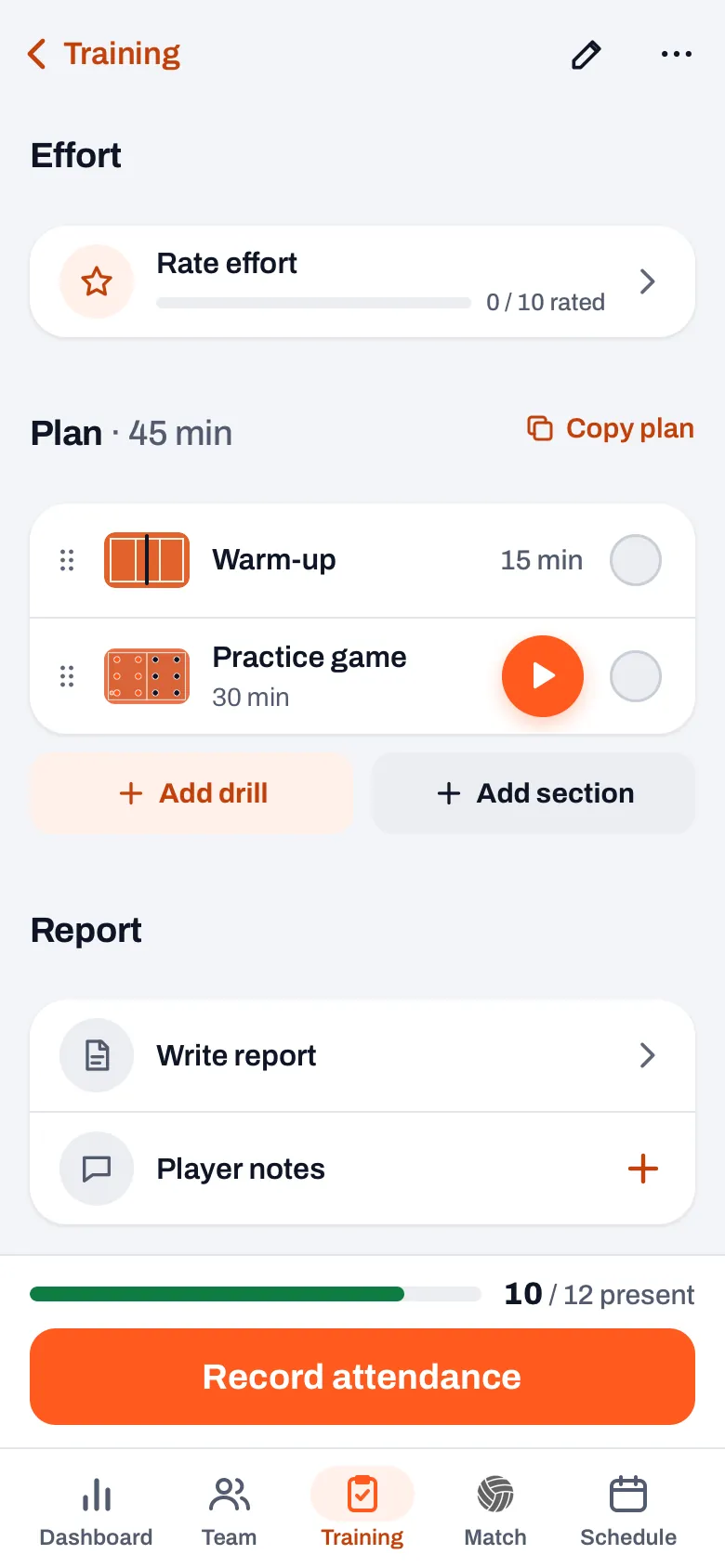
A setter coming back with a brace builds up the number of sets per practice. In Koach, the practice screen shows the plan with the report below it. With Add drill you put drills in the plan in which they play fewer balls overhead in the first weeks, and under Player notes you write after practice what was agreed with the physiotherapist: when the brace goes on, how many balls, when the next check-up is. That note also appears on their profile; players and parents don't see it. As long as they can't play at all, open Edit player and set their status to Injured: they then get no reminders and no nudge to respond, and teammates see Absent for them.
If you are new to coaching, starting as a volleyball coach covers what to arrange from the start besides the practices. What Koach costs after the trial is on the pricing page.
14 days free, no credit card. Write down tonight what you agreed with the physiotherapist, so your fellow coach knows it too.
Try Koach with your teamFrequently asked questions
Can you set with a wrist brace?
You can, but a stiff brace with stays brakes the movement you need for setting: the wrist bends back less far and the ball leaves your hands less softly. An elastic wrap is often easier to tolerate for setting. Test the brace at practice first and keep your palm and fingers free, so the ball touches your fingers and not the brace.
Why do setters wear a band around their wrist?
Often it is a terry cloth sweatband. It catches sweat before it runs down to your hands, so your hands stay drier when setting. A band like that gives no support or protection. A setter with wrist complaints gets nothing out of it; they should have the complaint assessed by a physiotherapist or sports physician and adjust their load.
Is a wrist brace allowed in a volleyball match?
A hard cast is not; a padded brace, as a rule, is. The FIVB rules don't mention a wrist brace by name, but they allow padded protection for protection or support. The FIVB Casebook rules out a cast around an injured wrist and says that support on the forearm must not give extra control over the ball. What applies in your competition can differ by country or federation. If in doubt, ask the referee before the match.
How long do you wear a wrist brace after a sprain?
That differs per sprain. According to the NHS, most sprains feel better after two weeks, but a severe sprain can take months. Agree with your physiotherapist or sports physician when the brace can come off and how you scale back. If the pain comes back or gets worse, have the wrist assessed again.
Record what you agreed with the physio
14 days free, no credit card. Your fellow coach can read it before the next practice.
Get started with KoachOr read first what the volleyball coaching app does.