
“If you swipe that screen away, nothing is supposed to happen”
Volleyball coach Dennis Boekhout on the set break screen in Koach: what you are allowed to change between two sets, and why the app says so itself.
The set is over, hands are slapped, and then there are about three minutes. In those three minutes almost every volleyball coach asks the same question: can you go changing your lineup between sets, or does that cost a substitution? The answer sits in the rulebook, but rarely in the place where a coach actually needs it.
Dennis Boekhout built Koach’s set break sheet around exactly those three minutes. A conversation about what is on that screen, what swiping it away does, and where undo stops.
A set ends. What does the app do at that moment?
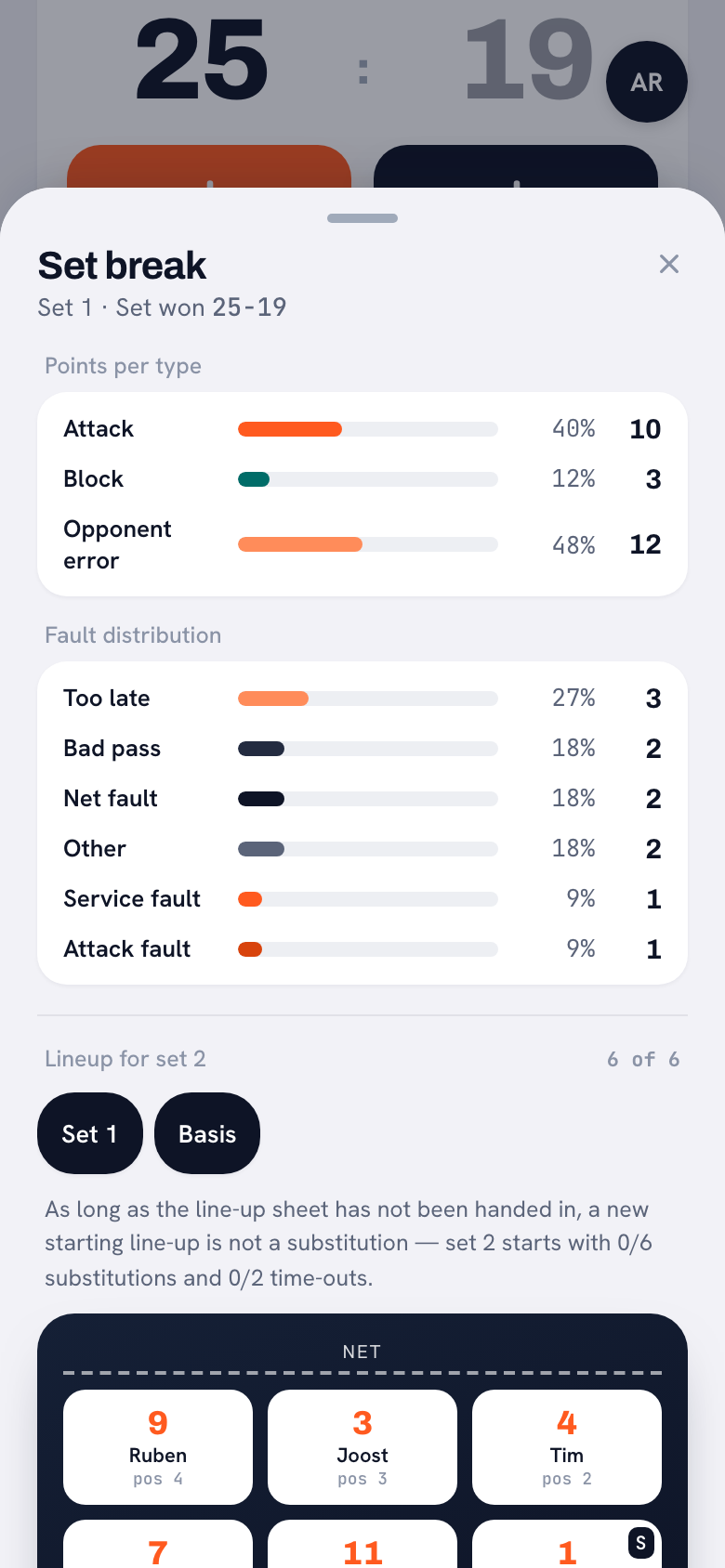
“The set break sheet slides up by itself. Not because it looks nice, but because that is exactly the moment you stand up and walk over to your team. The ball is down and you want to see in one glance what just happened. At the top it says which set it was and how it ended — in our demo set 1, won 25-19. Below that the set scores of the whole match, how the points in that set fell, and which errors we made ourselves.
“And it is not an extra step. The start button at the bottom of that sheet replaces the ‘Next set’ button in the bar above it: it closes the set and starts the next one. One tap, just with information around it.”
And if I swipe it away?
“If you swipe that screen away, nothing is supposed to happen. That sounds flippant, but it is a deliberate choice. Swiping closes the sheet and nothing else: the set is not closed, the next one does not start, your lineup stays exactly as it was. I have seen too many apps where dismissing a screen is itself an action.”
Does it come back if you do need it?
“Not on its own. It opens automatically once per set, and after that it stays away. Otherwise you are sitting on the bench with a sheet sliding over your scoreboard every ten seconds while you are talking to your captain.
“But the way back is always there: the dark bar at the top of the match screen stays put, with ‘Next set’ on it. One tap and the sheet is back. That is the difference between dismissing something and losing it.”
So the question this whole conversation started with: can you rebuild your entire lineup between two sets?
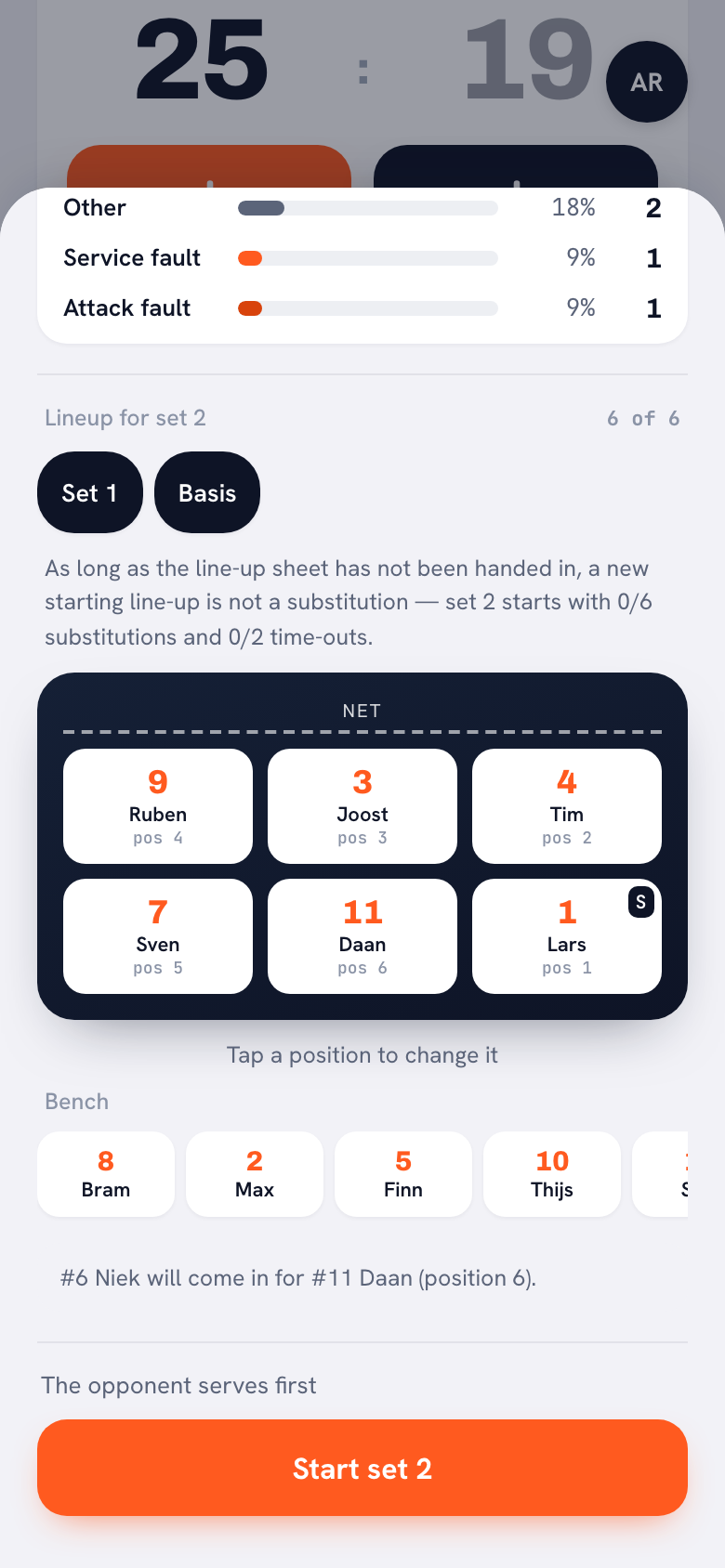
“Yes. And that is exactly the rule most coaches do not know. As long as the line-up sheet has not been handed in, a new starting lineup is not a substitution. Set 2 simply starts with zero of six substitutions and zero of two time-outs. Putting your six down differently has cost you nothing.
“That sentence is written into the sheet, right above the court. Not in a help page, not buried in a menu: in the place where the decision is made. Because that is where you hesitate.”
Why put a rule of the game into an app? Everybody knows it, surely?
“Referees do. Coaches often do not. I spent half a season thinking a different starting lineup would cost me a substitution, so I just left it alone. [laughs] That is a bad decision built on something that is not even true, and that is the most annoying kind.
“My reasoning is simple: if the app opens a screen at exactly that moment, it may as well tell you what you are allowed to do. It is not a lecture with an exclamation mark, it is one sentence you skip the moment you know it.”
So how do you actually put a new lineup in?
“With as little dragging as possible. Above the court there are chips: the lineup from set 1, and your saved lineups — in our demo there is one simply called ‘Basis’. One tap and your six is there. If you want to move people yourself, you tap a position and then tap who comes in; the bench sits right below. Top right it counts along: six of six.
“And the moment you change something, a ‘Undo changes’ chip appears that puts the lineup back the way it was when the sheet opened. That exists because I am the coach tapping away in a cold gym with cold fingers, hitting the wrong position.”
And if you pick nothing at all?
“Then set 2 starts with the same six as set 1, exactly the way it always worked. Nothing on that sheet is compulsory. It is there for the coach who already had a lineup ready, not for the coach who just wants to get on with it.
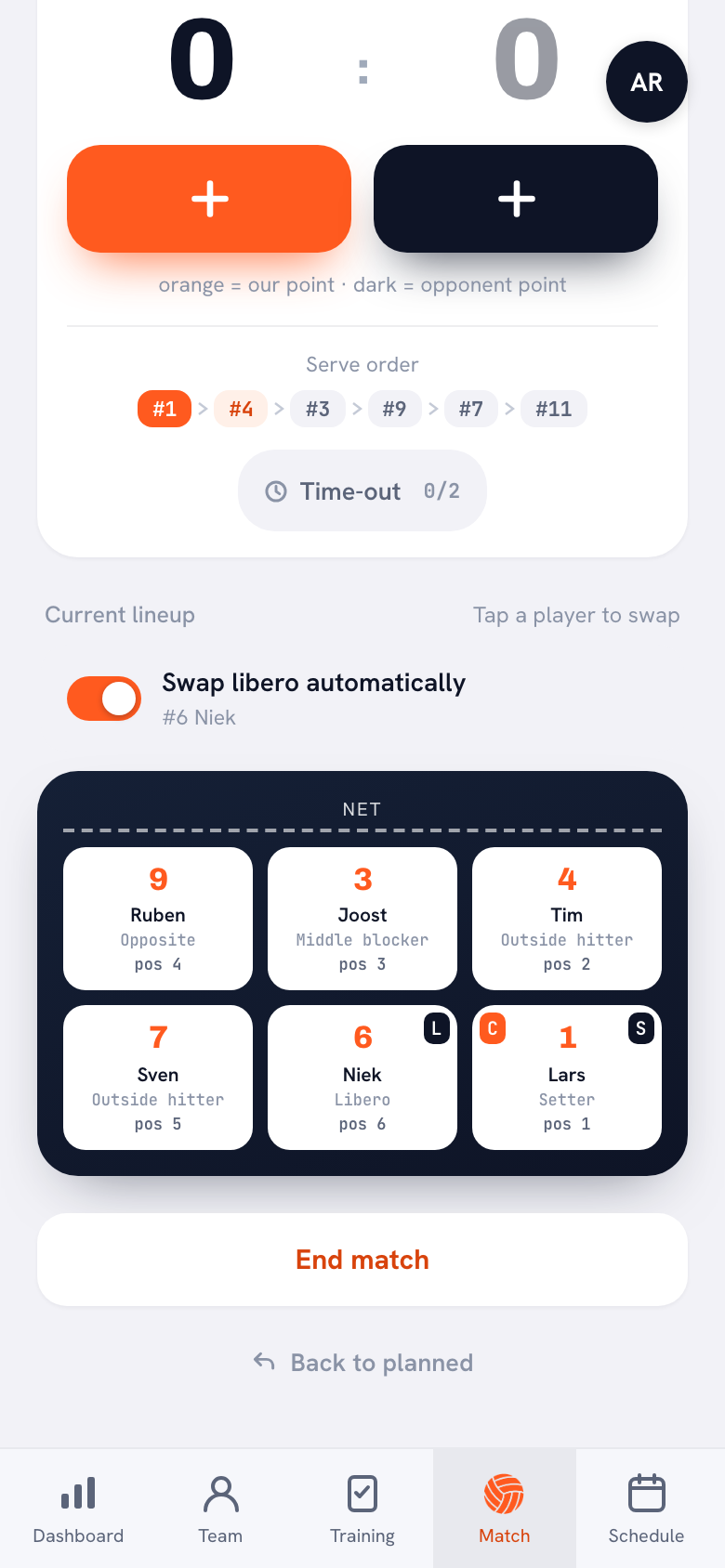
“Tap the start button and the board is back to 0-0, the serving order begins again and the time-out counter is back to zero of two. The libero deliberately gets no card on that lineup board: he does not belong on the line-up sheet, and the app brings him in for the back-row middle by itself at the start.”
So what does cost you a substitution?
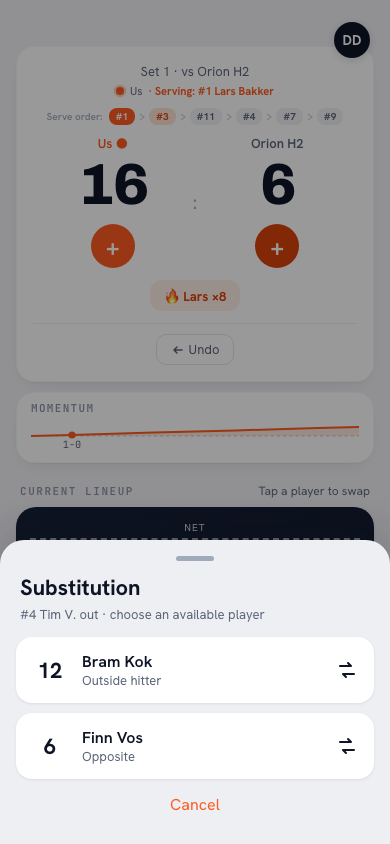
“Everything you do once the set is running. Then it is a real substitution: one player out, one in, and you get six per set. That sheet looks different — you tap a player on court and the app shows who is available, with shirt number and position, so you do not accidentally bring on the wrong opposite.
“And when they are gone, the app just says so: you have already made six substitutions this set. Same at two time-outs. That is not nannying, that is keeping you from standing at the scorer’s table with your hand in the air.”
Who serves first in the next set?
“In a normal set that flips by itself: whoever started the previous set serving receives in the next one. The app does not need to ask that, so it does not. There is one line above the start button — in the demo, the opponent serves first — and that is it.
“The deciding set is different. There is a new toss before it, and the app cannot possibly know how it landed. So there it does become a question with two buttons: us or the opponent. Guessing would be the worst thing it could do, because then your whole serving order is wrong for an entire set.”
And the change of sides at 8 points?
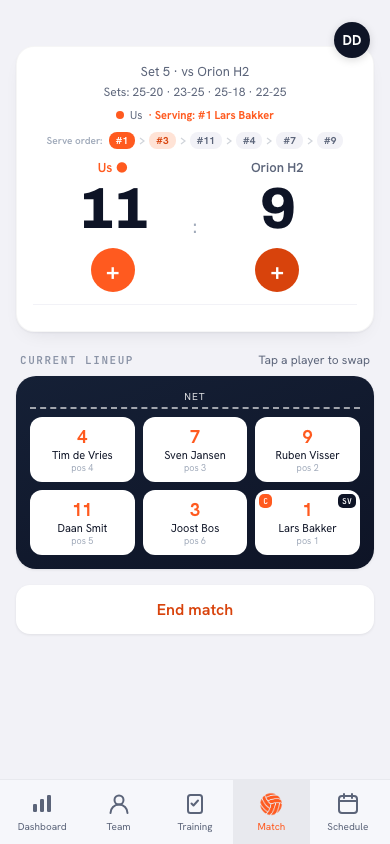
“The app went without that for a long time, even though it handled the rest of the deciding set: new toss, up to 15 instead of 25. But the change of sides is exactly what the officials are watching for. So now a bar appears the moment one of the two teams reaches 8: change sides, the teams swap halves now.
“With a ‘Done’ button next to it. That button does nothing to the score — it only clears the bar. That is on purpose. It is a reminder, not an action, and that is more honest than an app quietly flipping something and leaving you to work out whether the board is ahead of you or you are ahead of the board.”
Finally: where does undo stop?
“At the set boundary. Undo never runs across it. Once a set is closed you cannot peel it back point by point into the previous set. The button simply disappears at the start of a new set, because a button that sits there doing nothing is worse than no button at all.
“Inside the set you can reverse anything: a point, a point against with the error underneath it, a time-out, a pass rating, a substitution — that one puts the player back in his position. But a set that has been played is finished. That also matches what ends up on the score sheet.”
Coach the break, not the paperwork
Koach opens the set break by itself, lets you set up the lineup for the next set, and tells you what that costs under the rules. Free to try with your own team.
Try Koach free