
“I did that libero substitution in my head for years — the app still got it wrong”
Where the libero belongs, why he never serves, and how Koach came to handle the substitution itself — including what went wrong first.
Every rotation the libero steps on or off the court, and no coach thinks about it mid-rally — until the second referee raises an arm. The libero substitution is the one swap you keep making all set long without it counting, and that is exactly why an app finds it so easy to get wrong.
Dennis Boekhout explains why Koach now makes that swap for you, why the starting six deliberately stays on the board without the libero, and which mistake the app handed him first.
Of everything an app can get wrong, why is the libero substitution such a story?
“Because it is the only substitution that does not feel like one. A normal sub you make on purpose — you put your hand up, you send someone on, everybody sees it happen. The libero goes on and off every rotation cycle while nobody does anything for it. For me that runs on autopilot, and that is precisely the kind of thing you forget to tap in.”
Where is the libero supposed to stand?
“Back row, position 5 or 6. He comes in for the middle blocker who is in the back row, so the moment that middle rotates to the front, the libero has to come off and the middle simply comes back on.”
“Position 1 is deliberately not a libero position, because that is the serving spot. The libero is not allowed to serve. So as soon as the player he replaced ends up there, the libero is off court and the middle serves himself. That is not an app rule, that is the rulebook — the app just has to listen to it.”
And it wasn't listening?
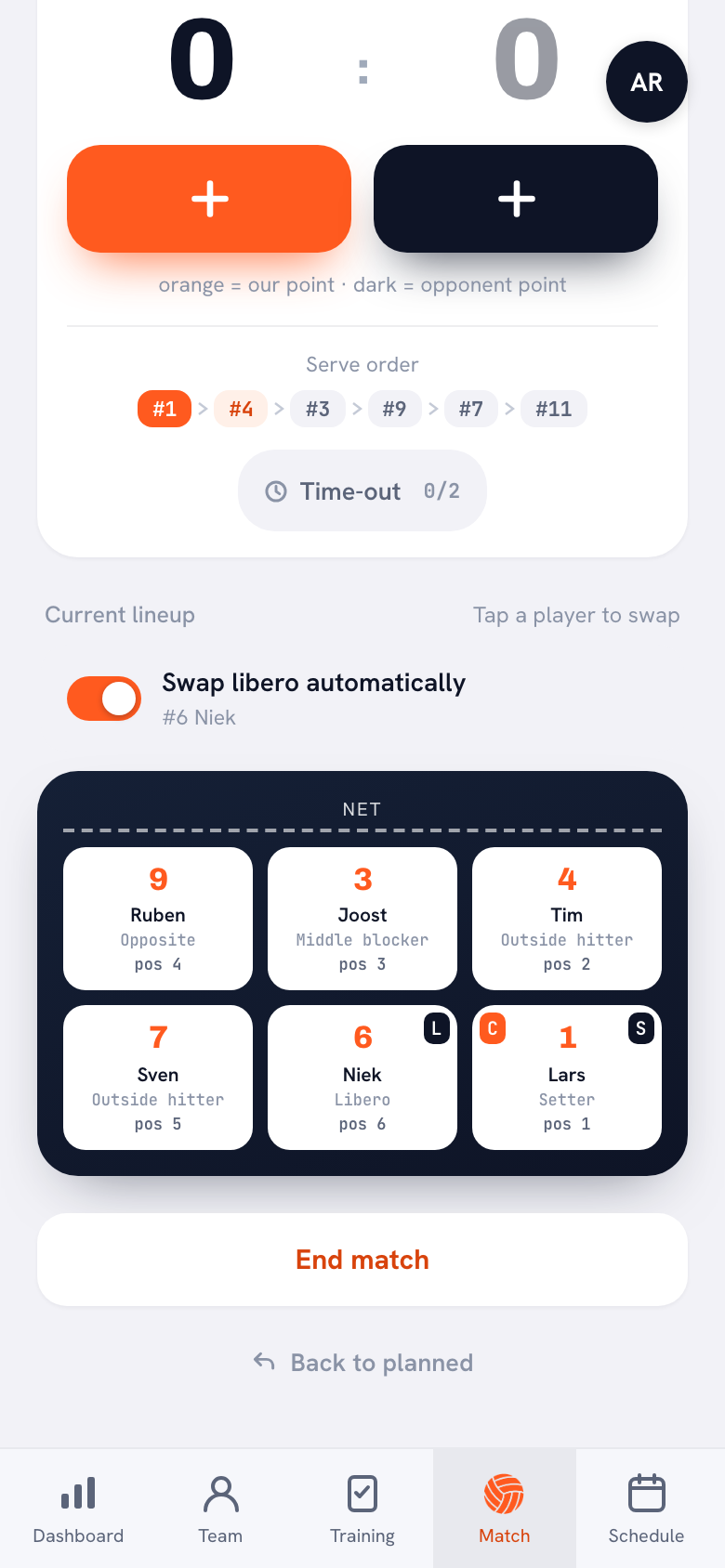
“Not for a while. The app followed the rotation properly: everybody shifts one position. Except that applies to six court players, and the libero is the seventh man. So he happily shifted forward along with the rest.”
“Then, as far as the app was concerned, my libero was standing in position 3, right at the net. That is a positional fault. And the worst part: nothing lit up. The app was handing me a line-up that would have been a point against us in the gym.”
How did that get in there?
“Through a resumed match. If you closed the app halfway and carried on later, it no longer knew who the libero was. The automatic swap went quiet, and without that swap the libero just rotates along. Now it falls back on the team's libero, so that hole is closed.”
“And if he does end up in the front row — position 2, 3 or 4 — the app puts a red notice next to it saying that is a positional fault. I would rather have one warning too many than an app that quietly watches you do something you are not allowed to do.”
On the line-up board I don't see the libero at all.
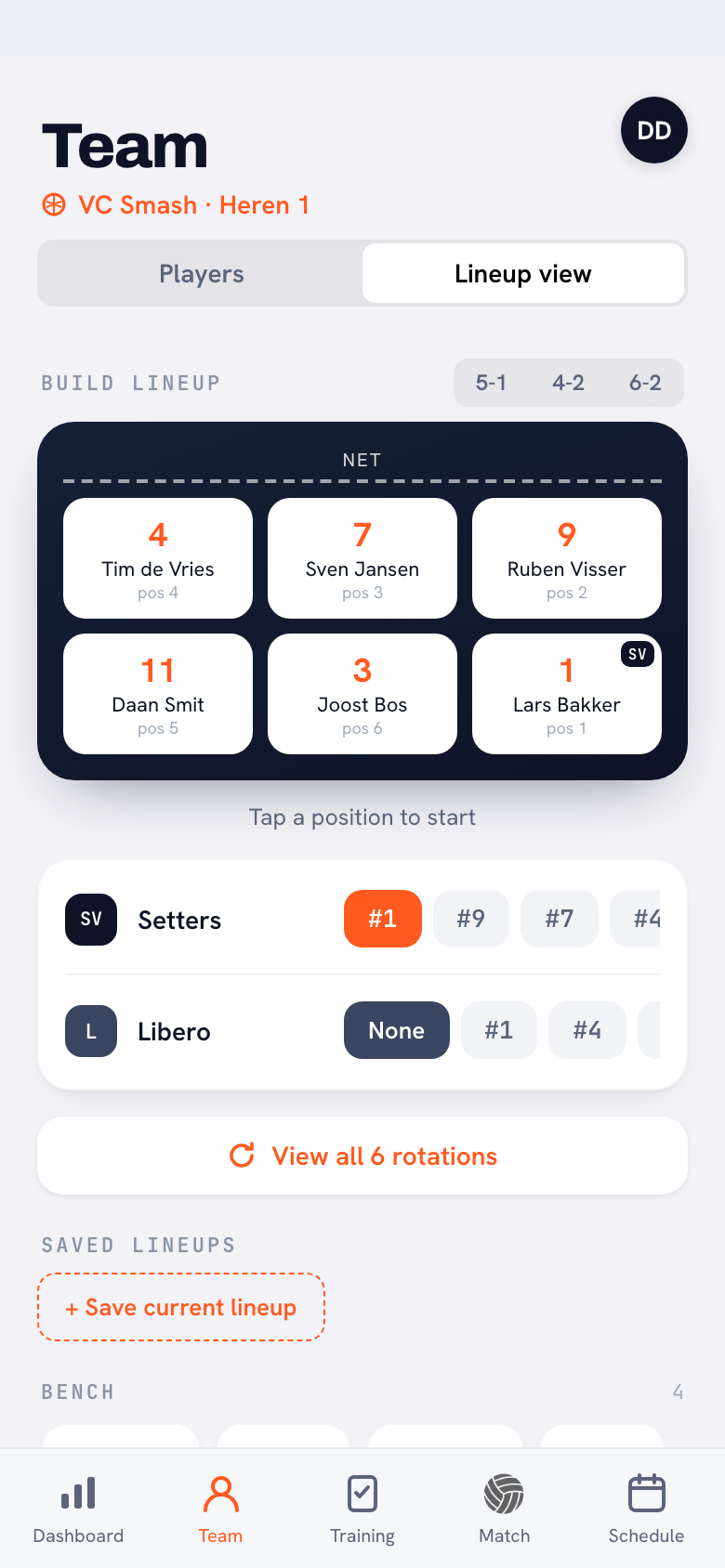
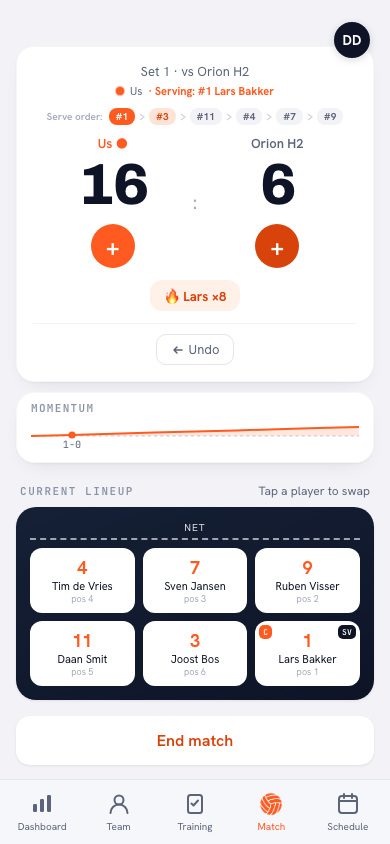
“Correct, and that is on purpose. The board shows the starting six, and those are exactly the six names that go on the line-up sheet you hand in before the set. Your libero does not belong among them.”
“You pick him in the row underneath, next to your setter. That way the board stays the line-up you give the referee, and the libero comes on by himself at the first serve.”
Can you see in advance what happens across the six rotations?
“Yes, you fold out all six rotations under the board. That is the calmest moment of my week: you see which middle stands where, and therefore where your libero walks on and off later. In the gym you do not have that time.”
“What is in those cards is always the six court players. The libero is named underneath, not inside the rotation itself — because he does not rotate along, he replaces someone.”
Why does the app take the libero off first and only then put him on? That sounds like a detail.
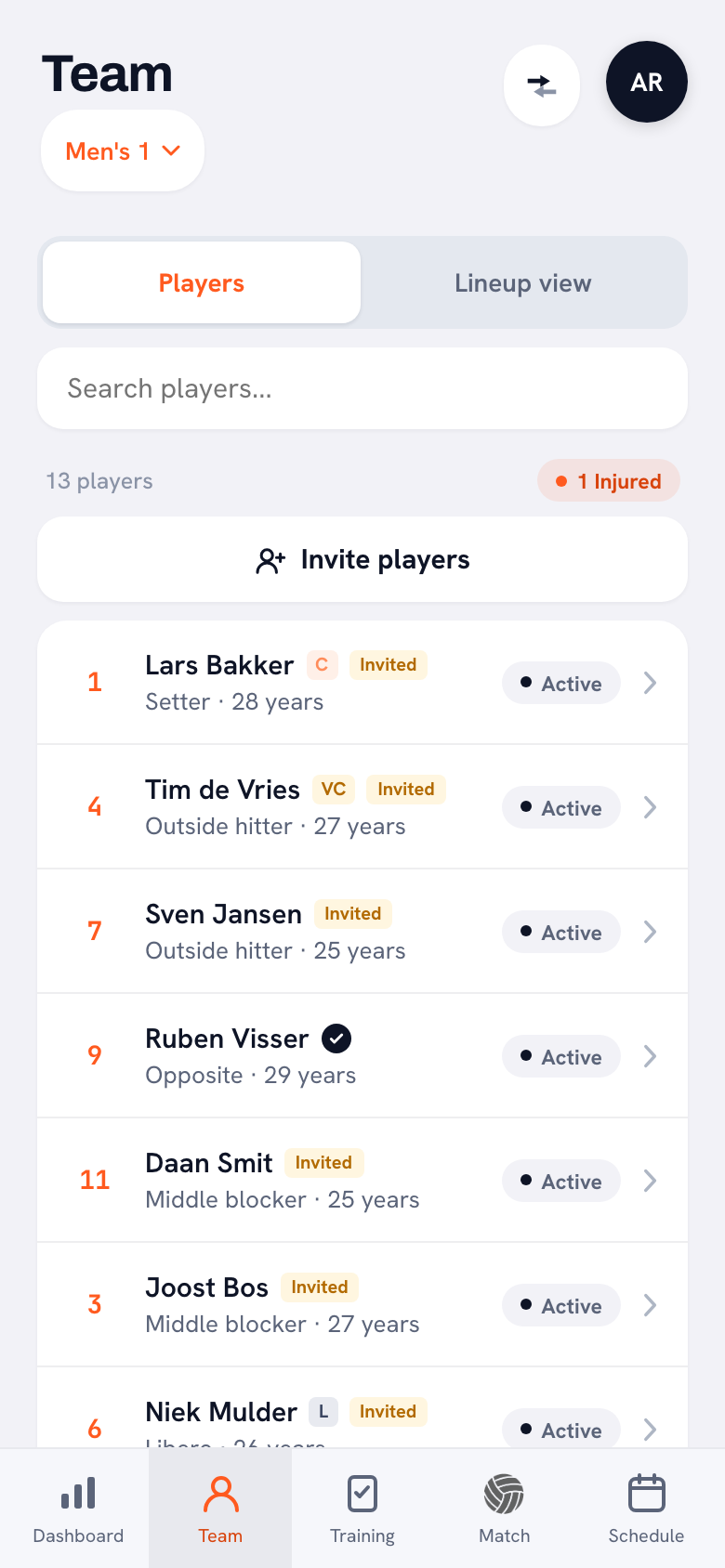
“It is a detail that comes around every rotation cycle. On one rotation, one middle goes to the front while the other arrives in the back row. Flip the order and the libero switches over to the wrong player, or he is briefly nowhere at all.”
“So first: is he in a spot where he does not belong? Off he goes, and the player he replaced comes back. Only then does the app check whether there is now a middle in 5 or 6 to come in for. In that order it holds up across all six rotations.”
Does a swap like that count towards your six substitutions per set?
“No, and that is exactly why you do not want to do it by hand. Under the rules a libero swap is not a substitution. If you made it on the substitution sheet, after one rotation cycle you would already have burned half of your six subs — on something that is not a substitution. [laughs]”
“The six real substitutions the app tracks separately, and at six it blocks the seventh. The libero swap runs entirely around that counter.”
And at the start of a new set?
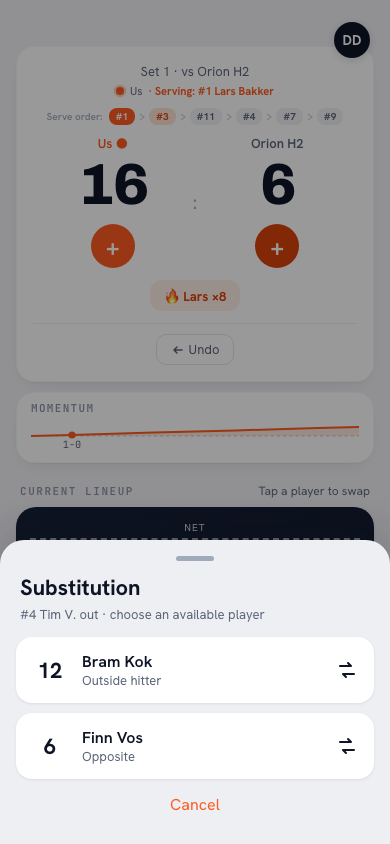
“In the set break you fill the six positions again, once more without the libero. Put him there anyway and the app tells you that position is better given to a court player: he comes in by himself for the back-row middle at the start.”
“And if there is no middle in 5 or 6, it tells you your libero stays off court for that set. That is allowed, it is not a mistake, but you want to know before the first serve and not halfway through.”
And teams that don't name a libero at all?
“Then nothing happens. No libero, no libero swap: the six on the board are the six on court, all set long. In youth volleyball that is the rule more often than the exception, so it had to work without you having to switch something off first.”
“And if you do name one but want to keep swapping yourself, you turn the toggle off and do it by hand, like before. I left that in because not every coach runs the same agreements.”
What does a coach actually notice during the match?
“That he notices nothing. That is the whole point. You tap the point, the court turns, and the libero is standing where he belongs. A short message shows who went on or off, and beyond that you are busy with your match.”
“And if you undo that point, the swap rolls back with it. That was my condition. An automatic substitution you cannot reverse is not help, it is a second problem.”
Leave the libero swap alone
Name your libero once in your line-up and Koach keeps him in the right spot all match. Free to try, with your own squad in it.
Try Koach free