
“A player sees their own numbers and nothing else — that is on purpose”
What happens the moment you tap Finish match, and why the app deliberately keeps half of those numbers away from the team.
The last rally is played, hands have been shaken, and somewhere at the bottom of a bag lies a phone with three sets in it. What happens to all that is a blind spot for most coaches: you tap finish and a screen appears. Dennis Boekhout built that screen, and he has firm opinions about which volleyball match stats after the game should reach whom.
A conversation about rallies instead of minutes, an attendance list nobody ticks, and the one boundary he hard-coded: a team member sees their own numbers and never a teammate’s.
You tap ‘Finish match’. What actually happens at that moment?
“A whole match gets converted in one go. During play there are no statistics at all yet. There is a row of rallies: who scored, how they scored, who made the error and which error it was, who was on court at that moment, who was serving and what the score was. One line per ball.
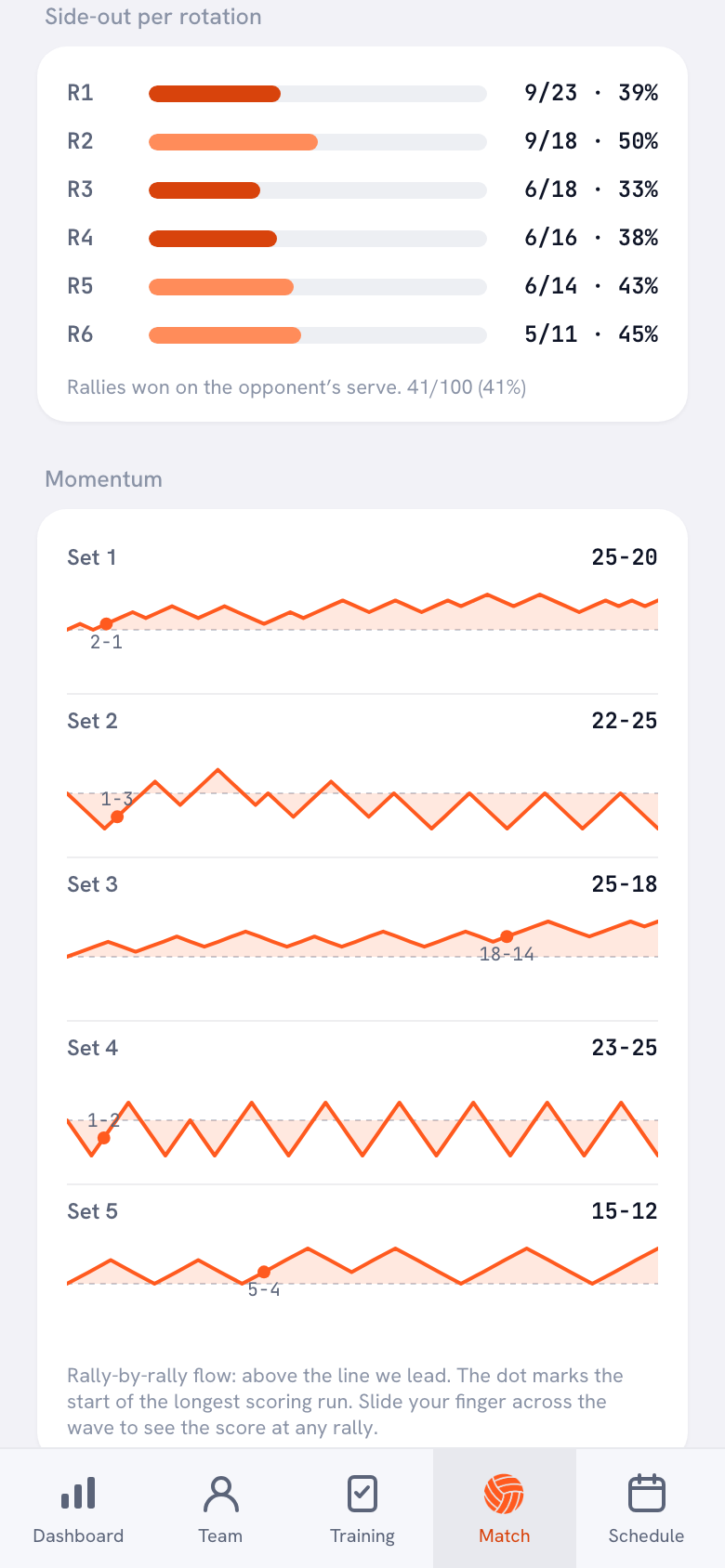
“Finishing puts that row through the mill. Out comes what you see on the match screen: points per player, the same points again per set, the error breakdown, the reception figures, side-out per rotation, the momentum wave, playing time and the longest serve runs. And then the app opens that screen for you. That is deliberate — this is the moment you want to do something with it, not three taps later.”
At the top of that screen there is a list of present players. Do you tick them yourself?
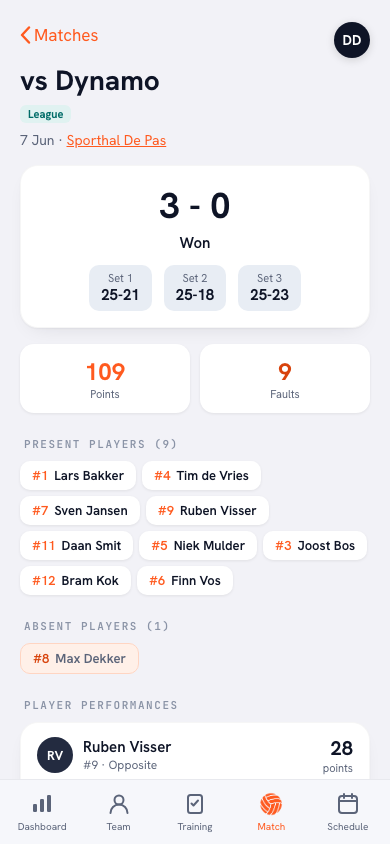
“No, and that took me the longest to settle. That list is derived. Everyone who stood on court during a rally ends up in it: the starting six of every set, everyone who came on, and the libero. I had to repair that, because the first version looked at the court as it was at the very last ball, plus the substitutes, plus whoever had scored. A libero who scores no points and happens to be off court at the final rally fell straight through that net. Four sets played, and listed as absent.
“What still rubs: whoever sat on the bench all match also ends up in the absent list. That is not attendance tracking, it is court-time tracking. I would rather say that out loud than pretend one list can do both jobs.”
And the per-player numbers, where do those come from?
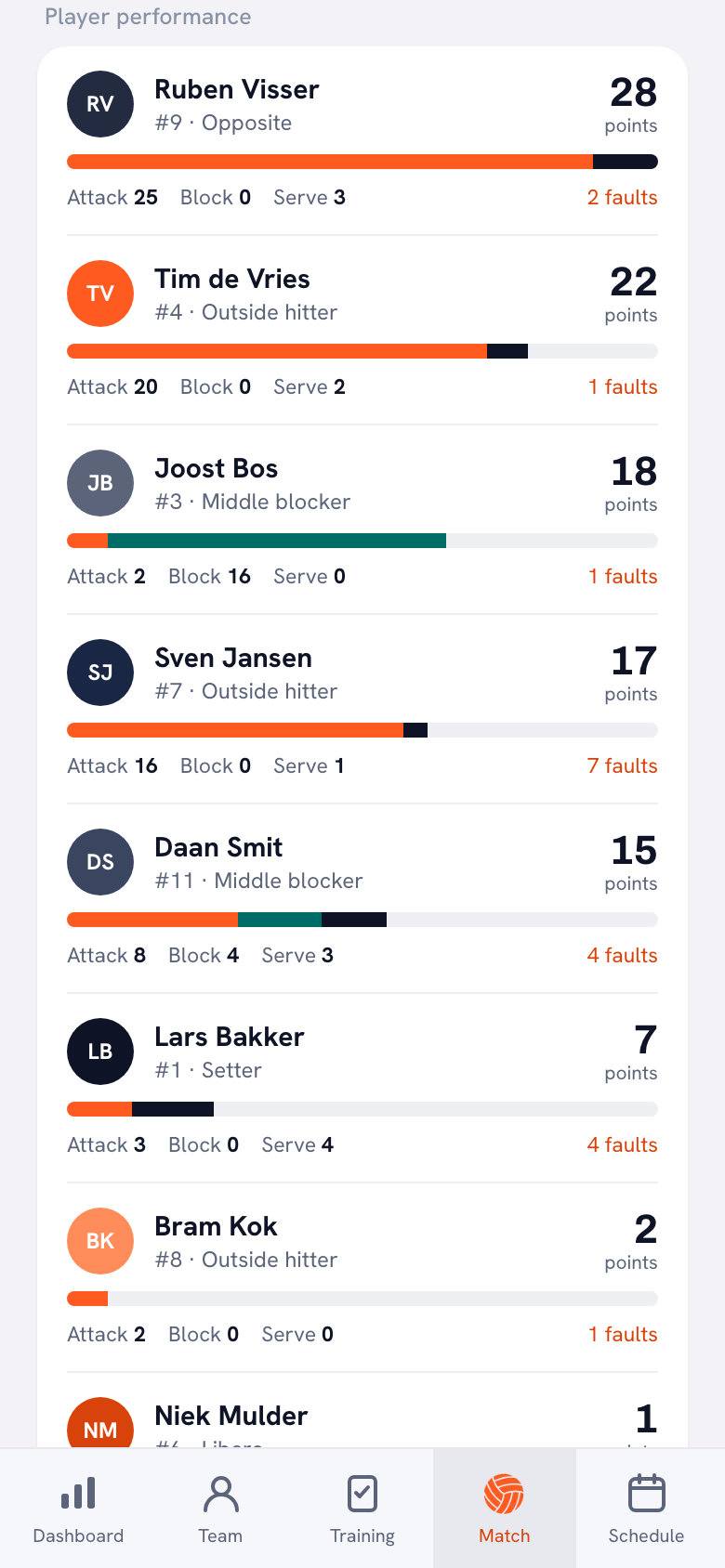
“From exactly two taps per point. During the match I mark who scored and how: attack, block or serve. On a point against, I mark what went wrong — service error, attack error, bad pass, net error, late. I ask for no more than that, because there is an opponent waiting. When you finish, that becomes the Player performance block: each player’s total, a bar showing where those points came from, and the error count alongside.
“You can scroll through it set by set with a slider. And one thing is deliberately missing: points you get from an opponent’s error. Those have no scorer, so they belong to nobody. They sit one block higher, under Points per type, as a team figure. Otherwise the player list never adds up to the set score and everybody starts hunting for a mistake that is not there.”
You count playing time in rallies and sets. Why not simply in minutes?
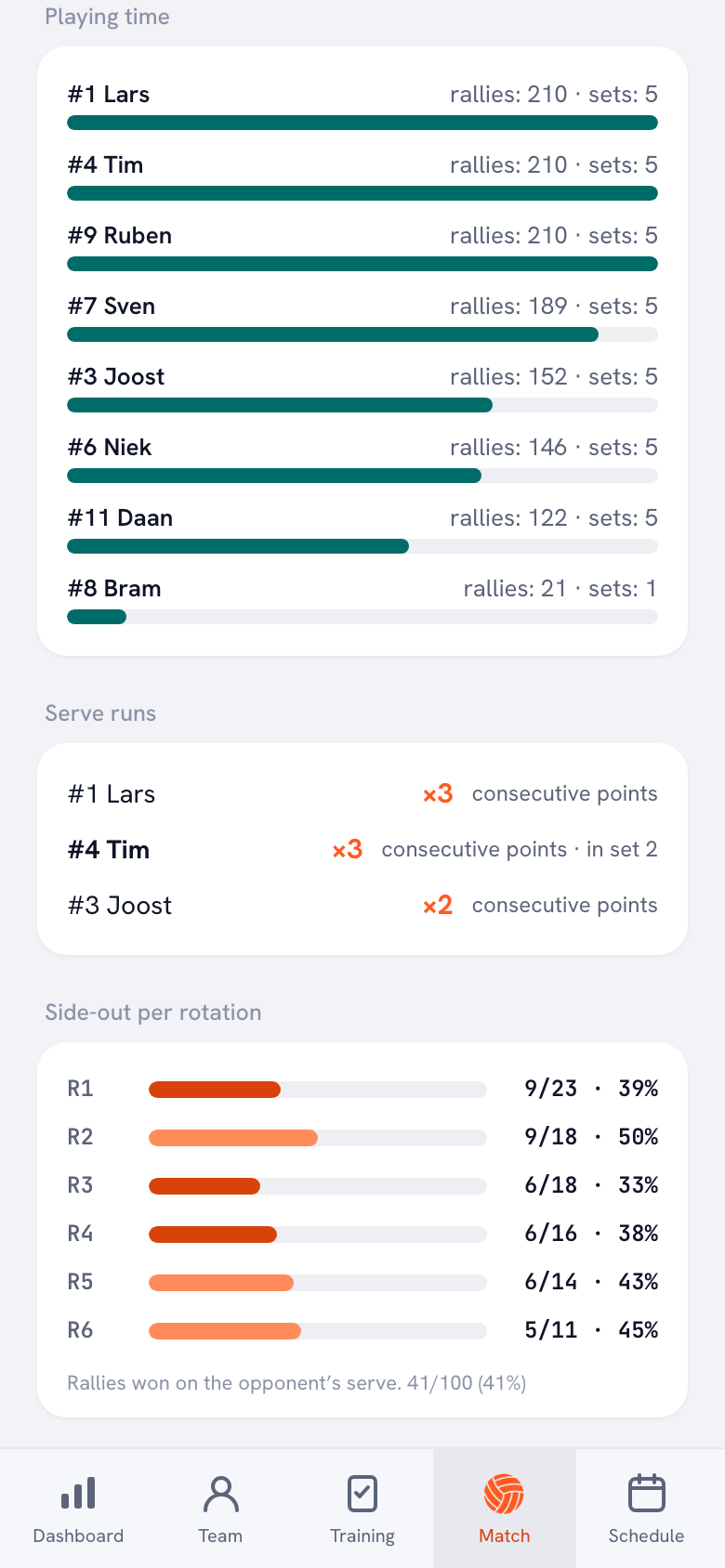
“Because volleyball has no clock. A set can be done in eighteen minutes and it can take thirty-five, and nobody can use those minutes for anything. I do not want to know how long a player was in the hall, I want to know how many balls they lived through while standing on court. That is the unit volleyball is actually played in.
“At every rally the app notes who is on court right then. Those snapshots together are the playing time: the number of rallies, and next to it how many sets someone stood in. A player who only came on in the second set gets a bar that is visibly shorter. You no longer have to open that conversation with ‘I have a feeling that’.”
And if you hand the scoring over to a player on the bench?
“You can, I regularly authorise someone who is injured. But they keep a simplified version on their own phone: the points and the errors, not the court. And without the court there is no playing time, no serve run and no side-out per rotation, because all three are calculated from those court snapshots.
“So the app simply leaves those blocks out. I find that cleaner than setting them to zero — zero is a number, and a number that was never measured has no business being on screen.”
Now the screen a team member sees. What is different there?
“A player sees their own numbers and nothing else — that is on purpose. The result, the set scores, the starting lineup, who played: that is identical for everyone, because that is the match. But where mine says Player performance, theirs says Your performances, with one row: their own. They see their reception average, not a teammate’s. They see their playing time, not everyone else’s. They see their longest serve run, not the ranking.
“And side-out per rotation disappears from their screen entirely. That is not a player figure but a team diagnosis, and that is mine to work with. So is my match note, by the way: right under that field it literally says ‘Only visible to coaches’.”
Why draw that line so hard? They are only numbers.
“They are not ordinary numbers when you are fourteen. Put a list in a group chat showing who made the most errors and you have created a pecking order you will be dealing with for the rest of the season. I need that comparison to decide who starts and what we train. A player does not need it; a player needs their own line to get better.
“Now and then someone asks whether that is not overprotective. Maybe. But I would rather be too strict than get a call from a parent because their child’s error count sits next to the neighbour’s kid in an app. What I do take from it I say out loud — to that one player, in the hall, with a reason attached.”
So what can you actually send out?
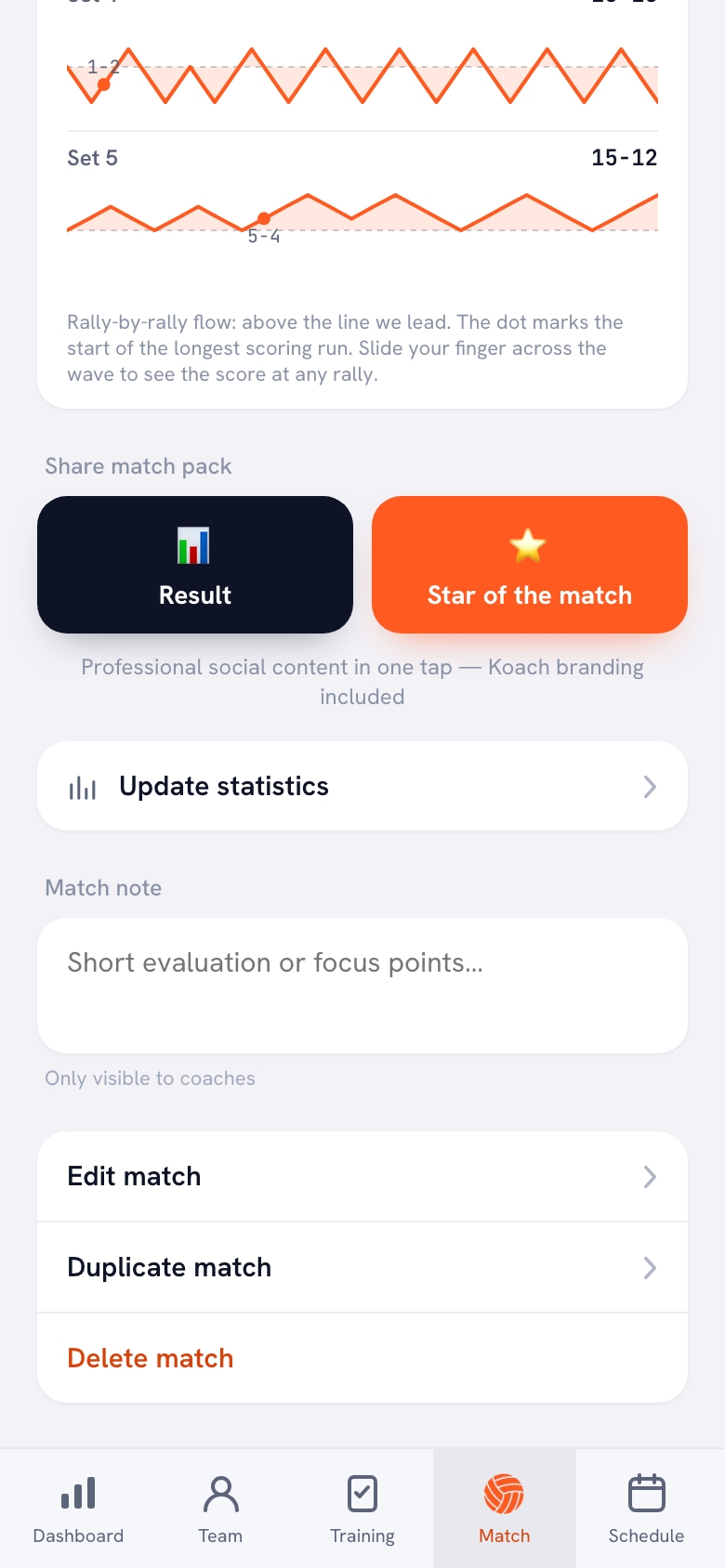
“Images, not lists. At the bottom of the match screen sits the share pack with two buttons: Result and Star of the match. The first is the team story — the score, the sets, won or lost. The second is the player story: one player lifted out. You can drop your own team photo behind it as a background.
“There is deliberately no button that pastes the full statistics list into the group chat. What you share is a picture you looked at yourself before sending it. Small difference, large consequences.”
The players do get to vote on something.
“They do, Player of the Match. That vote is for team members only, not for coaches and not for parents — I have no business weighing in. The candidates are exactly the attendance list, so whoever played. You cannot vote for yourself, and your vote is final; it says so before you cast it.
“The window closes two days after the match date. After that the outcome stands, with a crown, and it counts on that player’s profile. Two days is long enough to still do it on Sunday evening and short enough to stop a campaign getting off the ground.”
And the week after, what do you do with all those figures?
“The first thing I open is not the match but the home screen. Playing time this season sits there, and that list is sorted backwards: the player with the fewest rallies is at the top, not the bottom. The top two get a small tag next to them, ‘start first?’.
“That is not a verdict, it is a mirror. You genuinely think you are sharing it out fairly, and then after eight matches somebody is sitting at the top who you were sure had been involved everywhere. Underneath it says in how many matches this was measured, because without that number a ranking is just an opinion.”
Finally: what does Koach deliberately not do here?
“No minutes, no video and no grade. Nowhere does the app say that someone played well or badly; it says what happened. That judgement is my job, and it belongs in the hall, not in a bar chart.
“And there is one thing the app explicitly warns you about. If you scored live and then start overwriting the totals by hand, you are told that the per-set data disappears along with it. That is exactly what happens, so you should know it before you press save rather than after.”
See what your match gives back
Score your next match live and look at what appears on the final screen: points per set, playing time in rallies, and a team that only ever sees its own numbers.
Try Koach for free