Can the Libero Serve in Volleyball? The League Decides
Your libero is the best server on your team. A waste that they never get to the line, you think — until you notice there are competitions where they do. How that is possible, and what applies to you, comes down to which rulebook is on the table.
The FIVB rule: the libero does not serve
The official rule (19.3.2.2) is short: the libero may not serve, may not block and may not attempt to block. That ban is absolute — there is no rotation, no set and no situation in which they may appear behind the end line.
Most national federations adopt the FIVB rules almost one-to-one. In international play and in the leagues that follow those rules — from the top division to the lowest regional class and in every youth category — the libero may not serve. Doing it anyway is a rotation fault: the opponent gets a point and the serve, and the rotational order has to be restored — see wrong server.
Why you keep hearing that it is allowed
The confusion comes from domestic rulebooks, and above all from the United States. Under the domestic regulations of USA Volleyball and American college volleyball (NCAA), the libero may serve, but in only one rotational position per set. That is a national deviation from the FIVB rules, not an international rule: it does not apply at World Championships, at the Olympics or in European competition.
That explains why American instructional videos and English-language forums talk about it without hesitation. If you are watching those from outside the US, always check whether something is an FIVB rule or a national provision.
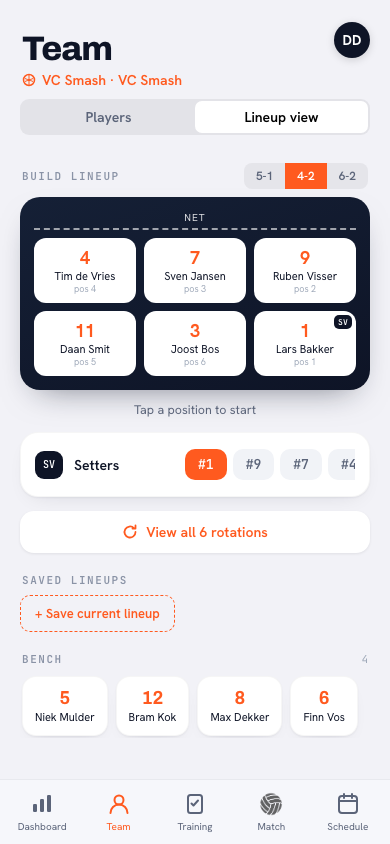
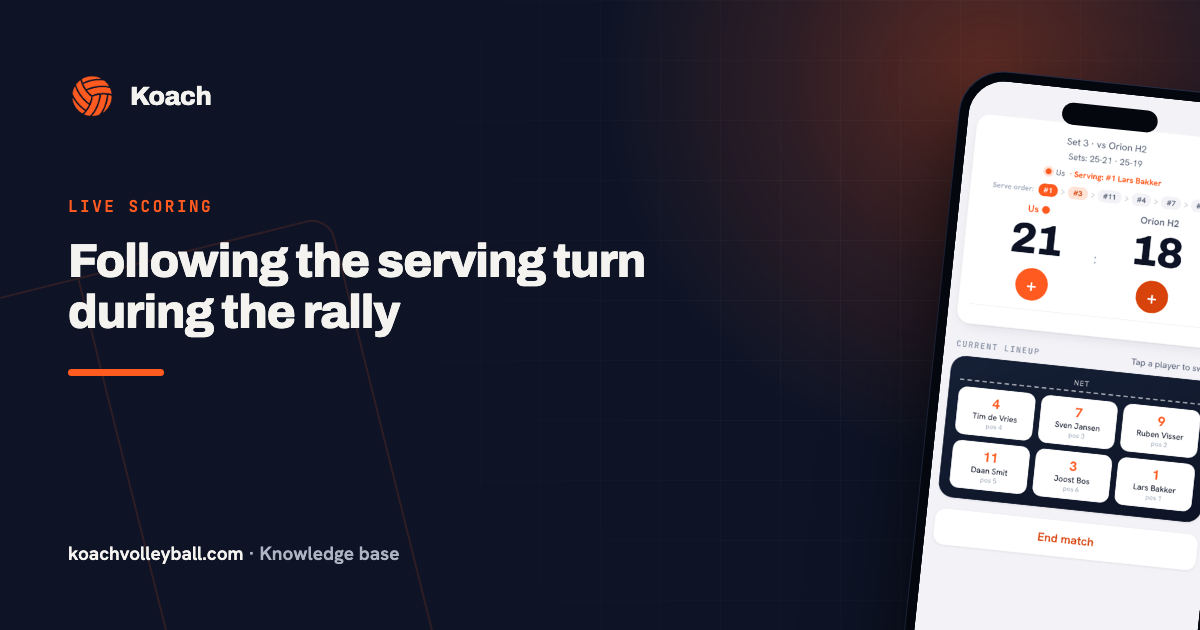
Whatever your league allows, Koach keeps the serving order per rotation while you score live, so you can see who served and what it produced.
How it works in practice: the libero replacement
The serving ban is not a standalone rule but the hinge of the whole libero construction. The libero replaces a back-row player and comes in and out through the zone between the attack line and the end line without limit — but only when the ball is out of play and before the whistle for the serve.
So when the player the libero replaces rotates to position 1, the libero has to come off, because that player has to serve. That is the moment teams stumble: the libero stays on, or the player coming back on does not realise it is their turn. All the conditions are in the libero replacement rules, and how to follow the service turn during a match is in tracking the service turn.
Where the libero came from
The libero has only been part of the game since 1998. The FIVB introduced the role because teams kept getting taller and rallies kept getting shorter: a hard serve was terminated before any build-up happened at all. By allowing one specialised defender with unlimited replacements, smaller players got a full role again and rallies got longer. That also explains why the job description is drawn so tightly: the role exists to strengthen the receiving side, not to hand an extra weapon to the serving side.
Why the rule exists
The libero was conceived as a defensive specialist and as a counterweight to ever-taller teams: smaller, more agile players get a full role that way. To stop them becoming a general-purpose joker, the job was deliberately restricted to passing and defending. If they could serve as well, a team could use them in every rotation for the two most important contacts in the game — serve and reception — without spending substitutions on it.
What does this mean for your line-up?
You lose six service turns per set to the players the libero replaces — and those are often middle blockers, statistically the weakest servers on the team. Two things you can do about it:
- Choose deliberately who your libero replaces. If you replace both middles, they still serve themselves as soon as they rotate to position 1. What you can steer is which player you replace at that moment with a regular substitution for a strong server.
- Use a serving substitution. Spending one of your six substitutions per set on a specialist server is a classic move — see the substitution rules.
Youth, mini volleyball and recreational leagues
In youth competitions the same ban applies as for seniors. In mini volleyball the libero role does not exist: all the children play all the jobs, precisely because specialising at that age is undesirable. Recreational and corporate leagues often play without a libero or with their own arrangements — what applies there is in that competition's regulations, not in the rules of the game. All the other libero provisions are in the libero rules.
Frequently asked questions
Can the libero serve in volleyball?
Not under the FIVB rules: the libero may not serve, may not block and may not attempt to block. Most national federations follow those rules, so in international and European play it is not allowed.
Why do liberos serve in American matches?
Because USA Volleyball and the NCAA use their own domestic provision under which the libero may serve in one rotational position per set. That is a national deviation and does not apply in international or European competition.
What happens if the libero serves anyway?
It is a rotation fault: the opponent gets a point and the serve, and the rotational order has to be restored. Points scored after the fault can also be cancelled.
Why does the libero have to come off when their player serves?
Because the libero replaces a back-row player, and on rotating to position 1 that player has to serve. At that moment the libero leaves the court, and after the service turn they can come back on.