
Coaching teenagers: a team that does nothing
You set up a drill, you explain it, and nothing happens. Thirteen fourteen-year-olds look at the floor, at each other, at their shoes. Whoever you speak to shrugs; whoever you speak to more sharply shrugs again. That isn't laziness, and it isn't a matter of a firmer hand either.
Doing nothing isn't laziness, it's status anxiety
Between roughly thirteen and sixteen the audience changes. Up to that age a child trains for the coach; after it he trains for the twelve peers around him. And for that audience, joining in costs something. The player who sprints first, who says "yes" out loud, who carries out an instruction literally while the rest are still standing — he is taking a risk nobody else is taking. If it goes wrong, he is the show-off. If he does nothing, he can't lose face. Standing still is simply the cheapest option in the hall.
That determines what works. If doing nothing is the safe choice, more pressure backfires: you are adding audience, and that makes joining in even more expensive. What does help is turning the sum around — making joining in cheap and doing nothing impossible.
Spend one whole practice observing first. Don't watch who moves after your instruction, but who looks at whom in the two seconds afterwards. Almost always three or four players first look at the same player — usually not the best one, but the one with the most status — and only start moving when he moves. That is the real start signal, and it isn't yours.
One thing often gets confused with this: the player currently tripping over his own feet isn't trying less hard — he is in the middle of a growth spurt. This article is about the other half: the behaviour and the relationship.
Authority without a power struggle
A teenager rarely tests you as a person. He tests where the line is, and above all: who is watching. That is why every correction made in front of the group is a public trial of strength, and one you can only lose. Lose it and your authority is gone; win it and you have cut a fourteen-year-old down to size in front of his entire audience. How to phrase a correction so that it contains information rather than a verdict is in correcting without shouting.
- Say it once and then say nothing. Repeating it in a louder voice is the opening move of the fight. Stay standing, look, wait. A coach who says nothing is more uncomfortable than a coach who shouts.
- Don't ask a question if "no" isn't a valid answer. "Shall we start?" invites negotiation. "We're starting, you're on that side" doesn't. Save your questions for the moments when the answer really matters.
- Never announce a consequence you don't carry out. One that follows costs you one difficult moment. One that doesn't costs you the rest of the season — including on small things like turning up late to practice.
Something else clubs misjudge: a nineteen-year-old coaching a youth team is often treated as a stopgap, but here it is more of an advantage. He has no adult authority to lose and doesn't need to beat a fourteen-year-old, because he isn't the parent. That makes it easier for him to stand beside the player instead of above him. The pitfall is the mirror image: trying to win the group over by being nice, or laughing along at a joke made at a teammate's expense. The line is simple — you can share anything except your judgement about behaviour. Laugh along once and you can correct nothing the following week, certainly not with the player who sets the tone; how to handle him is in dealing with a dominant player.
He won't do what you say, but he will do what he said yes to
This is the most usable mechanism of this age. An instruction from an adult is something a teenager has to position himself against: carrying it out means something, refusing means something, and both are seen. An agreement he has confirmed out loud himself is his — there is nothing there to rebel against.
So build two or three moments into every practice where someone says yes out loud. Not about whether there is training — that isn't up for discussion — but about how:
- Let them choose the standard, not the goal. "This drill stops as soon as you do it properly. Three times in a row or five times in a row?" Both answers are your plan; the choice is real.
- Have the player repeat his focus point back. "What are you going to do this round?" He says it, you nod. Five seconds, and the instruction has become his.
- Close with a check. "Agreed we'll do it this way again next week?" A yes on Tuesday is still a yes a week later — provided you remembered it.
Never offer a completely open choice. "What do you want to do?" produces the answer that costs the group least. Two options that are both fine work; three become a debate. And write the yes down — two lines on the back of the team sheet will do — because a yes that isn't recorded anywhere didn't exist next week. Come back to it at the very next practice, even if it went well: players need about three weeks to notice that their yes actually means something to you.
Making agreements instead of imposing rules
A rule is yours, an agreement is theirs. At no age is that difference as big as here. Fifteen minutes at the start of a practice is enough, and you can start with it at any point in the season.
- You set the topics, four at most. Attendance and calling off, phones, how we react to a teammate's error, and what happens when someone doesn't stick to it.
- They set the wording. Write down literally what they say. "No moaning when someone misses a ball" is a better agreement than the tidy version you would make of it, because this one is theirs.
- Five agreements in total, maximum. They won't remember more and you won't enforce more. A list of ten is a list of nothing.
- They set the consequence in advance. You have a veto on anything involving playing time — why is below.
- One review moment, halfway through the season. Two minutes: does this still stand, or do we drop something?
The broad outline of such a meeting is in the first team meeting; with a teenage team you are better off cutting it into short pieces.
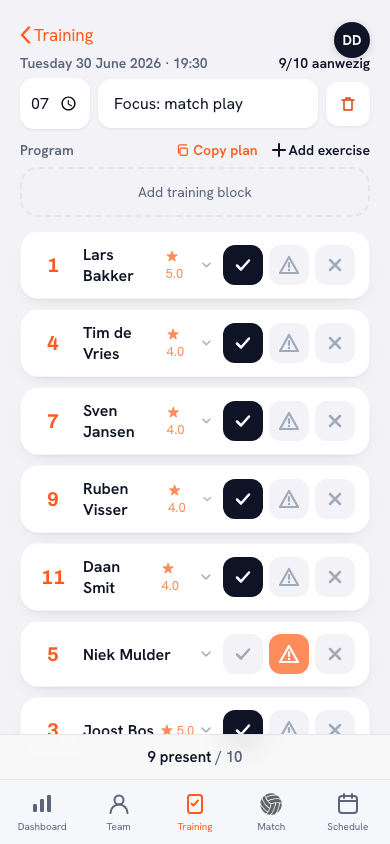
If you record per practice who was there and what effort you saw — in Koach or simply in a notebook — you have the conversation six weeks later with a fact instead of an impression. With teenagers that is decisive: "you've been missing a lot lately" is denied effortlessly, "you've missed three of the last eight practices, all of them on Tuesdays" isn't.
The trap: "train badly, don't play"
It is the first measure almost every coach reaches for, and with 13- to 16-year-olds it backfires in four ways.
- You punish exactly the reason he comes. Saturday's match with his mates is often the last thing keeping him there. The pattern is predictable: first a match on the bench, then two absences without a reason, then a message from a parent — see a child who wants to quit volleyball.
- You hand him status. A player visibly punished by the coach is no cautionary example to his audience but a hero. You give him for free exactly what he was after.
- You can't carry it out. With thirteen players and three absences your line-up falls apart. So you don't carry it out, and then the rule is folklore within two weeks — and your word with it.
- It usually isn't true. Training badly at this age is rarely unwillingness. It is the growth spurt, a rough week at school, or precisely the status anxiety from the first section.
What does work is a consequence that stays inside the practice and follows immediately. The drill goes on without him: "you're out until you join in", and then you really do carry on without giving him attention — coming back is always allowed, without a conversation, and it rarely takes longer than two minutes. The clock keeps running: if the explanation has to be given three times over, that comes off the game play at the end. Not a punishment but arithmetic, and you explain it once. And the consequence they set themselves, because you don't have to defend that one.
Drills in which opting out is impossible
This is where most of the gain is, and it costs you no conversation at all. The design rule: the smaller the game, the more expensive it becomes to do nothing. Three ball contacts per side split over six players is half a ball per player per rally; the same three contacts over three players is one, and in a 2 v 2 everyone touches the ball at least once every rally. In a six-a-side you can stay invisible for half an hour; in a three-a-side you can't. Five rules for rebuilding any existing drill:
- Never more than four players per half court in the core of your practice.
- Short turns with a hard clock. Ninety seconds, then rotate. Nobody hides for that long, and that long is also sustainable.
- Never more than three in a queue. A queue of six is an invitation to chat, and the group accepts it.
- A score that counts down. Collecting points allows you to do nothing for a while, losing points doesn't. Give each team eight points and take one away for every ball that lands on their side.
- You pick the teams. Letting players pick teams themselves isn't freedom at this age, it is a public ranking.
Three formats that follow from this, with timings:
- Count down, 3 v 3 (12 minutes). Half court, three teams of three or four, each team starts on eight points. Every ball that lands on your side costs a point, including your own errors. A team reaching zero goes off and the waiting team comes on; a team that stays on keeps its remaining points. There is nothing to collect, only to lose — which makes every ball count for everyone.
- Ninety seconds (9 minutes). 2 v 2 on a court about three metres wide, six rounds of ninety seconds, and after each round everyone moves on one court. Don't put anything on the board; the clock is the pressure.
- Three names (10 minutes). 4 v 4 or 6 v 6, ordinary scoring, but a point counts double if three different players touched the ball in that rally. Within two minutes they are looking for each other instead of avoiding the ball.
The technique you put into it doesn't change; only the shape around it, and that shape decides whether they join in. Build in one moment per practice where they do get to choose: which of two formats you finish with. That costs you nothing and produces a yes.
The two-minute conversation with the two who do want to
In every group of thirteen there are two or three who want to but don't dare go first. You don't recognise them by their level: after your explanation they are the first to look at the ball, while the rest look at each other. They are your lever. Speak to them separately, before practice, outside the changing room:
"Last week I saw you were the first to work out what needed to happen, and that you waited anyway. I get that. From now on I'm going to ask you to be the first to start on the set-up. Then you're not the one showing off — you're just doing what I asked. Is that all right?"
What you give him is cover: he can join in without paying the price, because it was your instruction and everyone can see that. Exactly the sum from the first section, and you are changing one side of it. Do this with three players at most; at four or more it stops being cover and becomes a clique.
Two things you don't do. Never hold these players up as an example to the group — "look, Sanne is doing it" burns her in one sentence. And don't leave it at that one conversation: come back to it briefly per player, two sentences after practice. Write one line per player, in Koach or in a notebook, and three weeks later you still know what it was about.
Phones, moods, and the day when nothing works
On phones, one agreement and no hunting beyond that: it stays in the bag from the moment you walk into the hall until after the last ball. What you don't do is confiscate — that is a power struggle in which you are holding someone else's property. Put your own phone away visibly: a coach checking his screen between two drills has withdrawn the agreement himself.
The changing room is the grey area, and the problem there isn't messaging but filming. Agree that explicitly: in the changing room no camera goes on, ever, by anyone. What clubs and federations have formally laid down about this differs per country and per club — ask your board which code of conduct applies where you are and refer to it, because an agreement that exists on paper isn't yours alone to defend.
Then moods. At this age they shift within a single practice, and that is normal; it only becomes your business when it becomes behaviour. So hold to this rule: you correct behaviour, not mood. You don't need to know why someone is in a bad mood, only to say what does have to happen: "You don't have to say anything. Joining in at whatever level works today is enough." Never ask "what's wrong?" in front of the group — the answer is always "nothing", and after that he can't come back without losing face. Ask afterwards, walking out, alongside him. And keep your conclusions small: one bad practice is one measurement, only three weeks of the same is a pattern.
Turning thirteen individuals into a group
A youth team isn't a group just because it has a name and a kit. What you usually see is three cliques of four and one player who only belongs because that is how the teams happened to be split. Cliques aren't the problem, they are always there. That one player is: he is the first to leave.
- Fixed pairs that you assign and rotate monthly. After three months everyone has worked with everyone. The cheapest tool there is, and nobody notices it.
- Jobs that give status and aren't about level. Who puts up the net, who keeps score, who sends round the line-up, who leads the warm-up today. Rotate them, and don't hand them to the best player as a reward.
- Doing something hard together. Groups form faster around shared effort than around a shared party: a tournament on a Sunday, or a practice that ends with thirty balls in a row over the net before anyone can go home. Do pick a number that is genuinely achievable.
- The last three minutes in a circle, standing, one thing from everyone. Always the same format, every practice. With teenagers repetition works better than variety: a fixed ritual doesn't need anyone to start it, so nobody can be the show-off for doing so.
What doesn't work is the team-building evening as a repair job after a conflict — then it is visibly an intervention, and this age rejects that. Formats that do produce something are in team-building exercises for a sports team, and how this group relates to what you train before and after it is in training youth volleyball by age group. And the honest part alongside it: you won't turn thirteen teenagers into a friendship group, and you don't need to. The goal is more achievable — that everyone can work with everyone, and that nobody is left standing alone.
Key point: joining in has to be cheaper than doing nothing. Every time you raise the pressure in front of the whole group, you make joining in more expensive — and you get back exactly the behaviour you were trying to remove. So change the drill and the audience, not your tone.
Frequently asked questions
From what age do you run into this?
In practice from about twelve or thirteen, with the sharpest period between thirteen and sixteen. Go by age rather than by the category label: what those age groups are called differs per federation, so the same label means different things at different clubs.
Should I get stricter if a whole group does nothing?
Getting stricter adds audience to a problem caused by audience. Change the shape of your drill first — smaller teams, shorter turns, a countdown score — and only then your tone. If the behaviour still lingers after that, it is about agreements and not about strictness.
What do I do with a player who only comes because his parents send him?
Ask him, separately and without judgement: what would make it worth your while? Then give him one role or job he says yes to himself and agree a deadline, for example until the winter break. Someone who chooses nothing usually quits anyway — but then with an honest conversation instead of in silence.
Does punishing with fitness work, or running laps?
Not at this age, for two reasons. It turns effort into a punishment when you need that same effort for the rest of the season, and it gives the punished player status with his audience. A consequence that stays inside the drill and follows immediately does more.
How do I handle phones in the changing room?
Make one agreement instead of hunting for them: phones in the bag from the hall onwards, and in the changing room no camera ever goes on. Never confiscate a phone. Which code of conduct your club or federation has formally laid down about this differs per country and per club — ask your board and refer to it.