
Coaching girls volleyball: what works in the gym
The short answer
Coaching girls volleyball is at its core simply good coaching: a climate where mistakes are allowed, concrete feedback and clear roles. What comes up more often on girls teams is the fear of being judged, tension in the group and topics such as periods and uniforms. It helps if you are the one who makes those open to talk about.
Coaching girls volleyball always raises the same question: does it have to be different from coaching boys? Less than you might think, and on a few points it does. Here you read what research says, how to give feedback that builds confidence, what to do about cliques and conflicts, how to get a quiet team talking and what to arrange around bodies and privacy.
Do you have to coach a girls team differently from a boys team?
Less than many coaches think. Smith, Smoll and Cumming taught coaches of youth basketball teams an approach built around effort, learning and improving instead of winning at all costs. Over the season their players became less anxious before matches, while that anxiety increased on the other teams, and the effect was as large on girls teams as on boys teams (Smith et al., 2007). So what good coaching is applies to both.
Still, some things come up more often on girls teams, especially from around age twelve. In a British survey of more than 4,000 teenagers, 61 percent of the girls said they feel judged when they play sport, and half said they don't feel good enough to take part (Women in Sport, 2022). You see that in the gym: players who don't dare to call a ball, who go quiet after one error, or who quit after the season without anything seeming wrong.
So don't treat your team as "the girls", but as twelve different players. What follows are things that often come up, not rules about how girls are. For the broader teenage side, a team that hides and doesn't seem to want anything, see coaching teenagers.
Feedback that builds confidence
- Name the good decision, even if the ball goes wrong. "Good that you called that ball", after a pass that was just short. Players who only hear what went wrong start playing it safe.
- Correct the movement, not the player. "Your platform is too flat" helps; "that was sloppy" doesn't. One point at a time.
- Pick your moment. A technical tip can come in the middle of a drill. A critical comment about effort or attitude you save for a short conversation one on one: a player who is called out in front of the group mainly hears that the group is listening.
- Ask what she saw first. "What did you notice on that last serve?" A player who names it herself remembers it better and feels taken seriously.
How to correct without raising your voice and what to say instead is covered in correcting without yelling.
In volleyball it hits hardest in serve receive. An opponent deliberately serves at the player who doubts herself most, and that player feels it. Talk about it openly ("they are serving at you because they think it works, so let's make sure it doesn't"), give her extra serve-receive reps and give her a smaller zone in the passing pattern until her confidence is back.
Cliques, roles and conflicts on a girls team
Friendships form on every team, and that is good. It becomes a problem when fixed cliques seek each other out in every drill, the rest are left out and teammates get talked about outside the gym. A few habits keep the team together:
- You make the pairs and groups. Not always, but often enough that everyone plays with everyone. It is better for the game too: every passer has to be able to work with every setter.
- Give everyone a role. Who leads the warm-up, who counts the balls, who watches during the timeout where the opponent is serving. A role gives a player a place that doesn't depend on the cliques.
- Deal with a conflict early and one on one. If you notice tension between two players, talk to each of them separately first and then together, outside practice. Don't let it spill into the group chat or the locker room, and don't take sides before you have heard both.
- Agree together on how you treat each other. Online too: no comments about teammates in side chats, no forwarding screenshots.
How to recognize groups that split the team and what to do then is covered in more detail in cliques on your team.
Getting a quiet team to talk on the court
Many young teams play in silence: nobody calls, and two players look at each other while the ball drops between them. Talking is a skill you train, just like passing.
- One word per action. Agree on a few fixed calls: "mine" for whoever takes the ball, "out" for a ball that is going out, and a call or agreed code from the attacker who wants the ball.
- Points only count with a call. In a game-like drill a won rally only counts if every player who touched the ball called it first. After ten minutes you hear the difference.
- Reward the call, not the ball. A player who calls and then shanks the pass gets praise for the call. Otherwise only the players who are sure of their ball will call.
- Let the captain lead the way. A captain who says something after every rally, even if it is just "next", pulls the rest along.
Start every practice with one agreement you check out loud. For example: today everyone calls every ball. Watch for it in the first drill, name it when it works, and at the end of practice ask whether the team thinks it worked. One thing at a time sticks, five at once doesn't.
Bodies, uniforms and periods: make it normal
These are the topics coaches would rather avoid, and precisely because of that players drop out without anyone knowing why. A few agreements make a big difference:
- Anyone who needs to step out doesn't have to say why. Agree at the start of the season that a player can go to the locker room without explaining. Then nobody has to call in sick or stay home because she has her period.
- Look at the uniform. Light-colored, tight shorts can be a reason to feel uncomfortable, especially during a period. Where your league's rules leave room, let the team have a say in the color and length of the uniform.
- No comments about weight or figure. Not as a joke and not as advice either. If it is about nutrition or fitness, talk about energy and what your body needs to train.
- Take the knee seriously. In sports such as soccer and basketball girls run a higher risk of an ACL injury than boys, and in girls the number rises during the teenage years. A fixed warm-up with strength, balance and landings helps; see ACL injury in volleyball.
Privacy and safety: what you arrange as a coach
This applies to every coach of a youth team, but on a girls team with a male coach people pay closer attention, and rightly so.
- Never go into the locker room while players are changing. Knock, wait, and preferably send a female staff member or the captain.
- Communicate through the group or the parents, not with private messages late in the evening. A message everyone is allowed to read can't be misunderstood by anyone.
- Make sure there is a female point of contact: an assistant, team manager or parent, for the questions a player would rather not ask you.
- Follow your club's code of conduct and the rules that apply in your country for working with minors. Know who players can go to in the club to report inappropriate behavior, and tell them.
Confidence and stats: who sees which errors?
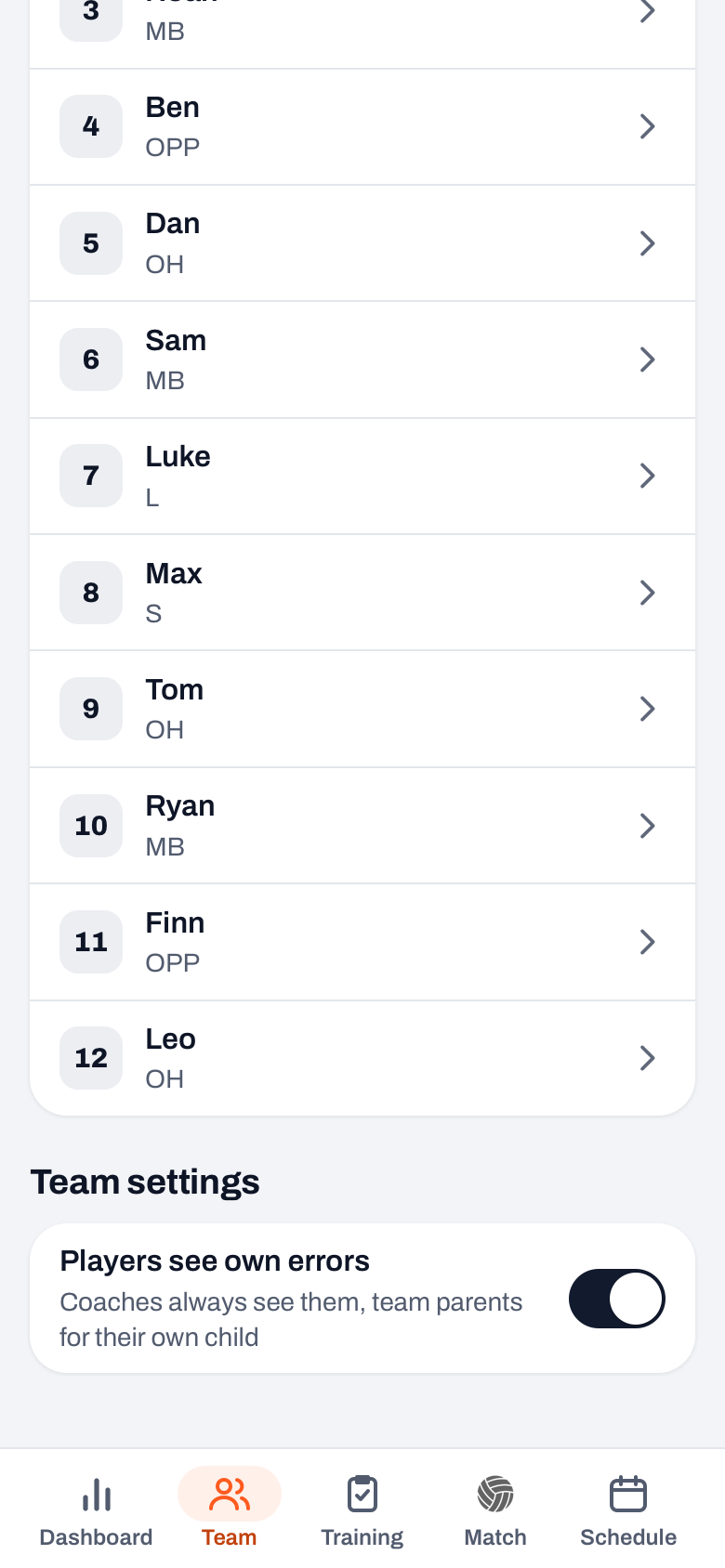
If you score live in Koach, after the match you see points and errors for each player. For you that is information; for a fourteen-year-old who already doubts herself, a row of errors under her name can mostly confirm what she already thought. That is why under the player list, in Team settings, there is the Players see own errors switch. If you turn it off, the error block and the error counters disappear from a player's own stats. Under the switch it says: "Coaches always see them, team parents for their own child". You set it differently for an individual player with Sees own errors under Edit player. When to show errors and when not is covered in showing errors to young players.
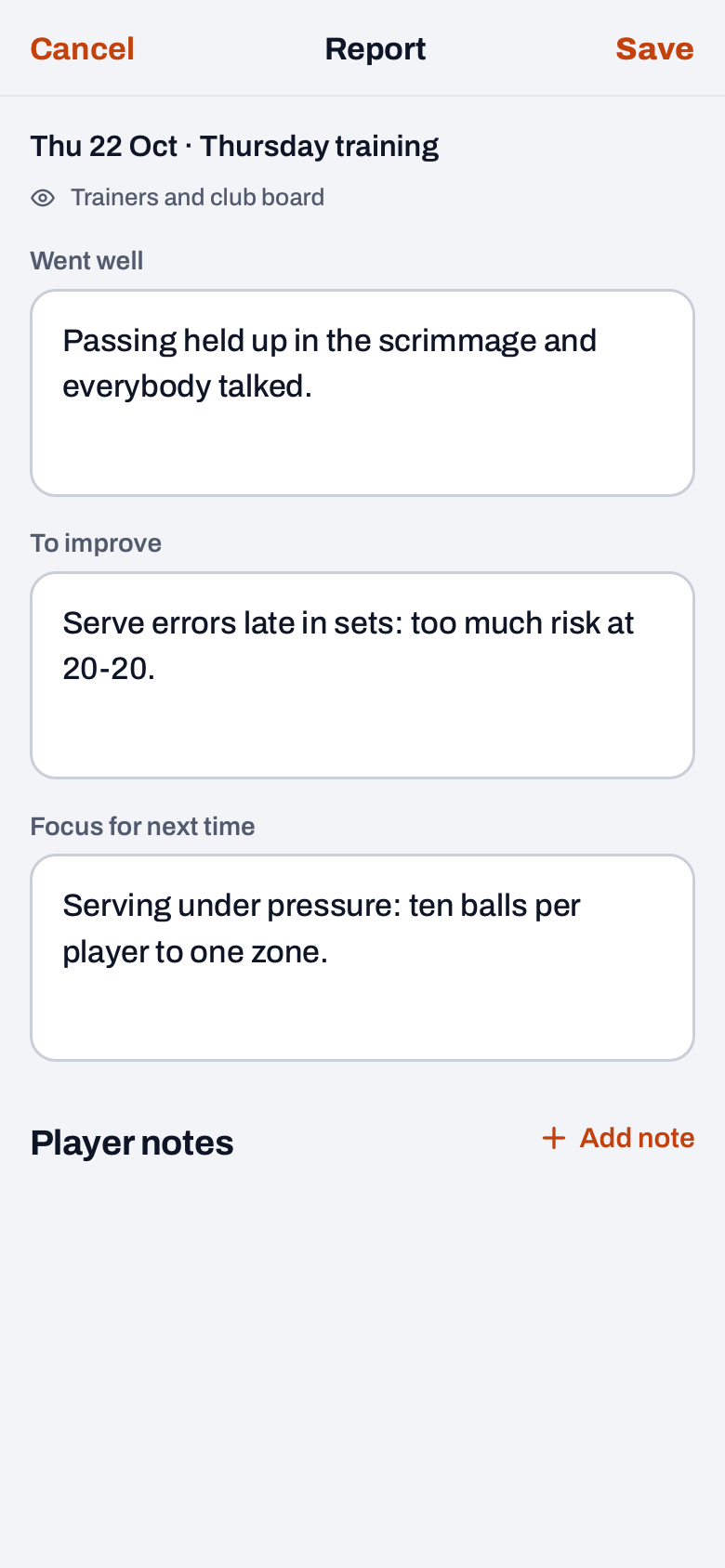
What you agree with a player in a conversation is quickly lost without a note. In a practice report you add a short note per player under Player notes. The report is only for coaches and club leadership; players and parents don't see it. That way in six weeks you still know that you agreed with her to do extra serve-receive work, and whether it is getting better.
If you have just started with your first team, also read starting as a volleyball coach. What Koach costs after the 14 free days is on the pricing page.
14 days free, no credit card. Add your team, decide who sees her own errors and keep track of what you agree with each player.
Try Koach with your teamFrequently asked questions
How do you handle tears or emotions at practice?
Give space without turning it into a moment for the whole group. Let the player sit out for a bit if she wants to, ask briefly how she is doing after the drill and come back to it after practice if needed. Tears after an error or a harsh comment are not a weakness. If it keeps happening with the same player, talk to her one on one and possibly with her parents.
How do you deal with periods on your team as a coach?
You don't need to have a conversation about it; above all you need to make it easy. Agree with the whole team at the start of the season that anyone can go to the locker room without explaining, and name a female point of contact among the staff or the parents. If a player often has a lot of symptoms, refer her through her parents to the family doctor.
Is a female coach better for a girls team?
Not automatically. What counts is whether a coach knows the game, takes players seriously and creates a safe climate, and a man can do that just as well as a woman. It is wise, though, to have a woman among the staff or chaperones whom players can turn to, especially on youth teams and at tournaments with an overnight stay.
Can you be strict with a girls team?
About agreements, yes: being on time, taking part and supporting each other. Clear boundaries actually give a team calm. What doesn't work is being strict on the person: sarcasm, putting someone down in front of the group or threatening playing time. Be clear about what you expect, check it and also say so when it goes well. That applies to every team, not just a girls team.



Coach your girls team with Koach
14 days free, no credit card. You decide whether players see their own errors.
Get started with KoachOr read first what the volleyball coaching app does.