
Cliques in sports teams: when they split the team and what to do
The short answer
Cliques in sports teams almost always form: players stick with those who are like them, have been on the team as long or ride with them. It becomes a problem when a group closes itself off, sets its own norms or only plays to each other on court. Then as a coach you change the groupings, the roles and the agreements.
Cliques in sports teams show up in small things first: always the same pairs in the warm-up, two huddles after a point, a silence when one group walks in. Friendships are fine. But when groups split the team into camps, the atmosphere goes downhill, and as a coach you do not turn that around with one talk.
Small groups are normal, camps are not
Small groups form in every team. Players who have played together for years, go to the same school, ride together, are the same age or play the same position seek each other out. In an interview study of eighteen college athletes from nine teams (Martin and colleagues, 2015), the athletes saw the formation of cliques as something you can hardly prevent, driven by how long someone has been on the team, who spends a lot of time together and who is similar to whom. They linked cliques to exclusion, to performance and to whether players kept playing. But they also saw that a group that draws others in can actually help the team.
So the difference is not whether there are groups, but how open they are. Keep three situations apart:
- A group of friends. Players hang out together off the court, but on the court and in the locker room everyone is welcome. Nothing to do there.
- A clique. A group closes itself off, has jokes at others' expense, its own agreements and its own opinion about the coach or the lineup. The team falls apart into "us" and "them". That is what this article is about.
- One player left outside the group. That is a different problem with a different approach, covered in bullying and exclusion in sport.
How to spot a clique that is splitting the team
You do not have to eavesdrop on conversations. Most signs you can simply see in the gym:
- In the warm-up it is always the same pairs, and at "find a partner" the group has split in two seconds.
- After a point two huddles form, or one huddle with a gap in it.
- On the court, calling and encouragement mostly happen within the group. After an error by one group you hear "no worries", after an error by the other it goes quiet.
- On a free ball the setter goes to the same hitters strikingly often.
- On the bench and in the locker room everyone sits in fixed blocks, and new players still have not found their way in after weeks.
- There is a second group chat, and what gets discussed there comes back to you as grumbling about the lineup or about teammates.
- The dividing line matches something you created yourself: starters against bench, old against new, first-years against the rest.
If you are not sure, write down after two practices who warmed up with whom, who sat next to whom and who left with whom. After two sessions you see whether it is chance or a pattern.
Why cliques form, and which levers you control
Part of the cause is out of your hands: age, school, friendships. A large part lies in how practice and the team are set up:
- Fixed groupings. Players pick their own partner, captains take turns picking teams, and in the scrimmage it is starters against bench every week.
- Unclear roles and playing time. A player who does not know why they are on the bench looks for support from others in the same spot. That is how a camp forms around a sense of unfairness.
- The coach's attention. If you always talk with the same players after practice, the rest sees that as favoritism, even if you do not mean it that way.
- Losing streaks. After a few defeats a team looks for someone to blame, and the line then often runs along the groups.
- The organization around it. Fixed carpool groups, a separate chat per group, fixed spots in the locker room.
Five changes in practice that improve team chemistry
- You make the groups. Set pairs and teams yourself and change them every few minutes. Mix on purpose: starters with bench, experienced with new, different positions together. Always do it, also when things are going well. If you only make the groups when something is up, you are handing out a punishment.
- Give mixed groups a shared score. A group of three sets a passing record together, a mixed team wins a game-like drill together. A task that only works together connects more than a conversation. More ideas are in team building exercises that actually work.
- Make pairs for a month. Pair a starter with a substitute, or a newcomer with an experienced player. They warm up together, watch each other's technique and review together. How to keep the bench involved is in keeping bench players engaged.
- Agree on behavior on the court. Everyone calls the name of the player getting the ball, after every point all six stand in one huddle, and after an error everyone gets the same reaction. These are agreements about the court, not about friendship, and you can check them every rally.
- Handle the edges yourself. Make the carpool schedule yourself, keep one official team chat that you are in, and do not let players sit in their fixed blocks at a team meeting.
Change the pairs before they set. In every practice, include one drill where you make the pairs, and make sure everyone has played with everyone within a month. It takes thirty seconds per drill and the group stops sorting itself.
The conversation: with the leaders, not with the whole team about cliques
A team talk about "the cliques" usually produces denial and sharpens the line: afterwards everyone knows exactly which camp they belong to. Instead, talk one on one with the players who set the tone in their group. Describe what you saw, not who they are: "In the warm-up you are with the same two every week, and after the new setter's error it went quiet." Add that friendship is fine, and ask them to use their influence: whoever sets the tone can also bring others in. A player who bends the whole team to their will calls for a different approach; that is in dealing with a dominant player.
With the whole team you talk about what you expect from each other on the court, not about who hangs out with whom. Put those agreements in writing and come back to them. What a team wants to stand for and how you see that in every practice is in building team culture. If this is your first team, start with starting as a volleyball coach: agreements you make in the first week, you do not have to fight for later.
With youth teams the parents play a part. Fixed carpool groups of parents often turn into fixed groups of kids. A carpool schedule that you make and that rotates removes that without you having to name it. If a group turns against you, or the team splits over a conflict with the staff, involve your captain and the club's technical leadership.
Mixed teams in your practice game
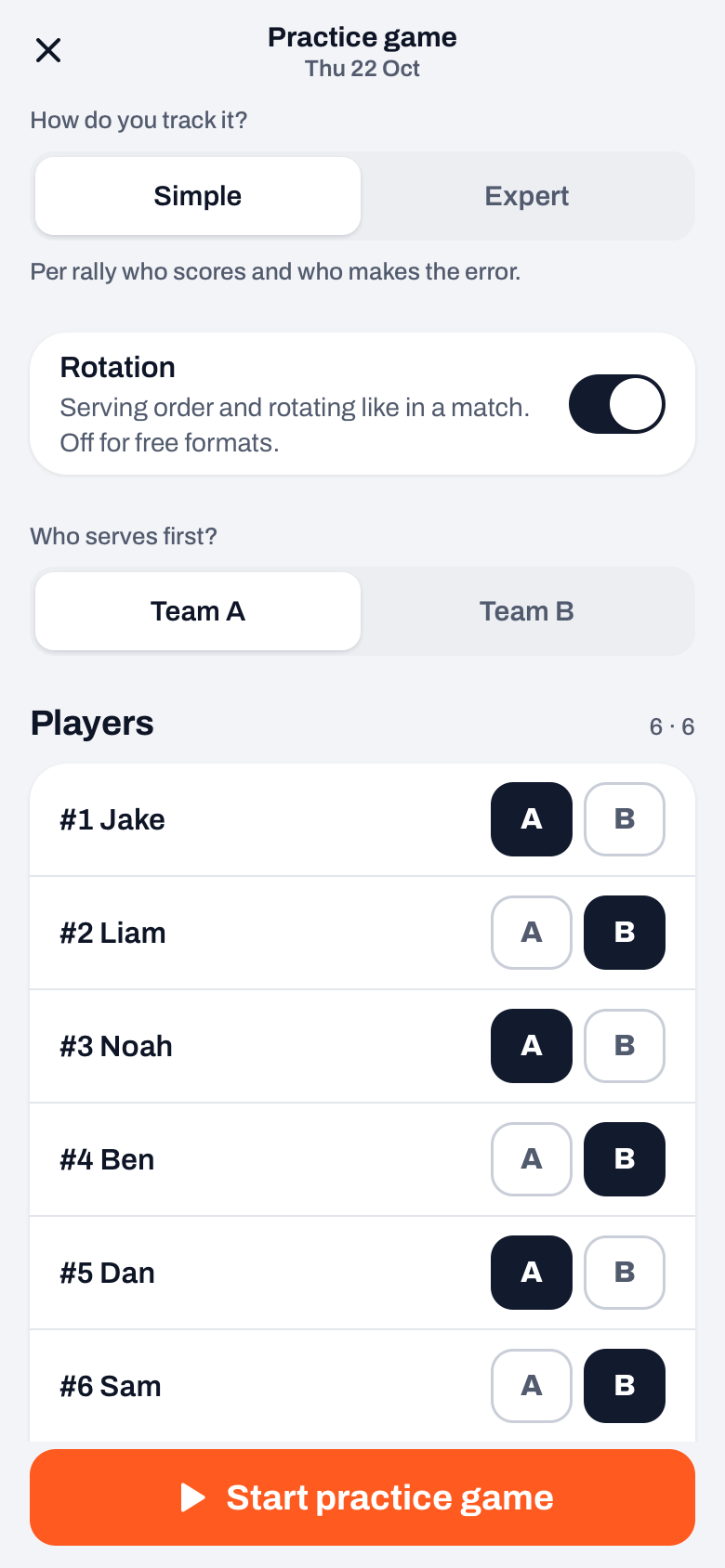
The scrimmage at the end of practice is when groups show most clearly. In a practice game in Koach you pick Team A or Team B per player, so the split is up to you and not to the players. During play, in Simple you move a player to the other team with one tap, and with New round (via the three dots at the top) you start again at 0-0 while the previous score is kept. That way you mix starters and bench differently every round. What you notice about the group goes into the Player notes for that practice. Players and parents do not see them, and after a few weeks you have a pattern instead of a feeling.
What Koach costs after the 14 free days is on the pricing page.
14 days free, no credit card. Set up your next scrimmage with mixed teams and see who starts talking to whom.
Try Koach with your teamFrequently asked questions
Are cliques in a team always bad?
No. Players who stick together because they are the same age, have played together for a long time or ride together are normal and often good for the atmosphere. It becomes a problem when a group closes itself off, leaves others out or only plays to and encourages each other on the court. Then the team splits into camps.
Should I address cliques with the team?
Not in a group talk about who hangs out with whom; that only sharpens the line. Talk one on one with the players who set the tone in their group, and discuss with the whole team what you expect from each other on the court. Alongside that, change how you group players in practice, because that is where most cliques form and stick.
How do you improve the atmosphere in a team?
Start with what you control yourself: make the groups and teams yourself and change them often, give mixed groups a shared task, make clear agreements about behavior on the court and be able to explain playing time. Small things that come back every week do more than one big team outing.
How do you prevent cliques in a youth team?
Make the groups yourself from the first practice, also in the warm-up, and change them every few minutes. Make the carpool schedule yourself so the carpool groups rotate, and make sure there is one team chat that you are in. Pay extra attention to new players: pair them with a regular, experienced teammate for the first weeks.



Mix your teams in the next scrimmage
14 days free, no credit card. After a month everyone has played with everyone.
Get started with KoachOr read first what the volleyball coaching app does.