
Volleyball team culture: three values you see in every practice
The short answer
Volleyball team culture is what is normal on your team when nobody is steering: how players react to a mistake, who picks up the balls, how the bench gets involved. You build it with three values that you turn into visible behavior and see again in your drills, your playing time and your feedback.
Volleyball team culture develops whether you work on it or not. The only question is whether it becomes the culture you want. Here is how to work with three core values you see in every practice, in the gym and not on a poster in the clubhouse.
What is team culture on a volleyball team?
Team culture is what is normal on your team. You see it in small things: what a player does after a teammate misses a serve, whether someone helps take down the net after practice, how the bench behaves when you are down 20-24, how a new player is welcomed on their first night. Nobody agreed on those habits, and yet everyone knows what is expected.
Culture has three layers. Values: what you find important. Norms: what those values look like in behavior. Habits: what you do the same way every week, from the warm-up to the moment after the final whistle. A team that only has values has a poster. A team with norms and habits has a culture.
Agreements about attendance, letting the coach know when you cannot come and playing time belong in the first meeting of the season; how to set that up is covered in the first team meeting. This article is about the layer underneath: where those agreements come from. With a new team you set the tone in the first weeks; what else comes your way in your first season is covered in starting as a volleyball coach.
Why three values and not ten
Nobody remembers ten values, and you cannot show them all in one practice. Three is doable: every player can name them, and in every drill you can see whether they are there. Pick words that mean something in the gym. Respect and fun are well meant, but too vague to coach on: what does a player who shows respect do after someone else makes a mistake? A value only works when you can see it happen, and see it missing.
Step 1: choose the values together with your team
Start with yourself. Which two or three things are non-negotiable for you, whatever happens? That is the core of your coaching philosophy. Take that to the team and let the players fill in the rest. Three questions work well:
- What do you want an opponent to say about us after the match?
- Which team did you enjoy playing on most, and what did they do differently there?
- What do you see on our team when we are down 20-24, and what would you like to see?
Let everyone write on their own first, group the answers and choose three words together. With a youth team of twelve-year-olds, you choose the words and ask the players what they mean by them. With adults, the team chooses, within the limits you set beforehand.
Step 2: turn each value into behavior you can see
An example with three values you come across on many volleyball teams: Every ball, Together and Grow.
| Value | In practice | In matches |
|---|---|---|
| Every ball | A ball that looks out of reach still gets a step; fetching balls is done at a jog | Chasing every ball to the wall; the bench stands up for every point |
| Together | Every first ball gets called; after an error a teammate says something or gives a tap within three seconds | A quick huddle in the middle after every point; in a timeout the bench stands in the circle too |
| Grow | A player keeps trying the new technique even when it goes wrong, and asks for feedback | An error after an agreed risk is not punished; after the match everyone names one thing they learned |
Write down two or three behaviors like these per value, no more. You will use that translation in your drills, your feedback and your conversations about playing time.
Step 3: build the values into your practice
A value that only exists in the locker room disappears. Put it in your drills, with scoring that rewards the behavior.
- Every ball: the save point. In a scrimmage, a ball that gets back into play after a dive or a sprint earns an extra point, even if the rally is lost afterward.
- Together: call it or lose the point. A first ball that was not called counts for the other team, even if the pass was good.
- Grow: the try point. In the last scrimmage, a successful action with that night's technique counts double, and a failed attempt costs nothing.
- A fixed closing. End every practice with one question: who showed one of our values today? Let players name each other, with a specific moment.
Activities that make the group stronger, with and without the ball, are in team-building exercises that work.
Step 4: make playing time and feedback speak the same language
This is where a culture succeeds or fails. If you say Every ball counts but the hitter who never chases a ball plays every set, your team learns that talent comes before the values. Players do not watch what you say, they watch who plays and who gets praised.
- Playing time. Make clear beforehand what role the values play in who plays, alongside skill level. How to share playing time in a way you can explain is covered in distributing playing time fairly.
- Praise. Name the behavior and the value: "That ball all the way to the wall, that is Every ball." That way the whole team hears what you mean.
- Corrections. Point to the agreement instead of the person: "We call every first ball. Whose was that?" How to correct without raising your voice is covered in correcting a player without yelling.
- The captain. Agree with your captain that they guard the values during the rallies. A player who calls out a teammate sometimes carries more weight than you on the sideline.
When your best player breaks a value
Sooner or later the moment comes: your best player does not chase a ball, grumbles at a teammate or shows up late. What you do then decides whether the values apply to everyone. Talk to them privately and briefly, at the break or after practice, not in front of the group. Give the same consequence you would give anyone else. And bring it back to the value, not to your irritation: "We agreed together that every ball counts. You let that one go." A team accepts differences in skill, but rarely differences in rules.
How you see whether it works
Take a look after four to six weeks. In one scrimmage, count how often a first ball is called, or how often a player says something after someone else's error. Ask players anonymously for a score from 1 to 10 per value: how often do you see it on our team? Repeat that halfway through the season. If the scores do not improve, look at yourself first: do you model it, and does it show in your decisions? If a value is still not alive after half a season, the word may not suit your team. Then pick another one together.
Make one value the focus each month. That month you watch for that one behavior in every practice, reward it in your scrimmages and name it at the closing. After three months each value has had its turn, and players know what you mean by each word.
Tracking team culture with Koach
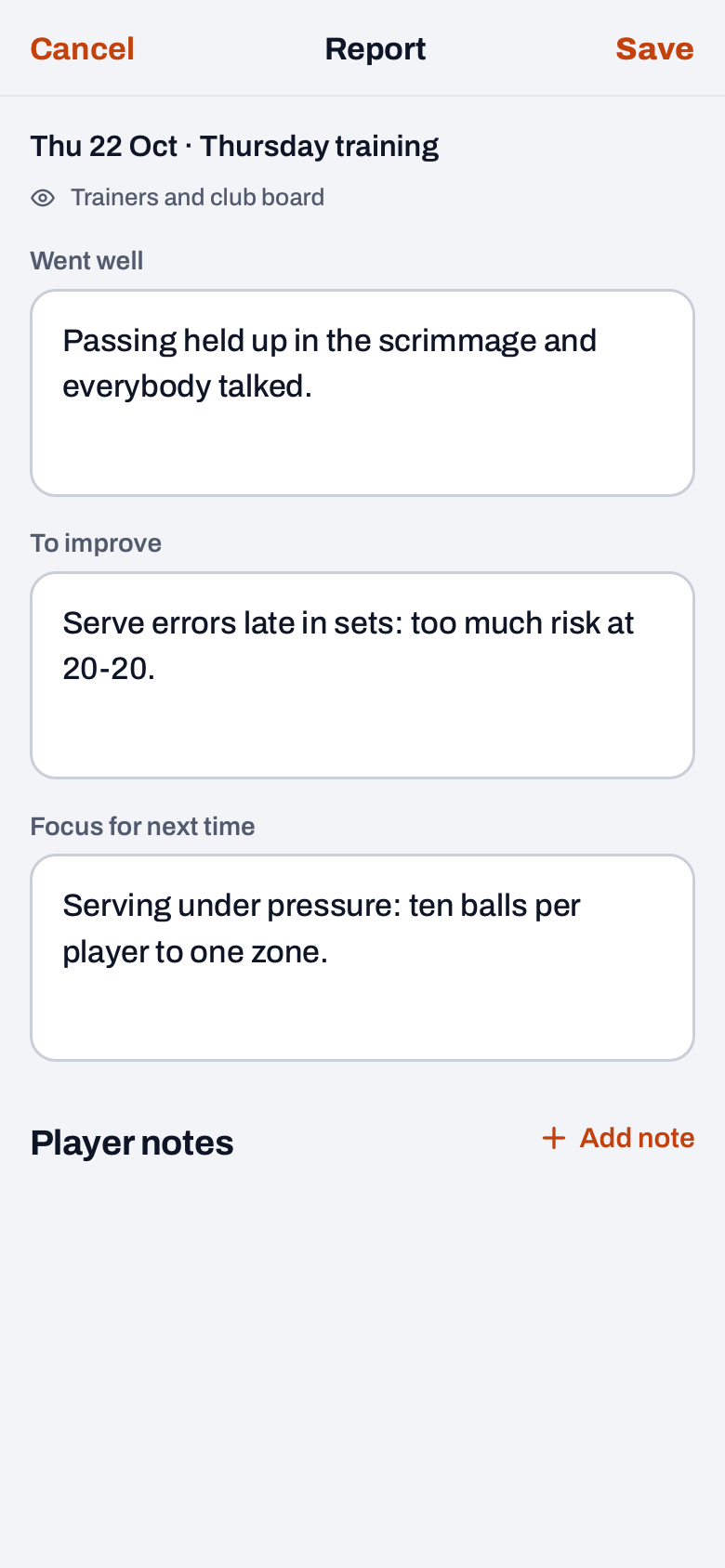
Koach has no separate field for team values. What does help is writing down briefly after every practice what you saw. In the practice report you fill in Went well, To improve and Focus for next time: write there which value you saw and where it was missing. With Player notes you attach a moment to one player, for example the diving save you named them for at the closing. Only the team's coaches read the report, and at a club the club board as well; players and parents do not see it.
With Rate effort you give the players who attended a rating from 1 to 5 per practice, for things like Work ethic, Effort and Coachability. In the player profile, History shows the average effort. That way you have a conversation about Every ball with something more concrete than your memory. What Koach costs after the 14 free days is on the pricing page.
14 days free, no credit card. After your next practice, write in the report which value you saw, and look back a month from now.
Try Koach after your next practiceFrequently asked questions
What is a good team culture on a sports team?
A culture in which a few clear values show in what players do, also when things go badly and also when the coach is not watching. Players know the values, they apply to everyone, and they come back in practice, in playing time and in how teammates treat each other after a mistake.
How do you change a bad team culture?
Start small: choose one value and one behavior you want to see, for example calling every first ball. Model it yourself, reward it in your drills and hold everyone to it the same way, including your best player. Involve the captain. Count on a few months: habits do not change in one practice.
Who is responsible for team culture, the coach or the players?
Both. The coach sets the framework, leads by example and makes sure playing time and feedback match the values. The players carry the culture in the rallies and in the locker room, where the coach is not present. A captain who guards the values makes the difference between the coach's culture and the team's culture.
How many core values should a sports team have?
Three is a good number. Every player can remember them, and you can bring them all back in one practice. With more values it becomes a list nobody can name. Choose words you can see in behavior, such as Every ball or Together, instead of general words like respect.



Write down what you saw after your next practice
14 days free, no credit card. A month from now you see whether your values are alive in the gym.
Get started with KoachOr read first what the volleyball coaching app does.