
Volleyball coaching philosophy: values, choices and an example
The short answer
A volleyball coaching philosophy is your own answer to three questions: why you coach, which values matter to you and how you show them in practice, matches and playing time. Write it down on half a page, with concrete choices, so you stay consistent under pressure and towards players and parents.
A volleyball coaching philosophy sounds like something for a coaching course, until in the third set you have to choose between winning and letting everyone play. That is when it shows whether you have one. This article helps you write down your own philosophy in five steps, with an example and the places where players notice it.
What is a coaching philosophy?
Your coaching philosophy is personal: why you coach, what you consider important and how you act on it. It is different from your club's documents. A coach handbook sets out the club's vision and what it expects of coaches. The coach code of conduct says what is not allowed. Your philosophy is about the space in between: the choices you make within those agreements.
A philosophy is not a slogan either. "Fun comes first" says nothing as long as you do not write down what you do when fun and winning clash. A useful philosophy contains choices you can be held to later.
Why you write it down
- Decisions under pressure. Who serves at 23-24? Does the player who missed two practices play? Without a choice made beforehand you decide on the emotion of the moment, and then you are different this week from last week.
- Clarity for players and parents. Whoever knows what to expect has less to guess. Many conversations about playing time start with an expectation that was never spoken out loud.
- A yardstick for yourself. At the end of the season you can check whether you did what you said, instead of only looking at the results.
Your coaching philosophy in five steps
- Write down why you coach. One sentence, and honest. "Because my daughter is on the team and otherwise there was no coach" is a perfectly good start; it tells you that you mainly want to keep the group together. "Because I want to make players better than they are now" calls for different choices than "because I want to win promotion".
- Choose three values, not ten. For example development, effort, courage, togetherness, honesty or winning. Winning can be on the list; that is more honest than pretending you do not care. Three is enough to remember and too few to hide behind.
- Make each value concrete. For each value, write down what you do and what players see of it. "Courage" then becomes: "An aggressive serve that goes out costs nobody playing time. A soft serve on set point is something we do talk about."
- Decide the hard choices beforehand. How do you divide playing time? Do you rotate positions or choose fixed roles? What happens when someone misses without letting you know? Who talks in the time-out? What do you do when a parent approaches you? How to divide playing time fairly is in distributing playing time fairly.
- Test it on three situations. Take three scenes from a real season and see whether your philosophy gives an answer. If it does not, it is still too vague.
Three test situations that come up with almost every team:
- It is 14-13 in the deciding set and your weakest server is up.
- Your best player missed two practices without letting you know and wants to play on Saturday as usual.
- After the match, with the team standing there, a parent asks why their child only played one set.
Example of a coaching philosophy for a youth team
This is what a worked-out philosophy can look like for a team of players aged 15 to 17. It is an example, not a template: your values may be different.
I coach because I want these players to still be playing volleyball in five years, and to be better than they are now. For that I choose three values.
Development. Everyone learns to pass, set and serve, the middles included. Until the end of this season every player plays at least two positions. In practice, learning comes before playing without mistakes.
Courage. We serve and hit to score. A mistake made out of courage costs no playing time; a mistake out of sloppiness, such as not calling or not covering, I discuss after the rally.
Together. We win and lose as a team. Whoever is on the bench has a job: counting, calling or watching the opponent. After a lost match nobody points at anyone else.
Playing time. Whoever came to practice plays at least one set in every league match. At the end of a set I choose the lineup that gives us the best chance, and I explain it. Whoever misses without letting me know starts on the bench.
Parents. I am happy to discuss questions about playing time, at a calm moment and not right after the match.
For an adult team in a competitive league it looks different, for example: "We play to win, within the agreements we make together. Playing time follows what I see in practice, and I explain every choice." Both are honest, as long as you do what it says.
Where players notice your philosophy
Players do not read your philosophy, they see it. In what you reward at practice, in who is on court at the end of a set and in what you say after a lost set. A few examples:
| Value | At practice | In the match |
|---|---|---|
| Development | Everyone also plays the second ball sometimes | With a big lead, substitutes still get their sets too |
| Courage | An aggressive serve that just goes out does not count as an error in a game form | No substitution after one service error |
| Together | Whoever is not on court counts or coaches along | In the time-out, players first say what they see |
| Effort | Absences are reported beforehand, not in the group chat on the day itself | Whoever misses without letting you know starts on the bench, even if they are the best |
Your philosophy says what you want and why. How you lead, directive, collaborative or hands-off, is your coaching style. The two have to fit together: a coach who says players should learn to think for themselves, but conducts every rally from the bench, contradicts themselves.
Read your philosophy before the match, not after. Put your three values and your playing time rule in your phone and read them on the morning of an important match. Under pressure you forget what you wrote in September, unless you have just read it.
Sharing and adjusting your philosophy
- Share the core, not the whole text. At the first team meeting, tell players your three values and your playing time rule. With a youth team you tell the parents the same.
- Align with your assistant coach. Two coaches with two philosophies give players two messages. Read each other's version and turn it into one.
- Look back halfway through and at the end of the season. Did the playing time match what you said? Did a mistake made out of courage really go unpunished? Ask your players too. Only then adjust the text, not in between after one bad Saturday.
If you are just starting as a coach, your first version is a beginning, not an end point; starting as a volleyball coach helps you through your first season.
Seeing your philosophy back in the app
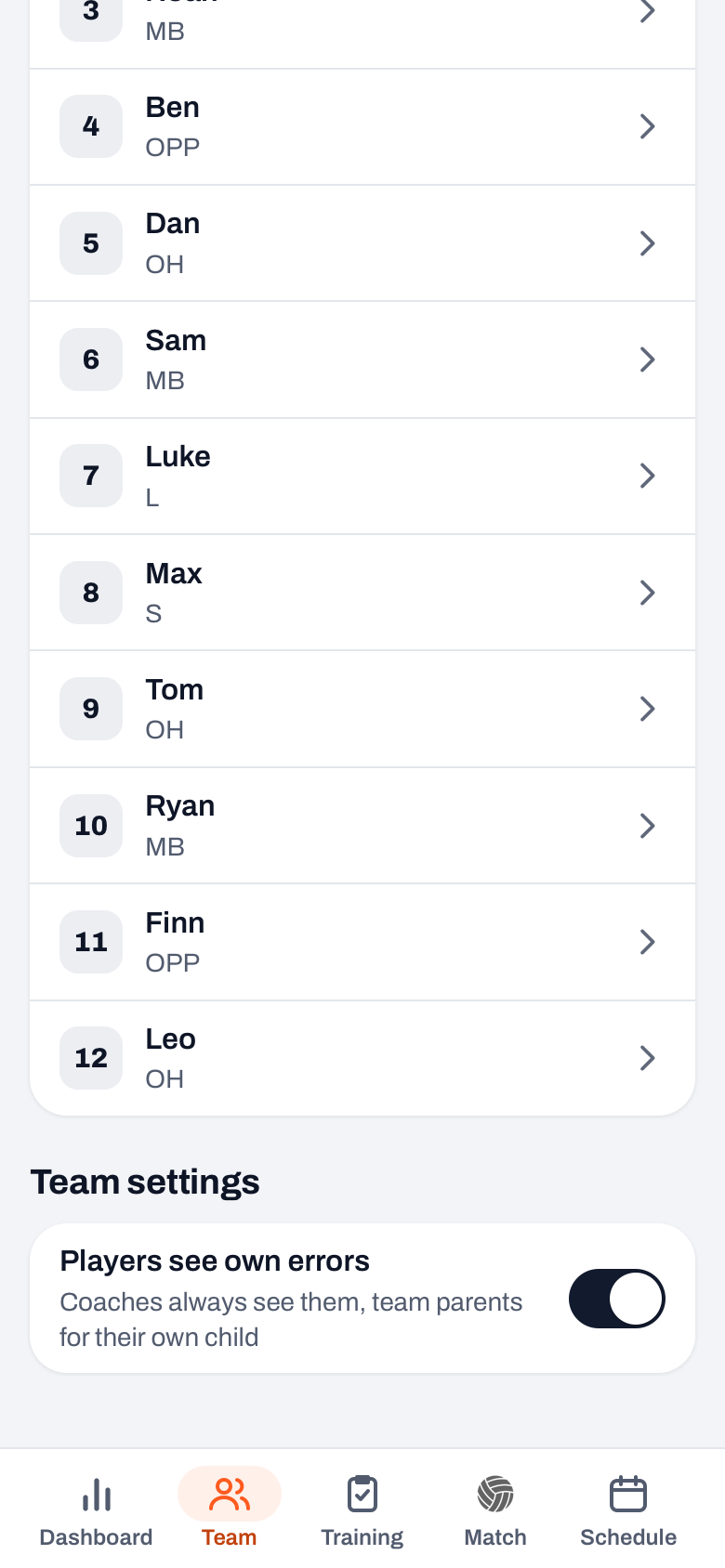
Two choices from your philosophy can be checked or set in Koach. The first is playing time: after a match you tracked live, the Playing time block under Players shows the number of rallies and sets per player and who played least. So you see in black and white whether you kept your own playing time rule. The second is about mistakes. Under Team, in Team settings, there is the switch Players see own errors. If your philosophy says players learn from their own numbers, leave it on. If errors in the stats mostly discourage your young team, turn it off. Coaches always see the errors, parents for their own child.
What Koach costs after the 14 free days is on the pricing page.
14 days free, no credit card. Score a few matches live and see whether the playing time matches what you promised your team.
Try Koach with your teamFrequently asked questions
How long is a coaching philosophy?
Half a page is enough: a sentence on why you coach, three values and for each value what you concretely do, plus your choices on playing time, absences and contact with parents. Longer does not make it better. A philosophy you do not know by heart is one you do not use at the moment it matters.
What is the difference between a coaching philosophy and a coaching style?
Your coaching philosophy says why you coach and which values and choices go with it, such as how you divide playing time. Your coaching style is how you lead: directive, collaborative or hands-off, per team and per moment. The philosophy is the what and why, the style the how. They have to fit together.
Should you share your coaching philosophy with parents?
With a youth team, yes, at least the core: your three values, how you divide playing time and when parents can approach you. Do that at the start of the season, for example at a parents' meeting or in a short letter. Parents who know beforehand how you choose have fewer questions afterwards.
Can winning be part of your coaching philosophy?
Yes. For an adult team in a competitive league, winning is often an honest value. Do write down what it means for playing time and development, and where the line is. With a youth team winning usually comes after development, but you can want to win there too, as long as you write down when it comes first.



See whether you do what you promise your team
14 days free, no credit card. After a few matches you see the playing time per player.
Get started with KoachOr read first what the volleyball coaching app does.