
Coaching styles in sport: which one fits your volleyball team?
The short answer
Coaching styles in sport describe how you decide, give instructions and leave room for players: directive (you decide), collaborative (players think along) or hands-off (players sort it out themselves). No style is always right. You direct in a time-out, collaborate at practice and let go of what players can already do.
Of all the coaching styles in sport, the one you use decides how a practice feels, how a time-out sounds and who makes the call when it gets tight. This article puts the styles side by side, shows when you direct, collaborate or let go, and how to find out which style you actually use yourself.
What is a coaching style?
Your coaching style is the way you decide, give instructions and leave room for your players. It is not a personality trait. A quiet coach can be very directive, and a coach with a loud voice can let players decide a great deal. Style is behavior, and behavior is something you can choose.
Research on leadership in sport measures it along a few dimensions. A widely used questionnaire, the Leadership Scale for Sports by Packianathan Chelladurai, looks at how much you instruct, whether you decide alone or together, how much social support you give and how often you give positive feedback. In practice two questions are enough. Who decides: you, all of you together or the players? And do you tell, or do you ask?
Three coaching styles side by side: directive, collaborative and hands-off
The classic split from leadership psychology has three styles: authoritarian, democratic and laissez-faire. In the gym they are more likely to be called directive, collaborative and hands-off.
| Style | What you do | Pitfall |
|---|---|---|
| Directive | You decide and say what happens | Players stop thinking and look at the bench after every mistake |
| Collaborative | You ask, explain and let players choose within limits | Talking too long, or asking questions whose answer is already fixed |
| Hands-off | Players sort it out themselves | Without agreements, hands-off is simply being absent |
Directive
You set the serve receive formation for each rotation, you choose who serves at the end of the set, and in the time-out you say exactly one thing: "Serve to zone 1, block takes away the line on their outside hitter." Directive works when there is little time, when something is new, when safety is involved and with a group that has nothing to hold on to yet. It goes wrong when you do it everywhere. Players become executors, and a team that only does what the bench shouts freezes as soon as the opponent does something unexpected.
Collaborative
You ask questions and let players think along, but you guard the framework. After a rally: "Where was their middle blocker when you hit cross-court?" In a drill: "Choose yourself whether you serve to zone 1 or zone 5, as long as it goes over the net." Before the season you make the team agreements together. In this style players learn to think for themselves, because they have to look for solutions. The pitfall is time: in a thirty-second time-out you are not going to take a vote. And players quickly see through fake input, where you ask questions while the decision has already been made.
Hands-off
Players sort it out themselves. The captain leads the warm-up, the setter chooses the distribution without signals from the bench, and in a scrimmage the team coaches itself while you watch from the sideline. Letting go works with players who can and want to, and it gives an experienced team ownership. Without agreements it becomes absence: the loudest voices take over and the quiet player disappears. Who your captain is weighs heavily here; see choosing a captain.
Which coaching style fits your team?
The most useful rule of thumb comes from the situational leadership model of Paul Hersey and Ken Blanchard: the less a group can already do something, the more you direct, and the more independent players become, the more you leave to them. So your style shifts with your team, and within a team per topic.
- Twelve-year-olds learning to set overhead. Directive on technique, because a hand position learned wrong does not disappear by itself. Collaborative in the game forms: let them discover for themselves why a high pass is easier to set.
- An ambitious youth team aged 16 to 18. Mostly collaborative. You set the framework (system, roles, the theme of the month), players think along about solutions and evaluate their own match.
- An experienced adult team. Lots of collaborating and letting go, because players often know their own game better than you do. You stay directive on what the team has to do together, such as the serving plan against a particular opponent.
- A recreational team. Largely hands-off, with a clear framework on time, safety and how you treat each other.
On top of that it differs per moment:
- Time-out: directive. One point, two at most, because nobody remembers more. How to fill those thirty seconds is in match coaching with time-outs and substitutions.
- Between sets: first briefly ask what players saw, then you decide.
- Practice: collaborative. Ask, let them choose, and only give the answer when they get stuck.
- Warm-up, equipment and the order within a drill: hands-off.
- Safety and behavior: always directive, with every team.
Giving autonomy without losing control
Collaborating and letting go are often confused with doing less. They are not. The Canadian researchers Geneviève Mageau and Robert Vallerand described in their motivational model of the coach-athlete relationship (2003) what a coach does who supports players' autonomy. Their seven points can be used directly in the gym:
- Give choice within rules and limits. "You choose which serve, as long as it lands in the court."
- Explain why. "We pass high to the middle, because then the setter has time to get under the ball."
- Acknowledge how players feel. "I get that this drill feels boring in the third week. We do it because serve receive still breaks down in matches."
- Leave room for initiative. Let the team find its own solution for the rotation where things keep going wrong.
- Give feedback on competence, without controlling. "You were still earlier, so the pass came higher" instead of "finally you do what I say".
- Avoid control through punishment, guilt or rewards. Punishment laps and "you are letting me down" produce behavior as long as you are watching, not longer.
- Keep the focus on the task, not on ego. Do not keep comparing players with each other; it is about their own progress.
According to the same model, structure and involvement belong with this: clear agreements, achievable goals and a coach who shows they care about their players. Autonomy without structure is letting go without agreements. How it connects with your team's effort is in how to motivate your volleyball team.
Which style do you use yourself? How to find out
Most coaches think they ask more often than they really do. Three ways to check:
- Have someone keep a tally. An assistant or an injured player makes a mark for one whole practice every time you tell something, ask something or let players decide. One evening already gives an honest picture.
- Watch your players. If they look at the bench after every mistake, you direct too much. If they stand there arguing after a rotation fault without anyone taking charge, you let go too much.
- Ask halfway through the season. Three questions, anonymously on paper: when does it help if I step in, when would you rather decide yourself, and what do you remember of what I say in time-outs?
Pay special attention to what you do under pressure. In a tight end of a set many coaches fall back on habit, and that often means getting harsher and more directive. How to correct even then without raising your voice is in correcting a player without yelling. What your style serves, your values and your choices about playing time, you write down in your coaching philosophy. If you are standing in front of a group for the first time, start with starting as a volleyball coach.
Choose your style per block, before practice. In your plan, put a D, C or H after every section: directive, collaborative or hands-off. That way you see in advance whether you will be doing all the talking all evening, and you can hand one block to your players on purpose.
Evaluating your coaching style after practice
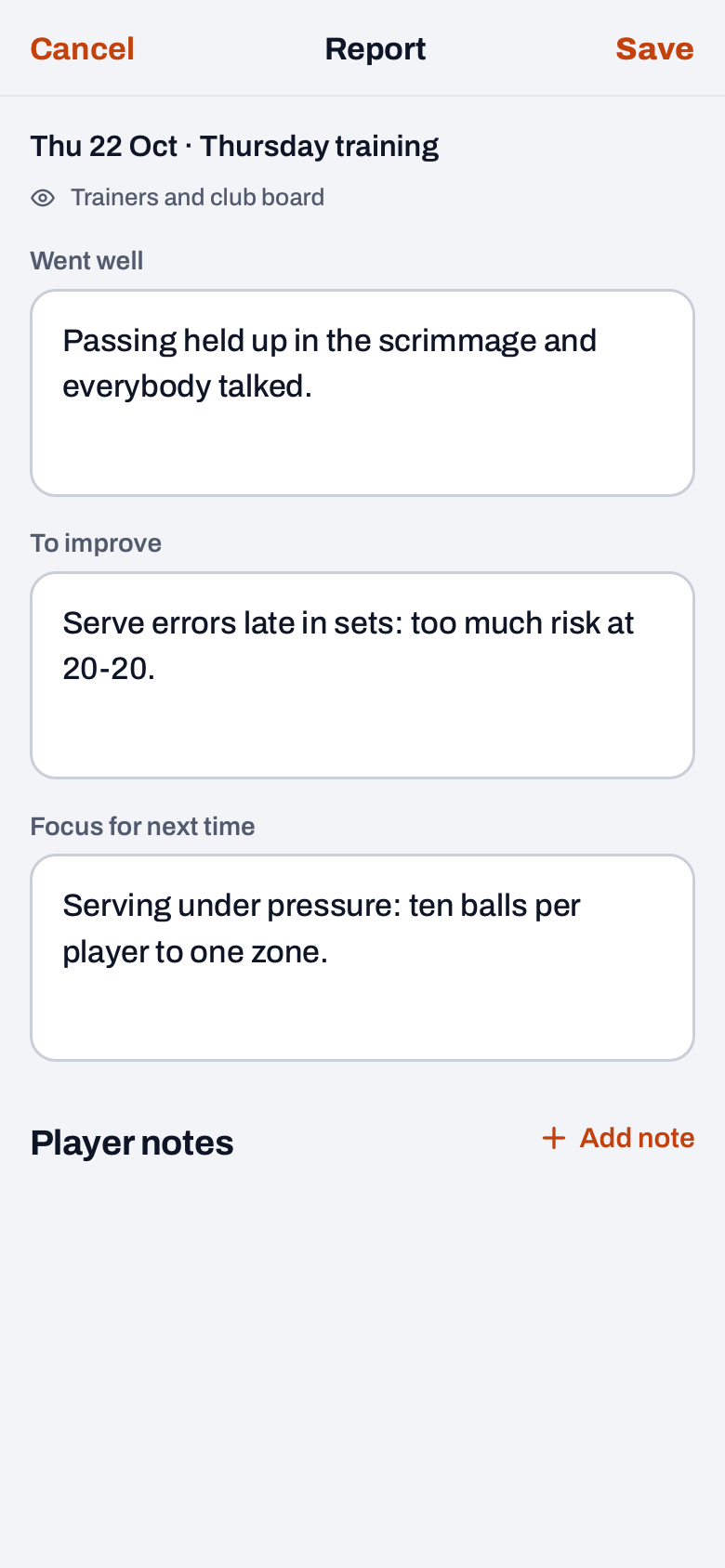
You do not change a style in one evening, but you do by looking at it briefly after every practice. In Koach you write a report after practice with three fixed fields: Went well, To improve and Focus for next time. Use them for your own coaching too. "Went well: players chose their own serving target and stayed sharp." "To improve: stopped block two three times, once was enough." The focus you fill in appears above the plan at the next practice, so you actually start with it. The report is for the team's coaches, and in a club on the Club plan the club leadership reads along via the team log; players and parents do not see it.
What Koach costs after the 14 free days is on the pricing page.
14 days free, no credit card. After your next practice, write one line about your own coaching and look back after a month.
Try Koach after your practiceFrequently asked questions
Which coaching style is best?
No style is always the best. What works depends on what your players can already do, how much time there is and what it is about. Research on motivation in sport does suggest that players become more self-motivated with a coach who gives choice, explains why and listens, within clear agreements. In a time-out you direct, at practice you collaborate, and what players can already do, you let go.
What is the difference between an authoritarian and a democratic coaching style?
With an authoritarian or directive coaching style the coach decides and players execute. With a democratic style players think along: the coach asks, explains and lets them choose within limits, or decides together with the team. Authoritarian is fast and clear, democratic teaches players to think for themselves more. Most good coaches use both, depending on the moment.
Which coaching style suits a youth team?
With young players you direct more on technique and safety, because they have little to hold on to yet. At the same time children learn most when they can discover and choose for themselves, for example in game forms or when picking a serving target. The older and more independent the team, the more you leave to them. Behavior and safety remain your decision with every team.
Can you change your coaching style?
Yes, because a coaching style is behavior, not character. Change one thing at a time, for example asking a question first before you give a correction, and keep that up for a few weeks. Have someone tally how often you tell and how often you ask, and ask players halfway through the season what they notice about your approach.


Look at your own coaching after every practice
14 days free, no credit card. After a month you see what you have started doing differently.
Get started with KoachOr read first what the volleyball coaching app does.